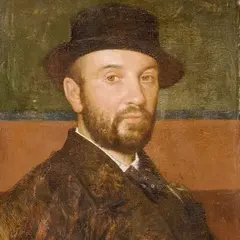
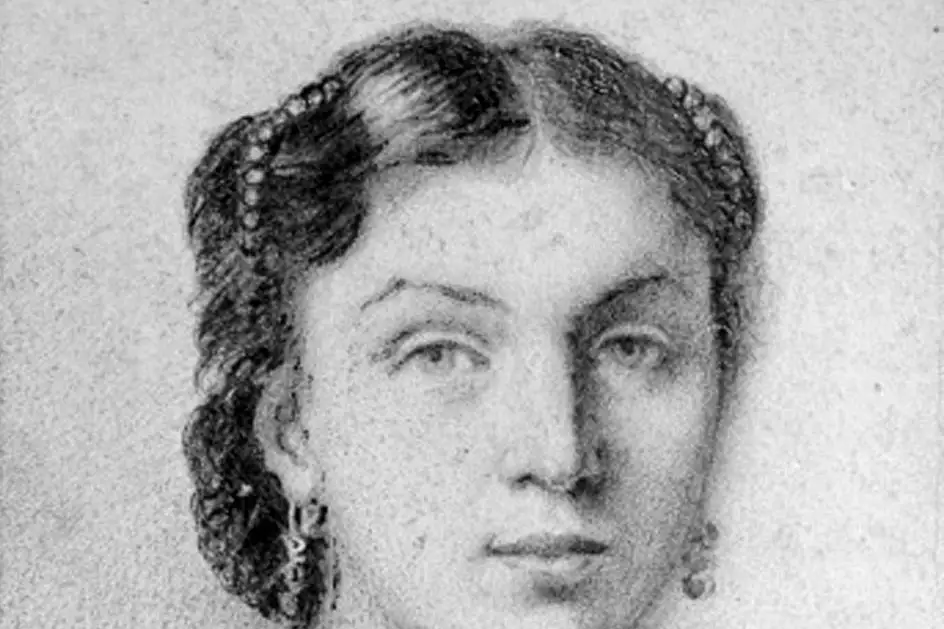

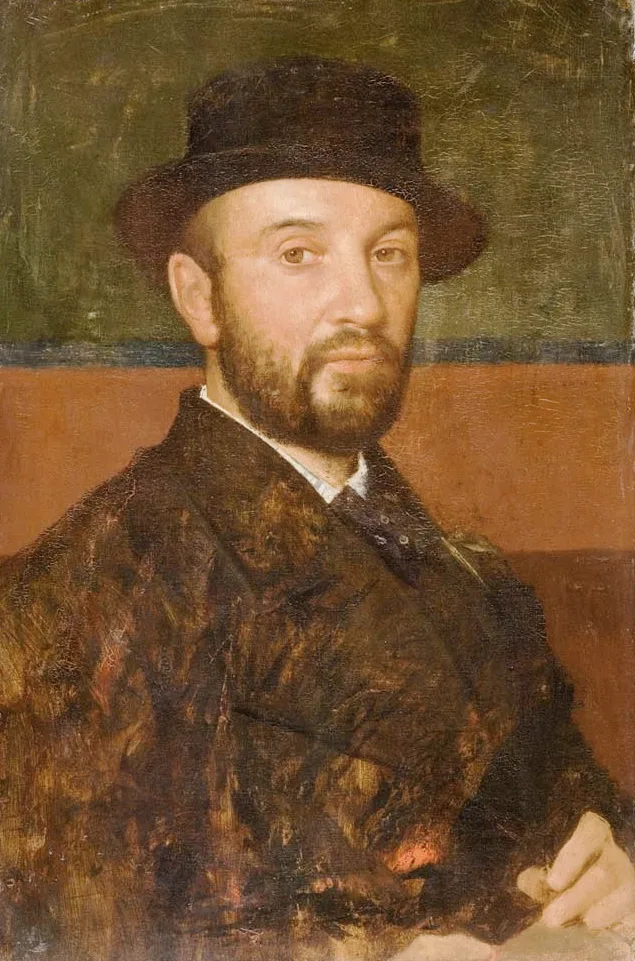
In 1866, the year after his previous Salon entry, Élie Delaunay submitted only a single painted portrait, that of M. H..., and one drawn portrait, that of Mme D..., to the Champs-Élysées exhibition. He did not appear at all in 1867, 1868, or 1869. From that point on, he granted only mediocre importance to the uncertain successes of the annual exhibitions, reserving his most serious efforts for decorative works. In these, he could both more completely express his artistic vision and more freely develop his technical skills. His reputation was already established among serious artists and enlightened connoisseurs, and that was enough for him.
A Turn Towards Decorative Arts
Several interesting commissions of diverse natures soon provided Delaunay with opportunities to embolden his imagination and refine his hand. A ceiling for the theater of the Palais de Compiègne, a mantelpiece for the salon of M. Paul Sédille, and a historical scene for the Hôtel de Mme de Païva would allow him to attempt what had always been his ambition: the harmony of firm drawing and seductive coloration, the union of correct style and lively expression.
Doubtless, it is more clever for a young artist aiming for quick fame to immediately fashion an appearance of originality for the gawking public by affecting a specialized and limited virtuosity, highlighting his spontaneous or acquired qualities through the very display of his shortcomings. Is this not what we see done every day, and not without success? And does the public not willingly fall for this charlatanism, much like that of clothing fashions, which, as we know, consists of emphasizing one part of the body by making the others ugly, heavy, or concealed?
Such a calculation or weakness could never enter Delaunay's mind. His intelligent observations in Italy had confirmed him in the eclectic and synthetic tendencies already perceptible in his earliest works. Before his departure, as submissive as he was to the discipline of Flandrin, he nonetheless admired Rubens and felt Delacroix keenly. After admiring the powerful, full, and complete masters of the 16th century in their virile flourishing in Rome, he experienced new impressions while traveling through Tuscany and Northern Italy.
It was not only for their rigorous or exquisite sense of form, nor for the virile harshness or elegant suppleness of their drawing, that he was captivated by all those Quattrocento masters whose memories fill his travel albums: Paolo Uccello, Filippo Lippi, Pollajuolo, Ghirlandajo, Botticelli, Gozzoli, Signorelli, Fra Angelico, Carpaccio, and Luini. He had clearly seen that in these painters—even before the dazzling bloom of the brilliant decorators and dramatists of Venice—an ardent love of nature and the naive tendernesses of the soul were already expressed through particular explorations of bright or warm harmonies. These explorations make them, at times, true, delightful, savory, and sometimes powerful colorists.
Resolved from then on to sacrifice nothing of what seemed equally necessary to the perfection of a painting—the rhythmic, harmonious, and clear composition of the whole; the lively presentation and decided character of the figures; the firmness of the drawing, sometimes strong and ample, sometimes tight and nervous, as the case required, but always characteristic; and the just application of an expressive color scheme by means of an intelligently varied and skillfully appropriate touch—he thus prepared for himself, as an artist, all sorts of anxieties, investigations, and labors. This explains both the relative rarity of his finished works and the constant progress that can be traced within them. It is noteworthy, however, that while he hesitated for a long time in choosing among the different aspects that an imaginative concept always offers, and while he sometimes even hesitated again in adopting a course of action in the colored execution, this hesitation leaves almost no trace, from the point of view of drawing, in the sketches and studies with which he began. With a pencil in hand, facing his own thought as he did nature, Delaunay was always a free, bold, and resolute artist. This will be well judged when his drawings take their place in our museums, alongside those of the finest draftsmen of all time.1