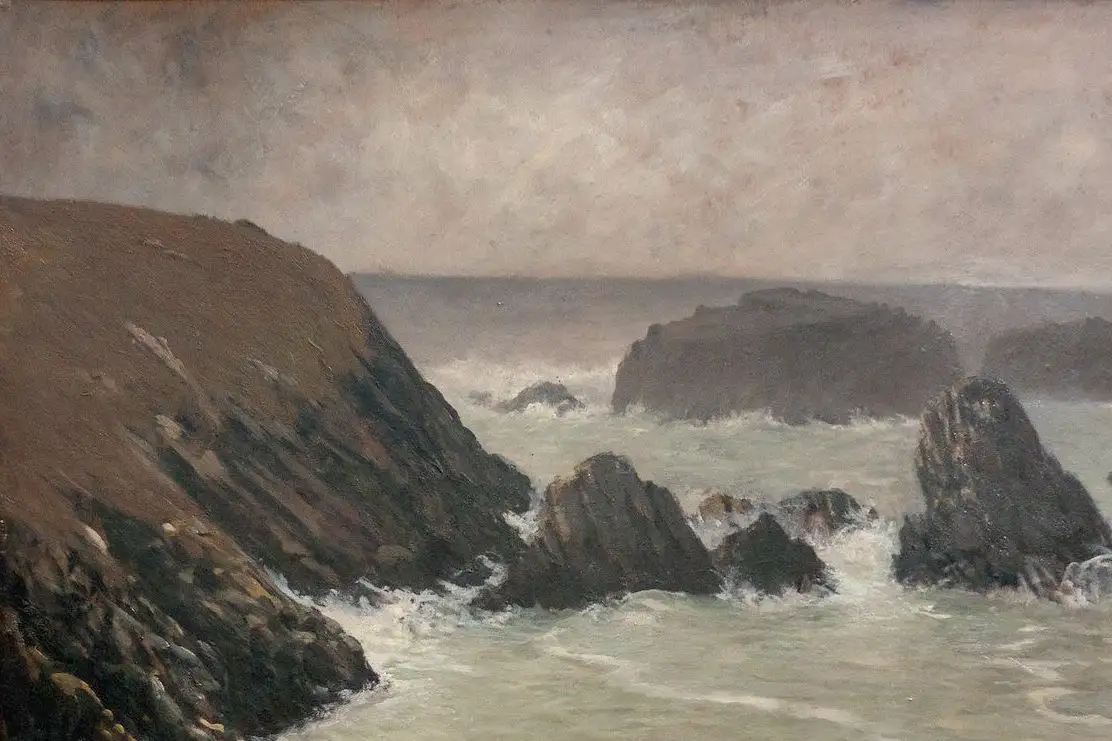

Amid the Salons of the 1890s, where analytical studies of light were pushed to their audacious, even reckless, extremes, a few canvases stood out for their paradoxical embrace of somber colors. These works, which seemed to retreat into night and mystery, announced the arrival of a temperament that would find its most profound expression in the rugged landscapes and stoic humanity of Brittany.
The "Black Band" and the 1895 Salon
Let us cast our minds back for a moment to the Salons of about a decade ago—to be precise, let’s say to the year 1895—and specifically to the exhibition of the Société Nationale des Beaux-Arts, then housed in the Champ-de-Mars palace that gave it its name. One surely recalls the impression made by a small number of paintings that contrasted strangely with their surroundings. Amidst the intensive development of analytical notations of luminous phenomena, a trend sometimes pushed to exasperation with audacities that often surpassed the boldest strokes for which the Impressionists were so sharply criticized, one noticed with astonishment, and almost with irritation, a few exhibits that seemed to display a paradoxical taste for dark colors.
Whistler and Carrière were no longer the only ones to envelop themselves in night and mystery. This was certainly not an organized group; here were a few foreigners, mainly from Scotland, who had formed, one might say, in Whistler's cone of shadow. There were a few Frenchmen, who had appeared from nowhere, seemingly overnight like mushrooms. Their names, also rather obscure, did not yet represent distinct individualities. Before mutual sympathies brought them together, they were more or less arbitrarily grouped and christened with a collective name: la bande noire (the black band).
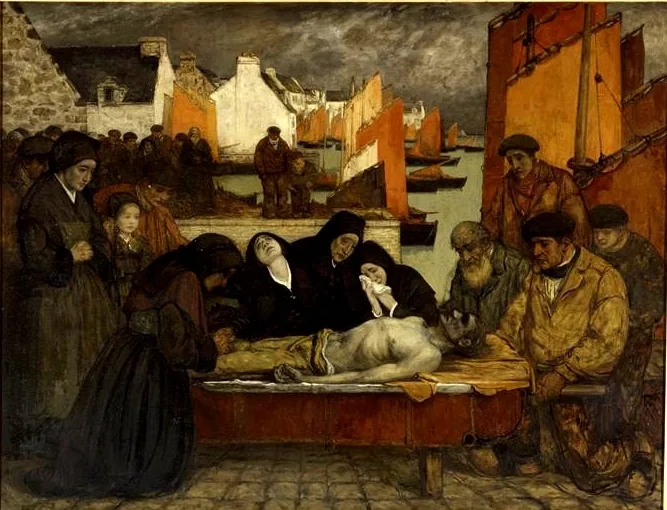
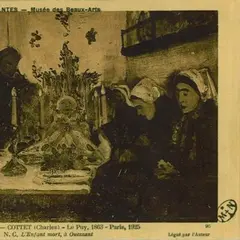
At that time, the one who appeared the most combative, the most turbulent, and the most unsettling to public peace was a thirty-year-old man: stocky, robust, energetic, and built for a fight. His deeply colored face was framed by a disorderly mass of curly hair and the most magnificent red beard. His features, strongly clustered, hinted at a mix of several mountain-dwelling ancestries. They were brought to life by two eyes sparkling with irony—terribly intelligent eyes beneath a high, thoughtful forehead—a fleshy nose with open nostrils, and a smile where some fundamental sense of benevolence vied with mischief. In repose, this witty, sensual, combative, and resolute face took on a character of reflection, gravity, and reverie that revealed the full intensity of his inner life and the hidden depth of his sentimental nature. This was Charles Cottet.
To be precise, in 1895, Cottet was not, in the strictest sense of the word, an unknown. He had already participated in six previous Salons; two years earlier, he had earned the honor of having a work acquired by the Musée du Luxembourg, and the year before that, he had been awarded a travel grant. But he had, as yet, inspired little more than hope—and those hopes, the so-called "sensible minds" agreed, he had since disappointed.