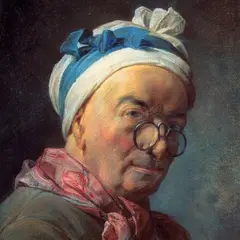
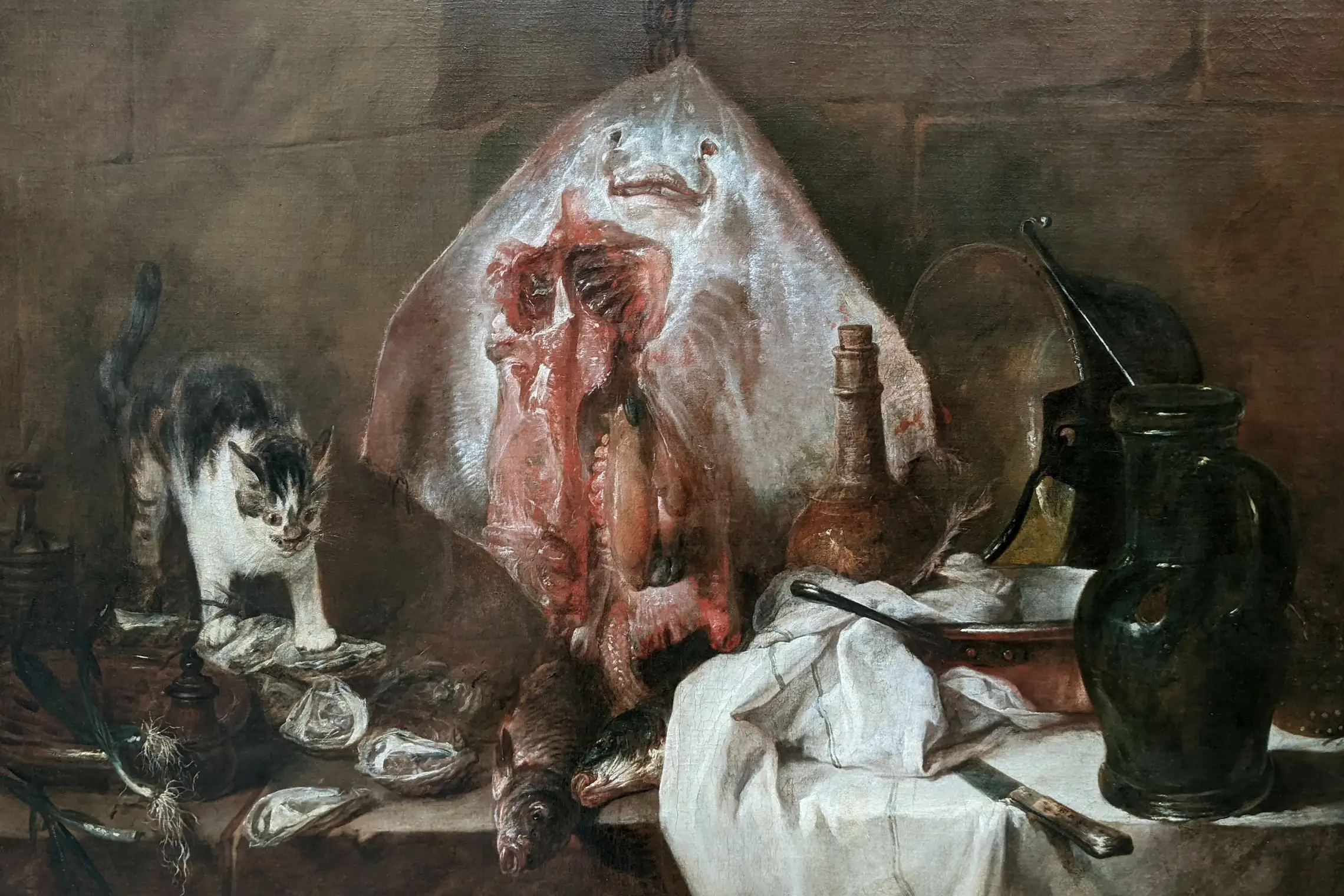
During his lifetime, Jean-Baptiste-Siméon Chardin adorned the Salon of the gentlemen of the Academy at the Louvre with his works; today, he adorns our French painting galleries with thirty of his masterpieces. His legendary modesty as a picture-hanger, always ready to use his own canvases as stopgaps to satisfy his colleagues, would almost entitle him to a long stretch of exhibition wall, even in the absence of his other merits. This lighthearted deduction is in no way offensive to the master's genius, for he is the painter of French painters, and his influence radiates everywhere. The Louvre is his true home, and were he the only one to represent our national art from Watteau to Prud'hon, he would suffice marvelously.
This might even be an advantage for his era, as that century, a bit too polished by minor masters, would benefit greatly from having its essence synthesized by this robust style of painting. One even wonders how the social atmosphere of such affectation could have allowed for the emergence of such a master. Rather than dwelling on uncertain hypotheses, it is better to adhere to the great law of superior artists who seem to appear by chance, without any other connection to their contemporaries. Indeed, everything about Chardin seemed destined to clash with the prevailing tastes of the time: the absence of a grand subject, the commonness of his objects and figures, and a thick application of paint in place of the pretty, dashed-off style—the torché—favored by the fashionable gallants. In short, he was the antipode of fashion.
For today's public, these same characteristics persist and run counter to the same childish prejudices. For it must be said again and again, to the shame of the majority, that the French do not love painting; they barely seek in it more than a colored imagery, good at most for the amusement of their imagination. The 18th century wanted it to be "piquant" (provocative), while the 19th wants it to be "interesting"—a synonym for a rather disastrous effect on the history of our School, with the exception of a real aptitude for composition. Given these weaknesses common to both eras, one must suppose that Chardin possessed a true talisman in his palette to have imposed himself so completely on the senses of even the least initiated.
The proof is an everyday occurrence. Take a young man who is indifferent or even hostile to the things of painting, have him walk through the Chardin collection in the Salle La Caze, and leave him to the effects of this confrontation. You will surprise him the next day on his way back to the Louvre, and he will not be ashamed to confess the reason for his unlikely return visit. Chardin will have touched him, opened his eyes, in the manner of a revelation, without any regard for his last bourgeois defenses. Chardin is indeed unique in his ability to immediately impart the notion of good painting. Is it the health of his talent, the distinct, clear strength of his technique, or the direct mirage of his color? It is all of him.
What a treat it is to encounter Chardin in French painting! One cannot be more of a painter, nor more French. How many academicians and history painters could be removed from our School without significantly impoverishing it? But remove Chardin, and you take away its very substance. Is he not, moreover, the most palpable argument against the false theory of "grand-manner painting"? To the old refrain, Ut Poesis Pictura (as is poetry, so is painting), he opposes, with the authority of a leader, the entire legion of still-life painters, establishing the specialty of their art, its independent and proper existence.
Incomparable verbal painters like Victor Hugo and Théophile Gautier tire us after a second attempt at describing butcher shops; despite the richness and precision of their language, they remain a thousand leagues from Rembrandt's Flayed Ox. The reason is all too natural. Flayed oxen, just like turbots, rays, seafood, hares, and birds—fur and feather, earthenware and crystal, wood, iron, and copper—are made for the brush, not for the word. In literature, they serve as a setting; in painting, they are the picture itself. Relative in the novel, they are primary on the canvas. One can argue breathlessly about high aesthetics and search the world's most academic books for the all-too-comical relationships between the beautiful and the good, between painting and morality, but one point will always remain: still-life painting is painting, and exclusively painting. Thus, the good artists of the genre, driven by a purely pictorial genius, are painters to their very marrow. They leave to others the sad privilege of too often being derivative imitators of poets, writers, philosophers, or even... vaudeville writers. Chardin, thank God, reassures us of the profession's solidity. When one is about to become disgusted with painting under the impression of ambitious or hollow works, it is enough to turn back to him to feel immediately restored by a substantial nourishment.
But Chardin is also the painter of the familiar life of his time. His intimate subjects are unique gems of storytelling. Nothing equals the simplicity and naiveté of his conception and expression. He extracts from the subject its essence, that which is specifically and uniquely suited to painting. He avoids the most common pitfall of the genre in France: the search for wit, ostentation, cleverness, and theatricality—all those preoccupations with the audience so dear to mediocre talents. The true artist's audience is himself, his temperament, his genius.
In both his still lifes and his interior scenes, Chardin's technical qualities are always the same. His drawing is sure, free from provocative touches, simple, and modeled on nature—it is French reduction squared. The master has an innate taste for relative distinction, that very real distinction of the honest lower middle class. And that seductive color—fluid and clear, delicate and vigorous—where did he get it? After Vermeer of Delft, he is truly the inventor of that French gray, so happily contrasted with the "Flemish sauces" and the bitumen of misty lands. To our eyes, a Flemish painting next to his looks as if it were cooked in beer. Contrary to those dark interiors, Chardin loves to make the rubies of French wine burst forth on the side of a bottle or a glass; he sees things in the clarity of that amiable wine. Ultimately, he is one of the men most capable of making one love the true and healthy genius of France in painting.