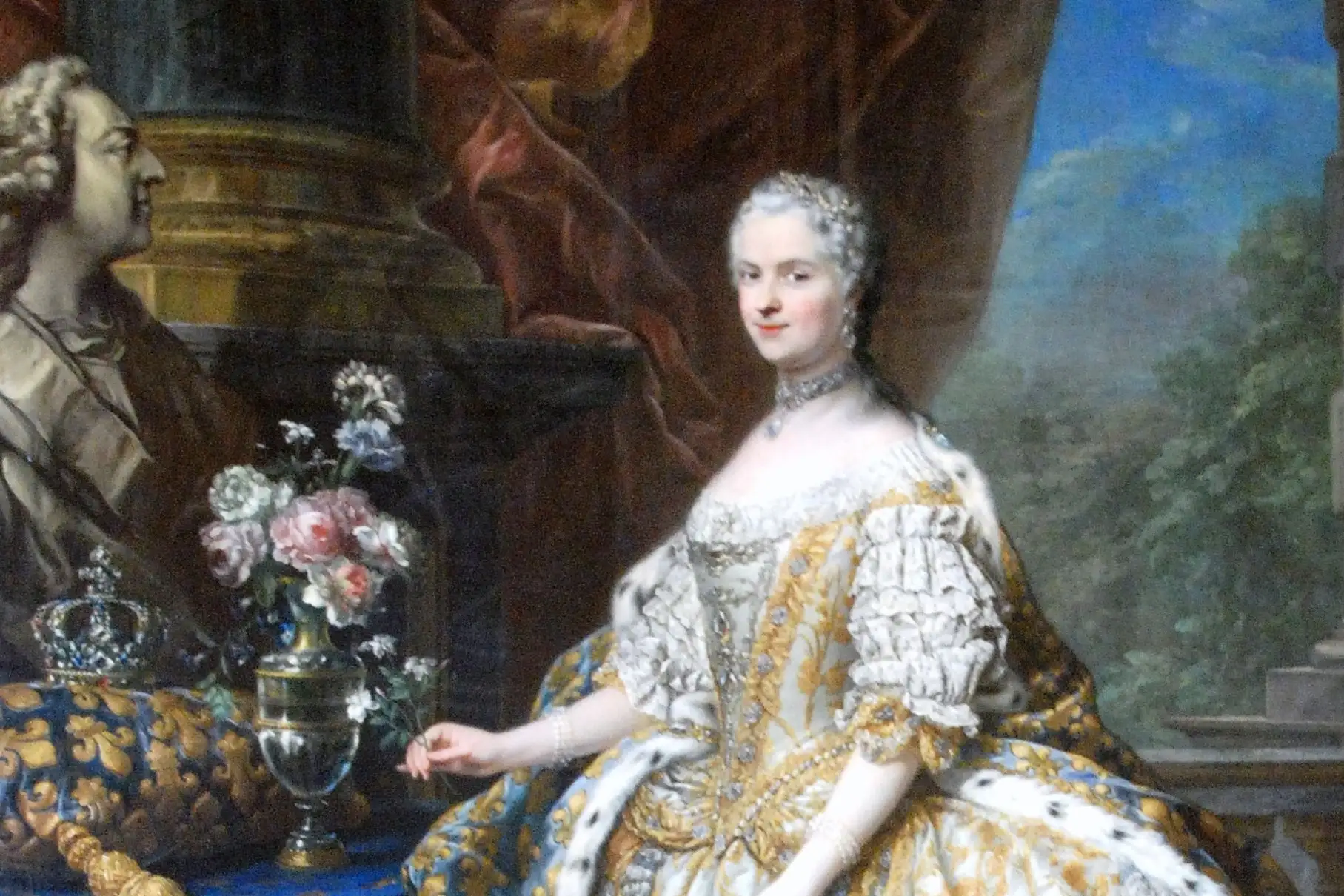
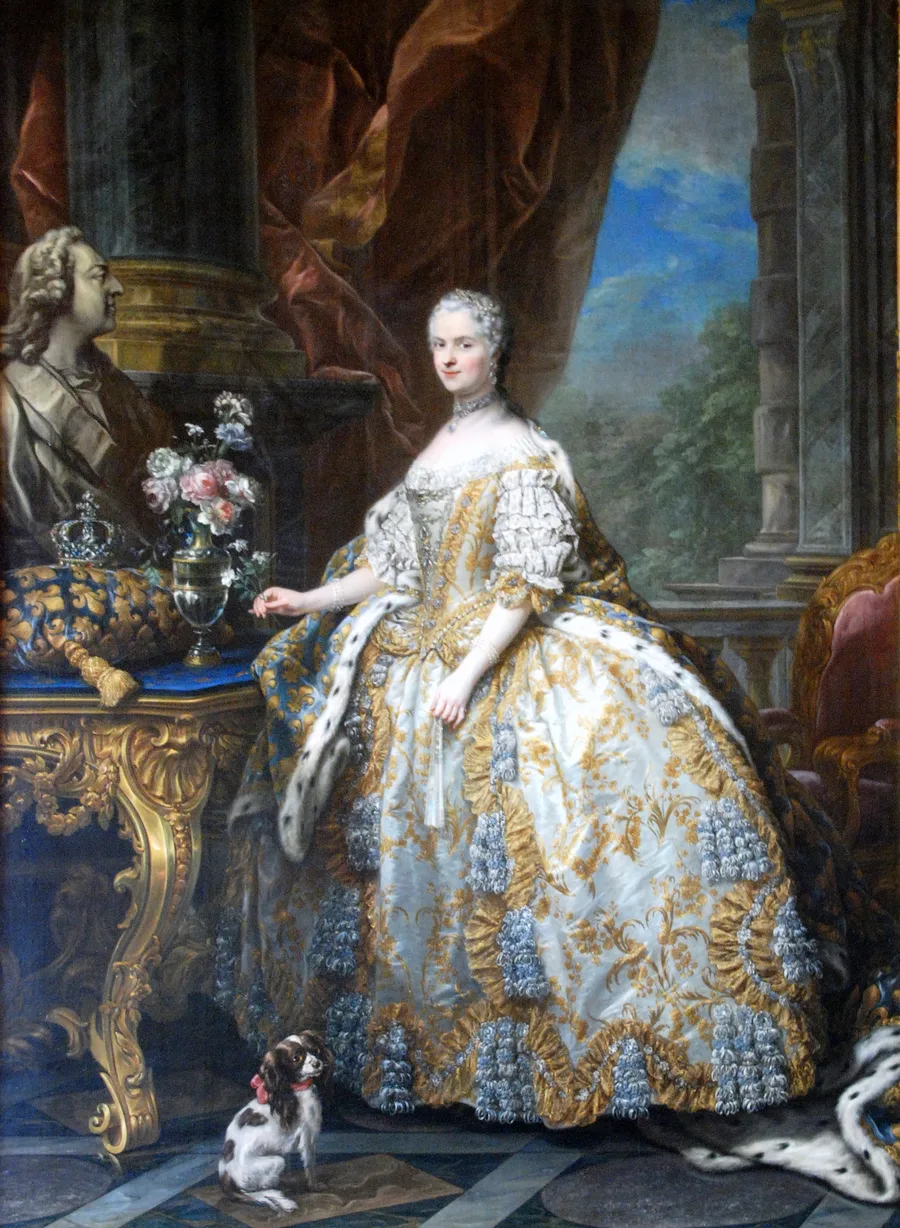
The full-length portrait of Queen Marie Leczinska by the sieur Carle Van Loo, a professor at the Academy, was one of the great successes of the Salon of 1747. The exhibition was installed in the Apollo Gallery and the Grand Salon of the Louvre, under the care of the sieur Portail, keeper of the King's plans and pictures.
A Triumph at the 1747 Salon
The full-length portrait of the Queen by M. Carle Van Loo, for which the head was based on a pastel painted by M. de la Tour, is one of the most beautiful things ever made in this genre. Its composition is grand and noble. There is great propriety in having placed the bust of the King on the table and great skill in having rendered it so lifelike. One finds, throughout this portrait:
A pure and knowing choice of simple charms,
A great taste for drapery, for beautiful attire
Negligently artful, prudently arranged;
A learned wisdom, a rightful abundance.
— Epistle in verse from a Father to his son, on Painting, by M. Coypel
A contemporary critic, Abbé Le Blanc, offered a detailed and laudatory assessment of the work. In his Letter on the Exhibition, he praised Van Loo’s masterful handling of every element, from the royal garments to the still-life details.
The royal mantle and all the Queen's attire are treated with admirable art. The folds of the fabric are everywhere rendered with a truth that creates an illusion. Nothing is so difficult for most Painters as to give grace to fashionable clothing. For the great painter, nothing is impossible... He knows how to hide what might be less fortunate through the disposition and arrangement of the garments, and often lends charm to the most extraordinary aspects of the Fashions. This is what M. Carle Van Loo has so happily executed. The vase of flowers on the table is as if it had been painted by Van Huse (Van Huysum).
The little dog is full of life. In a word, everything in this magnificent Portrait proclaims a man who is a Master in all parts of his Art.
Thus expressed Abbé Le Blanc, a friend of Quentin de la Tour, who was exhibiting eleven pastel portraits at the same Salon. We have nothing to add to this very precise judgment from a contemporary.
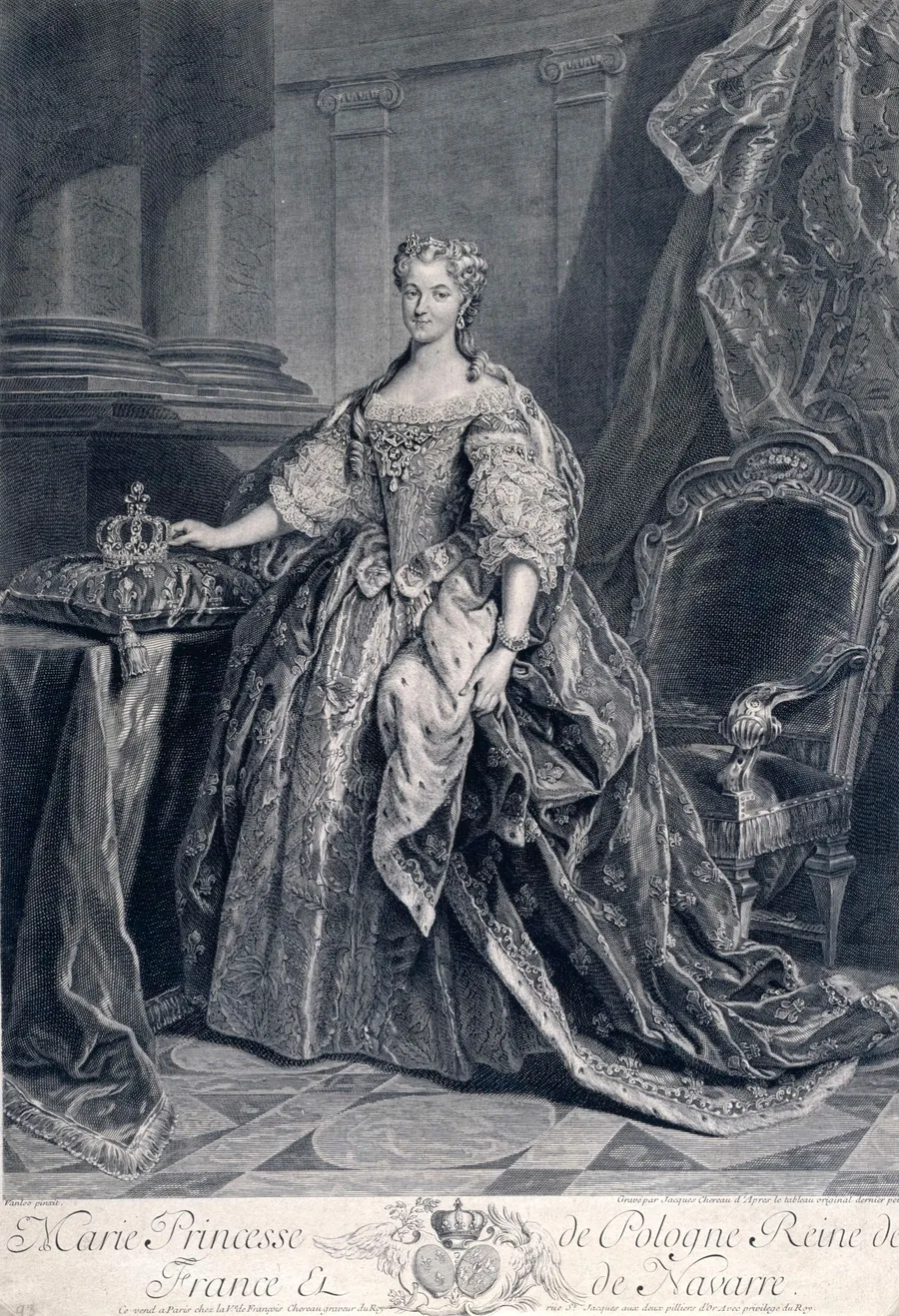
As can be seen in the canvas that moved from Versailles to the Louvre Museum, and in the very exact and intelligent engraving by M. Gaujean, Carle Van Loo—then forty-two years old but already famous for more than twenty years for the flexibility of his talent and the variety of his skills—had indeed shown himself to be a "master in all parts of his art." Although the figure was essentially a state portrait, he had posed her simply, in a tranquil attitude, under a moderate light, for "it was his custom to seek out gentle, pleasant lighting effects, agreeable to the eye and more capable of pleasing than of astonishing."
An Official Image for a Private Queen
In this official representation, despite the splendor of the furniture and the extraordinary fullness and luxury of the clothing, the gentle Polish queen remained, beneath all her jewels, the "good queen," surrounded by her greenery and her flowers. Even her little dog, whom she loved so much, had not left her side; for the occasion, it had merely exchanged its usual collar, bearing the motto "I belong to the queen," for a pink ribbon.
Moreover, Marie had not posed for this portrait, any more than she had likely posed for similar images in which she had previously been depicted. The sculptor Guillaume Coustou, in 1731, had metamorphosed her into Juno (Louvre Museum), and the good painter Tocqué, in 1740, had represented her according to 17th-century tradition, proudly draped in her royal mantle and, with a solemn gesture, pointing to her crown.
These obligatory apotheoses did not align with the tastes of this simple, witty, and delicate princess. She wrote so charmingly to her father, King Stanislas: "There is nothing the good French will not do to distract me... I undergo at every moment metamorphoses, each more brilliant than the last. Sometimes I am more beautiful than the Graces, sometimes I am of the family of the Nine Muses... Everyone does their best to deify me, and doubtless tomorrow I shall be placed above the Immortals. To make the illusion cease, I put my hand on my head, and at once I find, my dearest papa, the one you love and who loves you so very tenderly, your dear Maruchna."
The Splendor of the Royal Wardrobe
Regarding the queen's gowns, M. Henri Bouchot has kindly shared some curious and interesting information with us. He notes that the queen’s appearance was a source of unease for Louis XV, which led to a particular strategy regarding her wardrobe.
This plain and insignificant woman made Louis XV uncomfortable. He had conceived the idea of adorning her extraordinarily to divert his own suspicions, and so everything the jewelers knew, everything the weavers of Lyon or Tours could produce, went first to the queen's grand habits. Marshal de Richelieu collected samples from the princess's wardrobe for 1736 and the following years (Prints, Lh 45). There is a whole series of precious brocades, either manufactured in Marseille by M. Olive, in the style of India, Persia, or China, or at Mme Vidal's or the widow Jean's, or in Tours, or in Lyon.
The records reveal a staggering opulence. For her grand habits, the queen had silver brocades at 60 livres per ell; she wore an ample gown of duck-green fabric with large gold flowers.1 She had white satins with naturalistic rose flowers, and gros de Tours with a checkered background from which her petticoats and gowns were made. A violet satin flowered with silver was used for a winter skirt, and the gown seen in Tocqué's portrait at the Louvre was worn by her as early as 1736; it was called a robe abattue.
For a single year, Marshal de Richelieu collected 27 samples, each more ornate and richer than the last. This is not insignificant, even for the wardrobe of a Queen of France between 1736 and 1756. Perhaps the gown in Van Loo's portrait was cut from that gros de Tours decorated with bunches of celery tied with ribbon, of which fragments can be found, unfortunately too small to judge properly. There is, therefore, this peculiarity: the Queen of France reputed to be the plainest, the least seductive, is precisely the one of whom we have preserved the most decorated portraits. It was the compensation the king made to her.
Two Portraits, Two Personas
She had, however, a way of making the illusion cease, or at least of preserving only the prestige of her resigned grace: to entrust herself, for a more familiar and accurate image, to artists who were less ostentatious but more sincere. A painter herself (a copy by her hand of Oudry's The Farm, from the Louvre, can be seen at the Trianon), she had been among the first to admire and encourage the growing talent of La Tour.
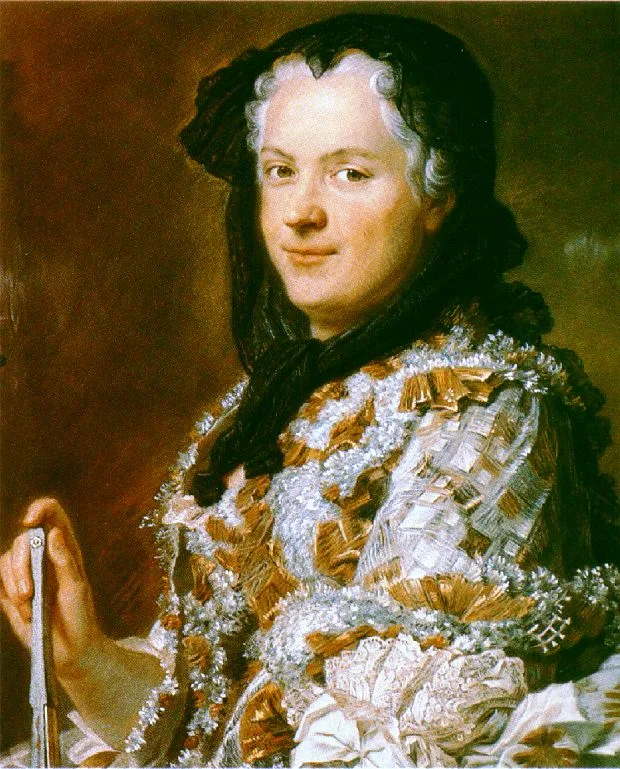
It was before the free and frank pastellist that she had consented to sit, in her customary posture, her hair powdered under a simple fanchon of black lace. Over her shimmering gown with its joyful draperies, she wore one of those ruched and frilled mantelets that she had brought into fashion, for she always retained an artist's weakness for beautiful fabrics, a trait for which her piety and sense of order sometimes reproached her.
Never did La Tour feel more at ease than before the noble ingenuity of this royal model, so intelligent and so modest. With what frankness, what good humor, what respectful ease he captured the fine crinkling of her irregular eyes, with their gaze so direct and frank, without giving the small, slightly upturned nose and the full lips, filled with smiling affability, more elegance and regularity than nature had granted them!
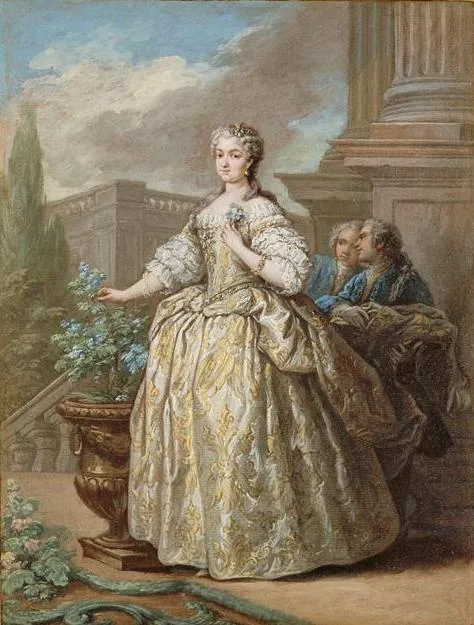
One can understand why, from then on, for her official portraits, the queen referred artists to this faithful image—too faithful, no doubt, in that case, for all who used it did not fail to rectify and ennoble it. Van Loo's Marie Leczinska resembles La Tour's as a worldly sister resembles a bourgeois one; she is less of a woman, more of a queen; prettier, less amiable.
This transposition, entirely in keeping with the customs of the time, was common practice among almost all portraitists, except for La Tour and Chardin. It was all the less surprising because the neglected queen, so simple in her private life, knew how to resume her royal bearing whenever necessary. "This same princess, so good, so simple, so gentle, so affable, represents with a dignity that commands respect and would be disconcerting if she did not deign to reassure you. From one room to another, she becomes the Queen again and preserves at Court that idea of grandeur, such as we are shown that of Louis XIV."
It is thus, from one room to another in the Louvre Museum, that Marie Leczinska, as seen by La Tour and by Van Loo, is still transformed, just as she was transformed before the eyes of the President Hénault.