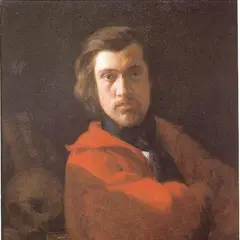
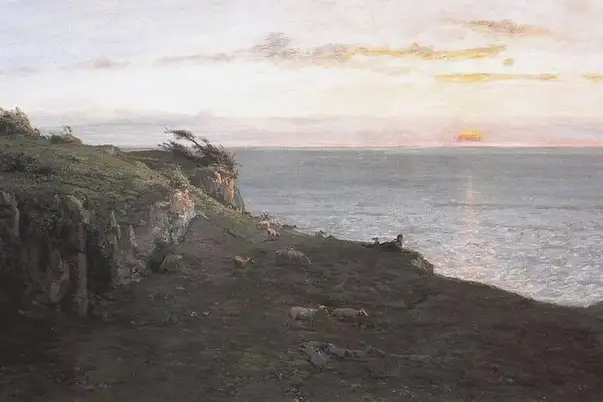
Antoine Chintreuil is finally receiving from his contemporaries the serious attention to which his talent was entitled. He owes to a pious and devoted friendship the revival of a posthumous glory that will redeem, in the history of modern art, the prejudices and indifference of which he was too long a victim.
A Will Forged in Nature
Chintreuil entered life endowed with two invaluable gifts that were to secure his career as a landscape painter: he possessed an intuition for the mysterious language of Nature, and he had willpower. Therein lay his strength, the key to his future, and even the secret of his resistance to the terrible illnesses whose reputedly fatal attacks he so often had to endure.
This willpower compensated for the native weaknesses of his hand. Through an unheard-of tenacity in his research, he developed the faculty he long lacked: to express with a clean, clear, and captivating touch what he saw or divined with the tender and poetic originality of his heart. He felt these things more vividly and more intimately, no doubt, than many of his rivals.
The Influence of Corot
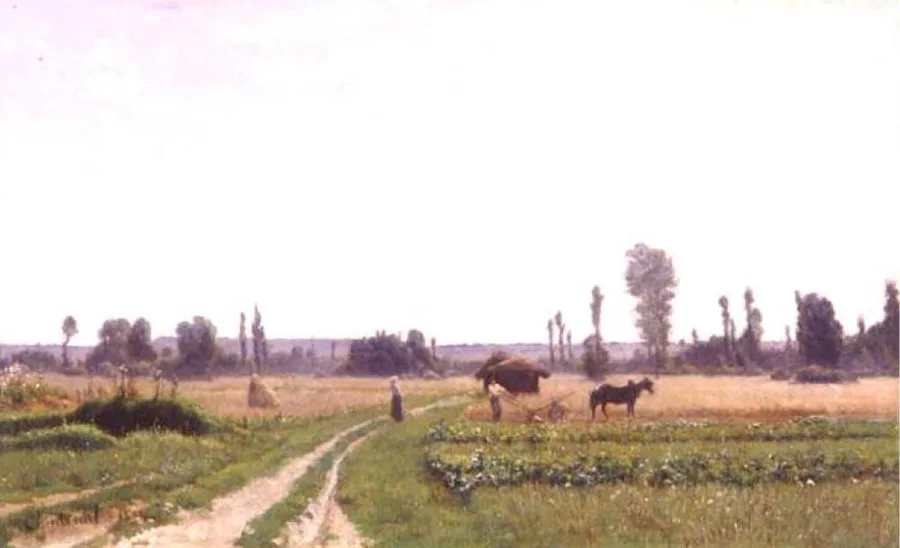
The Salon catalogues present him as a student of the great painter Corot, because the administration, with a singular mania for regimenting exhibitors, requires that one be officially the student of someone. We must be clear about this qualification of "student," which could strangely mislead the Vasaris of the future. In reality, Chintreuil received from his illustrious predecessor only the advice of a friend, true paternal encouragement, and at most a few effective corrections of the irregularities and gaps in his early studies.
He did not work under Corot's eye, under what is called his "ferule," or authority. Above all, he did not follow, under his pedagogical direction, a scholastic method of teaching, as happens with specialized masters who bend an entire disciplined generation of apprentices to a common law and an immutable rule. Neither Corot nor Chintreuil had the temperament for such a relationship; the former was not one to model a disciple in his own image, and the latter was not one to subordinate his cherished sensations or individual inspirations to the demands of an intellectual director.
Corot, with the charming good faith of a poet in love with nature and the masterful simplicity of an artist who has mastered all its secrets, endeavored to develop the aspirations and tendencies of his young protégé by comforting them with his friendly approval. He had immediately understood, or rather divined, the ideal—still somewhat confused and very weakly defined in the laborious but formless essays of the neophyte, who was more enthusiastic than experienced. With a perspicacity worthy of his admirable talent, he knew how to set him squarely on the path he sensed he was inclined to follow.
From the observations that his attempts inspired in the master, Chintreuil drew the confidence to pursue research that too often met with failure. He gained the certainty that there was something within him, since Corot understood the new language that he was still only stammering.
A precious memory of Chintreuil's, recounted by M. Frédéric Henriet, marks the day his artistic independence was declared. Seeing the child freed from his swaddling clothes and ready to take flight, Corot told him:
And now, my love, you must walk on your own.
On that day, Chintreuil became a painter. His poetics, so frankly personal and so well suited to the exquisite delicacy of his perceptions, had finally found its formula.
An Uncompromising Vision
The public, resistant to anything that seems to deviate from the routine adopted by fashion, long refused to understand him. They passed by his sincere works with indifference, when not with irony—works that had cost the artist all the torments of a desperate struggle and of poverty. Yet he persisted in his faith; he made no concessions to trivial taste, nor did he flatter popular trends.
He wrapped himself resolutely in his sacred belief, redoubled his efforts, and spurred on his courage. Ultimately, he became what he had resolved he would be. Men of this mettle, if they fight for a religion, become martyrs; in war, they are heroes; in the arts, they rise gloriously to the rank of masters.
The Artist's Early Life
Antoine Chintreuil was born in Pont-de-Vaux on May 5, 1814. His family had once been wealthy, but at the time of his birth, they were reduced to forced labor to survive. His mother ran a small boarding school for young girls, and as a young child, Chintreuil participated in the modest instruction of his little companions. It is doubtless to this early, entirely feminine education that we must attribute the excessive timidity that was the most salient feature of his character until his mature years.
He also had a dreamy and romantic turn of mind. From childhood, the phenomena of nature exerted a strange and mysterious influence on his imagination. Storms and other convulsions of nature drew him in as if against his will. At the first sign of bad weather, he would escape from the house and run, as if to a festival, to breathe in the wind, the rain, and the mists across the countryside.
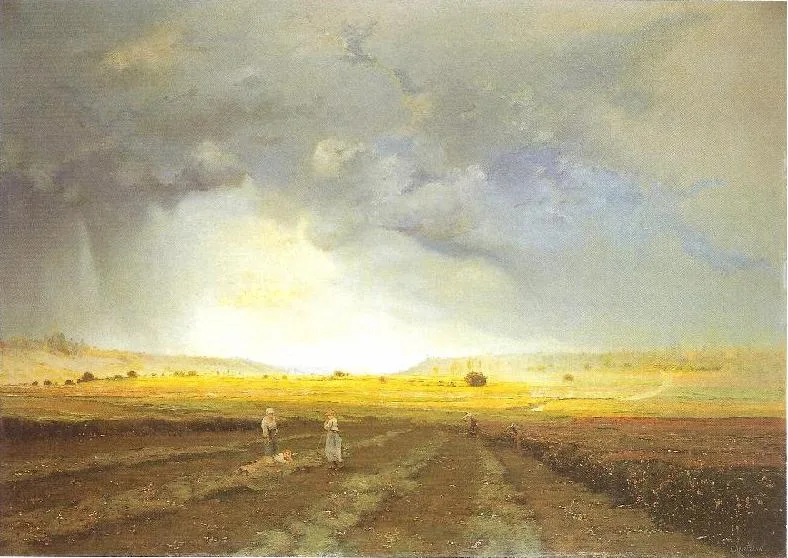
At the edge of town, there was a long avenue of ancient poplars that charmed him above all else. He would contemplate with an admiration not without poignant anxiety these great trees twisting and clashing under the force of the tempest. The rustling of leaves battered by the wind held mysterious harmonies for his ears.
He had just turned fifteen when, for the first time, he tried to translate his impressions with a pencil. A local amateur, M. Buisson, a friend of his father, gave him some useful lessons. These were abruptly interrupted by the death of his mother, who bequeathed to him the care of providing for an old, infirm father. Through much effort and patronage, he managed to remain at his college in Pont-de-Vaux as a drawing master for the lower classes.
Three or four years later, a small inheritance, which he received and gave to his father, allowed him to return to his artistic vocation without failing in his duties as a son. He came to Paris and found a position as a bookseller's clerk that allowed him to live.