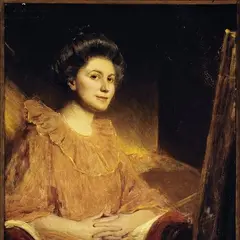
It was at the Salon of 1898, with Retour de la chasse (Return from the Hunt),¹ that the artistic personality of Mademoiselle Delasalle began to reveal itself; the jury awarded the painting a second-class medal. The virility of her drawing was already asserting itself. No longer was she seduced by the pretty, common, and conventional, as she had been in her early days; what now captivated her was character, without which there is no real beauty. A deliberate approach to light and shadow and a muted symphony of halftones gave her modeling a new power. She managed to achieve that decomposition of movement which preoccupied so many masters, realizing it through sheer tenacity, as seen in the figure of the woman blowing on the fire, or in that of the hunter who, braced against his right thigh, pulls with both fists at his enormous quarry.
But to achieve the heroic contours of these primitive musculatures in her preparatory studies, the pencil had seemed insufficient. In a cavern she constructed of sand, pebbles, and cardboard, Mademoiselle Angèle Delasalle had kneaded the heroes of her drama directly from clay with a forceful thumb, learning the craft of a sculptor—a skill she would never forget in her best canvases.
Retour de la chasse would mark Mademoiselle Delasalle’s final incursion into the domain of prehistory. From then on, her eyes would open to contemporary life, never again to turn toward an imaginary and necessarily artificial past.
The Turn to Modern Life
One day, as the young artist was returning to her home in Grenelle, she had to cross the Champ-de-Mars, which was being cleared in preparation for the Exposition Universelle. Evening was falling. The work crews were leaving the vast spaces, which were crisscrossed with trenches. Suddenly, a few steps away from her, a robust silhouette of a laborer advanced against the yellow sky, where the Trocadéro and the Eiffel Tower were profiled. With his left hand in the pocket of his wide velvet trousers and the other holding a pickaxe and shovel over his shoulder, a scarf knotted around his neck, and his drill jacket and velvet vest open over his shirt, the man appeared gigantic in the backlight. His rough features, hollow cheeks, and stubborn forehead shaded by a felt hat completed the image.
His attire—that of all such laborers—was, in fact, infinitely more picturesque than the clothing of the bourgeoisie, which was constricting and deliberately stripped of all character. What artist has not noticed that, in our time, only tradesmen know how to dress? While a Constantin Meunier or a Dalou always struggled with the challenge of sculpting a "gentleman" in a frock coat, what beautiful images they have left us, in contrast, of the peasant and the miner.
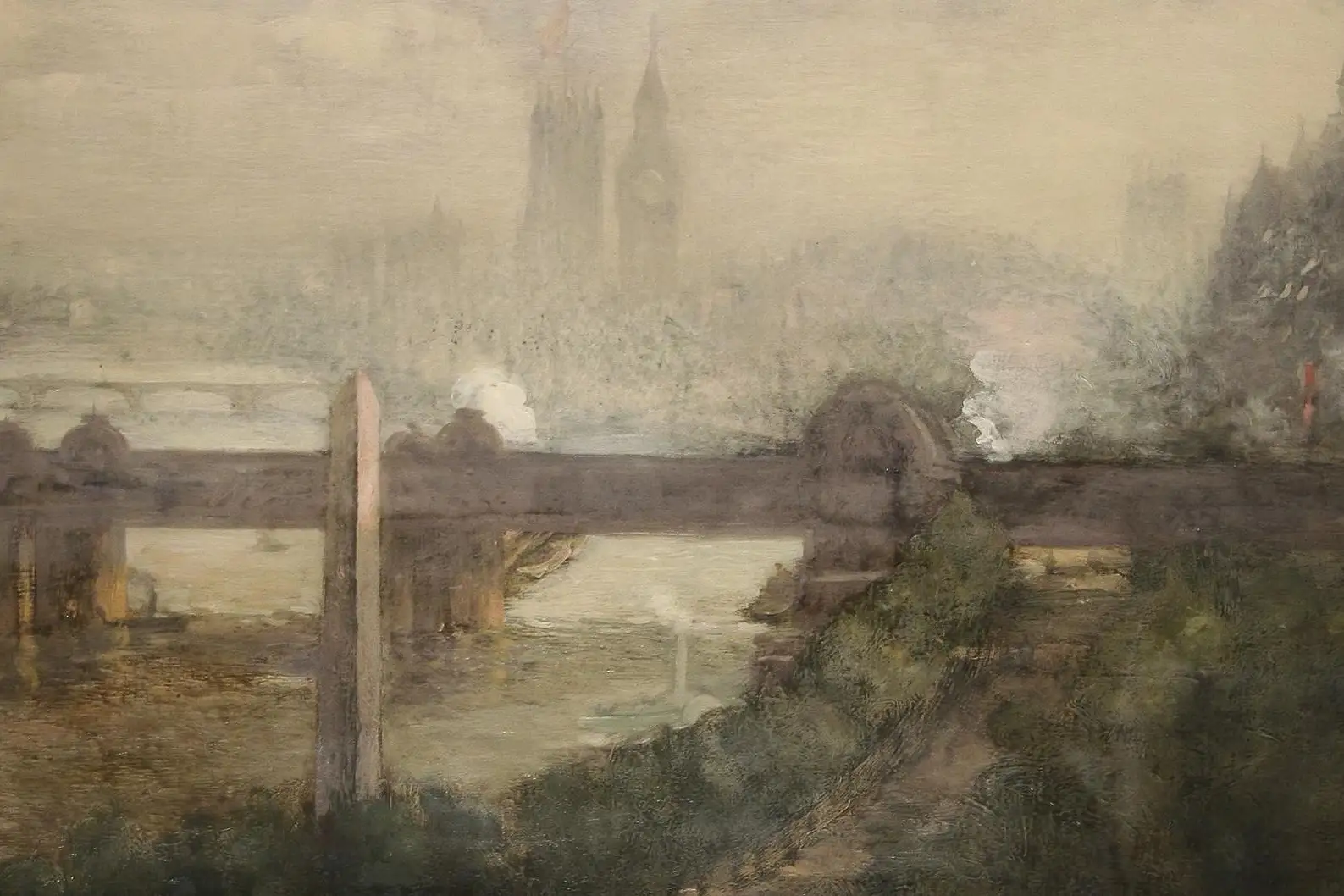
From that point on, like her friend Adler, of whom she has given us such a delightful portrait, the artist—who lived on rue Dupleix, surrounded by factories—often dedicated her palette to evoking the somber beauty of working-class life. She pursued her focused study of this proletarian mass, which offered her masculine talent the spectacle of a solemn strength. This can be seen in La Forge (The Forge), where she found material for beautiful contrasting light effects; in Le Couvreur (The Roofer), whose strong frame is magnificently silhouetted against a stormy sky dominating the great, misty city; in her Travailleur de la terre (Worker of the Earth); and in a whole series of sketches and etchings.