
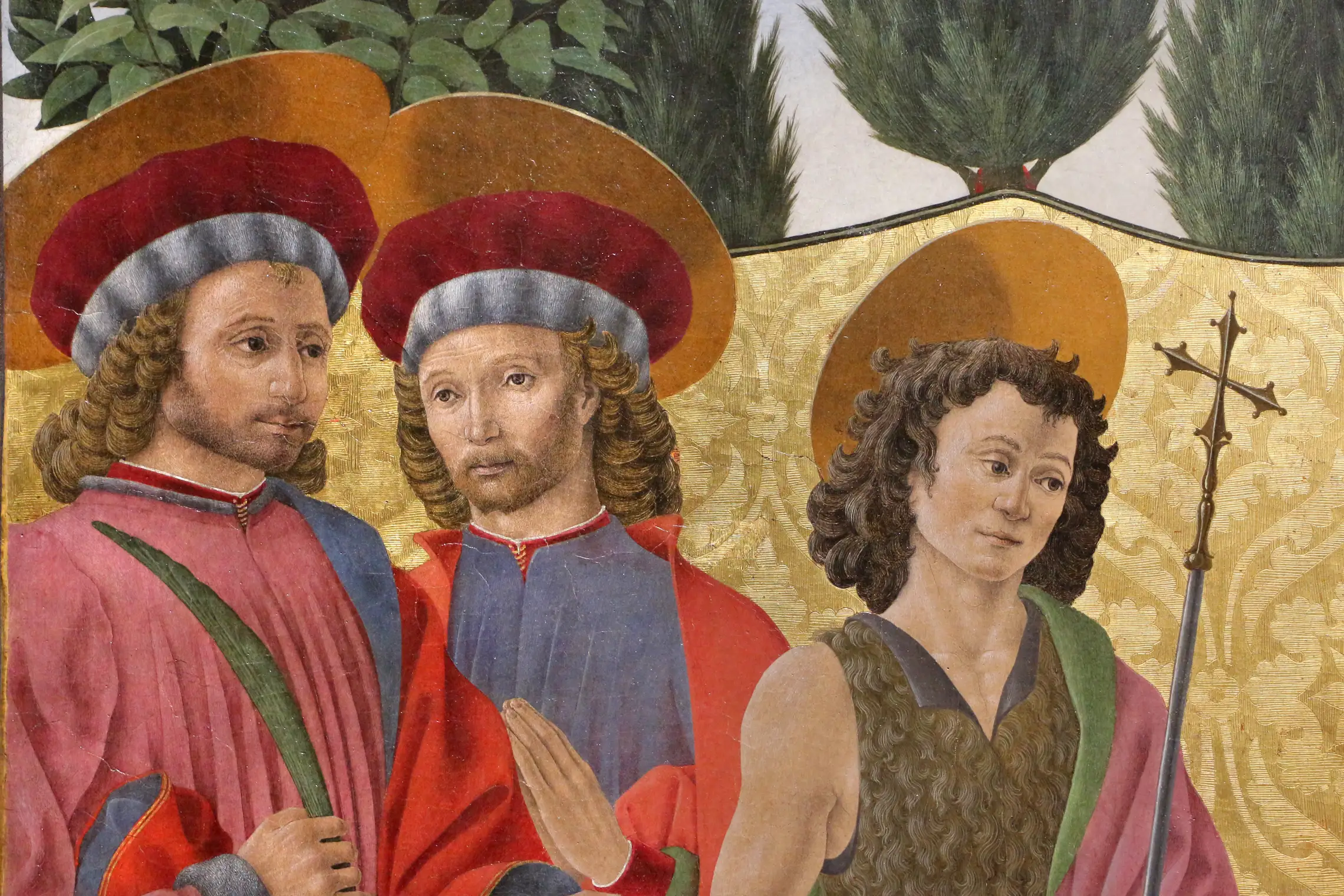
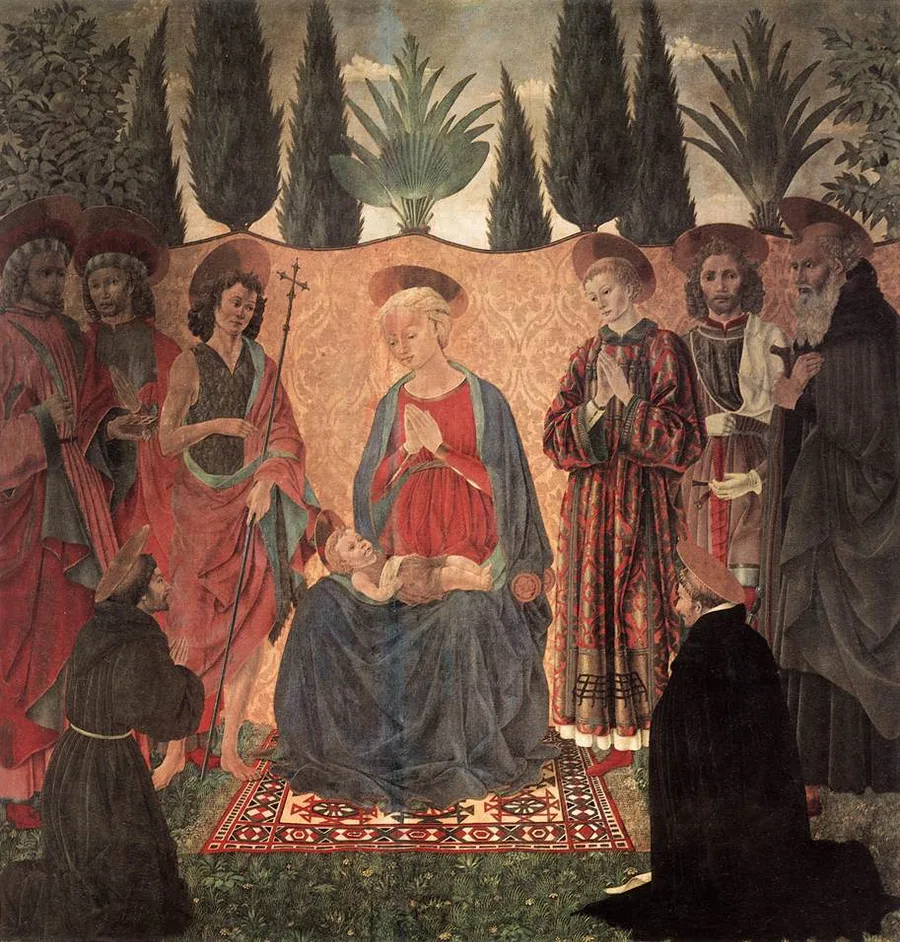
Many years ago, while I was leafing through albums in the very hospitable shop of Messrs. Braun, Clément and Co., my eyes fell by chance upon a photograph of a Madonna attributed to Piero della Francesca. I immediately recognized the style of a much rarer master, one just as interesting and at times almost as great as Piero: the Florentine Alessio Baldovinetti.
I knew that this Madonna had once belonged to the Duchâtel collection, but my efforts to learn what had become of it were in vain. At last, I had the good fortune to encounter it in the collection of the Duke de la Trémoïlle. The work exceeded my expectations. With a hieratic majesty, yet possessing a subtle feminine charm, the Virgin adores the Child, seated on a throne that overlooks a landscape of powerful contours and cheerful vistas. The grime, poor varnish, and repainting that soiled the picture may have slightly altered its beauty, but they did nothing to diminish the pleasure it gave me.
Leaving this masterpiece, I wondered if I would ever see it again, and in what place, at what time, if such happiness were ever to be granted to me. The sad peregrinations of paintings are never over until they find a definitive home in one of Europe's public collections. To be sure, these collections multiply the obstacles to our enjoyment at will: their classifications obey every principle except the aesthetic one, which is the only legitimate one. A masterpiece always risks being stuck, like a postage stamp, on a wall already covered with canvases of primarily historical interest, instead of being isolated in its own special niche like the image of a jealous god. And yet, despite these drawbacks, one rarely sees a true work of art in a private collection without wishing for a swift end to its migrations.
It was therefore with great joy that I learned this Madonna had been acquired by the Louvre. It is, without a doubt, the most important Italian painting to have entered Europe's public collections in several years. Even the directors of the Berlin Museum, whose riches grow daily, can on this occasion envy the perspicacity and good fortune of their colleagues at the Louvre without reservation.
I will not attempt to express the beauty of this Madonna here. Mr. Ary Renan has already done so, as much as it is possible to evoke it with words, in his excellent article in the Chronique des Arts (March 5, 1898). The faithful reproduction provided here should serve only as an illustration for his precise and eloquent appreciation. I will content myself with a more humble task. I will simply try to prove that the Louvre's new acquisition is not the work of Piero della Francesca, to whom it was attributed at the time of the sale, but rather of Alessio Baldovinetti. Even on this point, Mr. Renan has so thoroughly anticipated not only my attribution but also my arguments that I can see little left for me to add; I can only go into slightly greater detail. And I must say that Mr. Renan is not the only one to strip me of the merit of priority. In researching what other critics have written about Baldovinetti, particularly the most authoritative of all, the late Cavalcaselle, I found that he had already, many years ago, attributed this Madonna to Alessio.
The Life and Work of a Little-Known Master
It is the small number of his works, not a lack of talent, that makes Alessio Baldovinetti so little known, except to specialists. A few words about him will therefore not be out of place. He was born in 1427 and died in 1499. History does not tell us who first placed a paintbrush in his hands, but knowing a painter's very first master is a question of superficial interest. It is infinitely more important to learn which spirit most influenced an artist's youth, which molded and developed his talent, giving it its definitive artistic form. On this matter, historians and their documents are of no help to us. It is a point we must establish for ourselves through the study of the artist's works, combined with that of his predecessors' productions.