
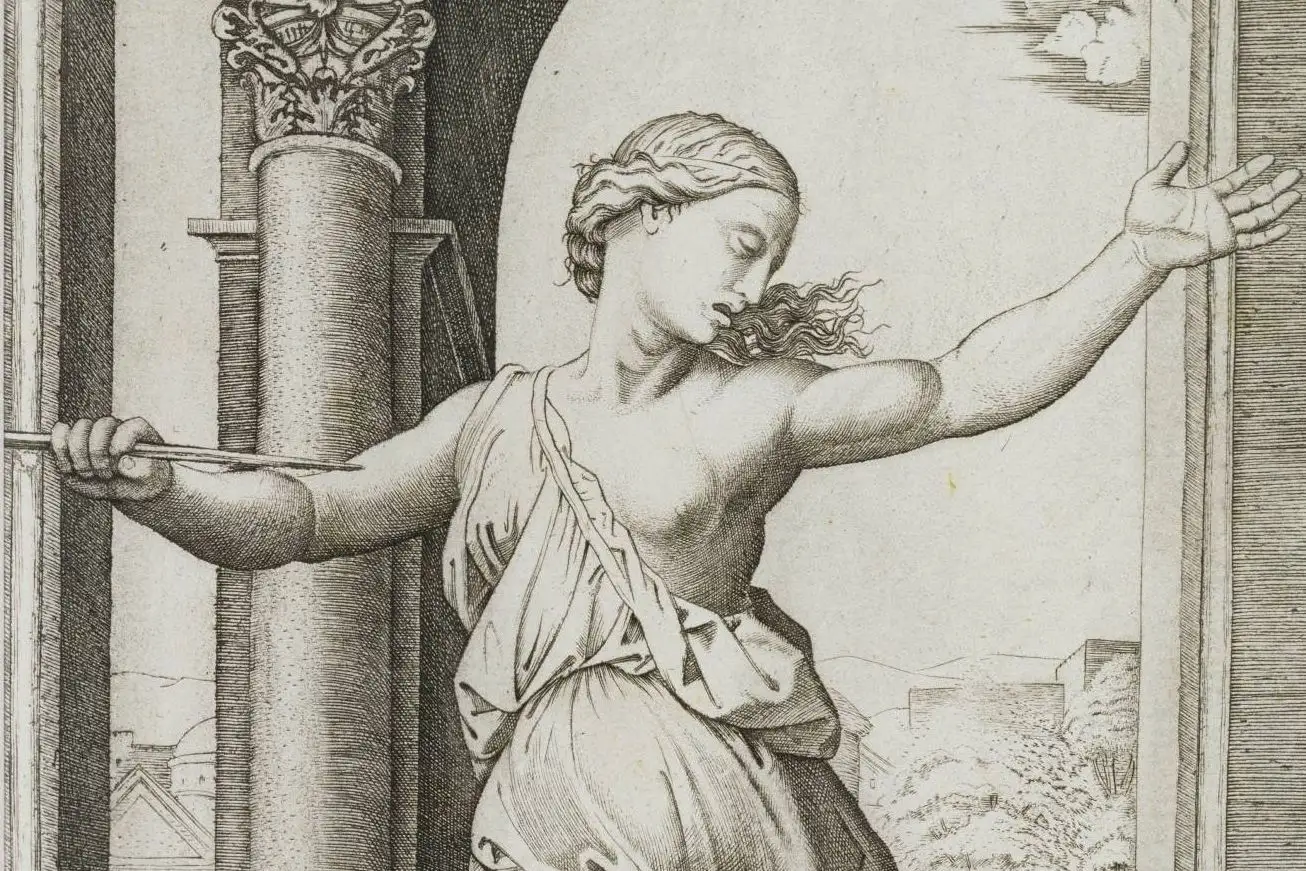

Photogravure will replace neither etching, nor the burin, nor the drypoint; it does not create. However, when applied to a pre-existing translation, it renders it with an exactitude that defies the most scrupulous conscience and the most unalterable patience of the engraver. It is the thing itself, and from an archaeological perspective, this elimination of the intermediary is one of science's most useful conquests for the history of art.
The Art of Reproduction and its Historical Value
The value of the intermediary always intervenes to elevate, diminish, or even distort the character of the original model, and its suppression is a significant advancement. Through processes like photogravure, important rarities can become known to all and, through their reproduction, serve an almost direct purpose. In this way, we disseminate and often even save unique or incomparable pieces.
These works are typically too expensive to be found anywhere but in state museums or the closed, unknown collections of the wealthiest private individuals. They are too rare for the public to know and benefit from them. These reproductions, while honoring their fortunate owners, spread the influence of the works. Through the instruction they provide, they become useful to artists, while also serving the historical study of art's past.
In the two volumes that concern us,1 more than one piece exists in a unique state. No single person has ever possessed all of them, nor will they ever.
Assembling the Collections
For the collection of Paul Potter's works, although almost all the plates were taken from the admirable collection of M. Dutuit, four are nevertheless missing from it. The portrait of Paul Potter after Van der Helst and the botanical plate of the Zabucaia branch are housed in the British Museum. This latter piece was almost certainly made for a Flora of India or South America, which has yet to be located. The other two missing plates are in our own Cabinet des Estampes and in the collection of M. Edmond de Rothschild.
The Sincere and Solid Etchings of Paul Potter
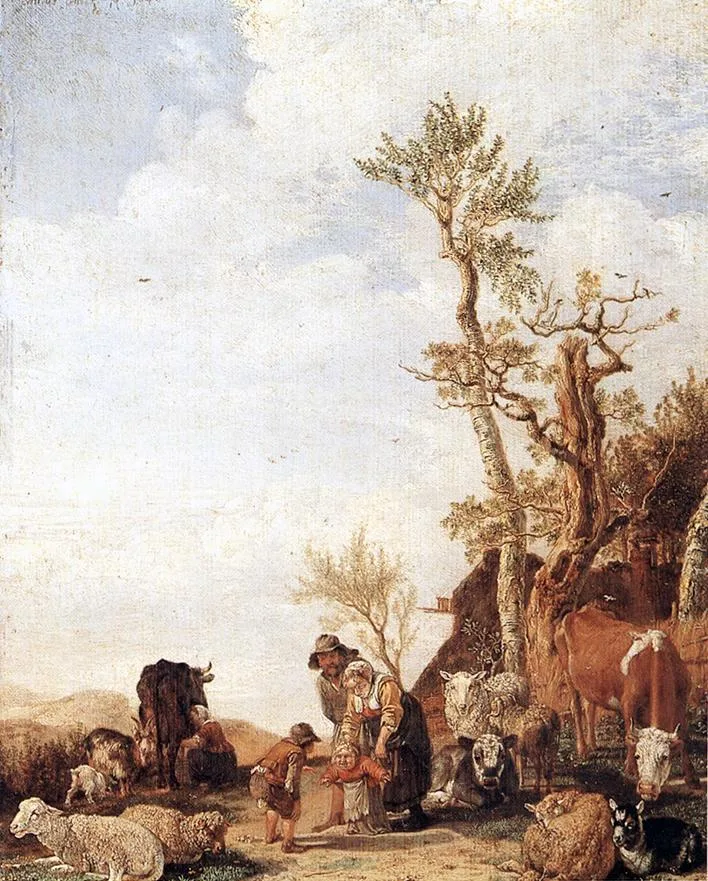
Paul Potter was a painter who rightly gave animals a place in painting that they had not held before him. He disappeared too young for the art world, dying in 1654 at less than twenty-nine years of age. His paintings, I say, are rare and not always pleasant. The series of his etchings, however, allows for a thorough study of their sincerity and solidity.
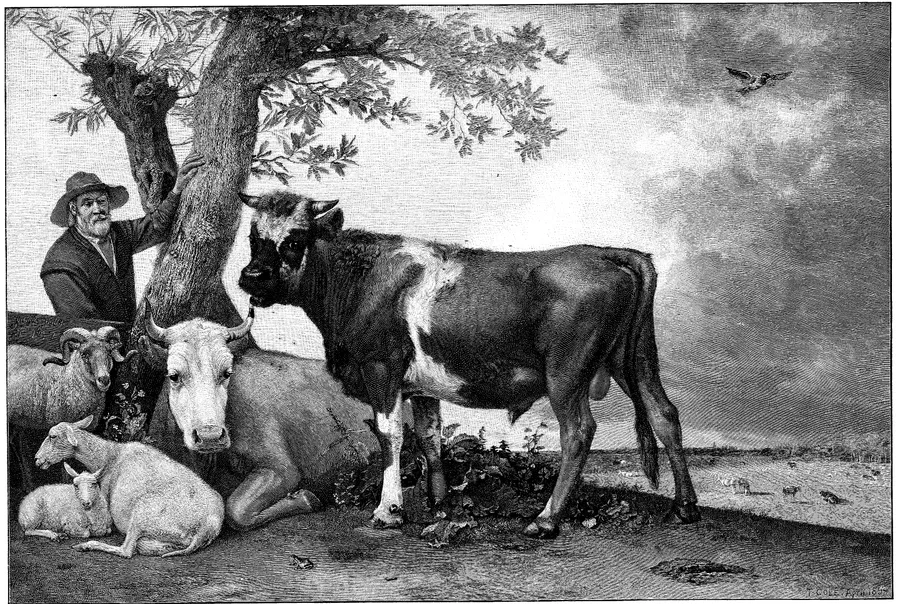
It is remarkable that his two oldest pieces, The Herdsman, dated 1643, and The Shepherd, dated the following year when he was only nineteen, are also the most populated with figures and are true compositions. In contrast, all his other etchings are simple study sketches. But who has ever better rendered the sharp bone structure of a cow's hindquarters or the swell of its belly, especially when it is lying on the ground?
Who has better captured the gentle, always slightly astonished, and sometimes expressionless quality of their long gaze? Nicolaes Berchem, who lived until 1683, had a finer and seemingly more spirited point, and many connoisseurs will prefer his brilliant skill. Yet all his etchings derive from Paul Potter and possess far less conscience and real solidity.
This is the dominant quality of Potter, who never chases after the skipping liveliness and prestesses of execution. His technique is even, even monotonous; his works are drawings with a certain added heaviness. This results from the frankness and uniformity of the acid bite, which has brought the backgrounds forward, blackened the foregrounds, and widened the line to the point of thickening it.
At first glance, one experiences a certain disappointment; it seems too simple, even naive and almost clumsy. If one looks longer, however, one is soon captivated by the serious quality, the comprehension, and the perfect naturalness of this conscientious and patient talent. P. Potter places the most sincere labor in the service of the most just observation.
Even within these etchings, there are exceptions to this kind of heaviness. One example is the beautiful Frisian horse, dappled with spots and with a braided mane, engraved in 1652. Never did the skill of Wouvermans produce something so vigorous and so simply strong.
The Spirited Mastery of Anthony van Dyck's Etchings
With the etchings of Van Dyck, we enter an entirely different manner. Here, naivety in the proper sense disappears to make way for spirit and the most complete and intelligent sureness of hand. After eliminating the doubtful pieces, whose value is very skillfully discussed in M. Duplessis's preface, M. Amand Durand reproduces twenty-one etchings that are unquestionably by Van Dyck.
It took no fewer than four French and three English collections to bring together the originals for this publication. In France, M. Galichon contributed two, M. Ambroise-Firmin Didot three, Baron Edmond de Rothschild four, and M. Dutuit five. In England, the British Museum provided five plates, while the Duke of Devonshire and M. C. S. Bale of London each supplied one.
Of these twenty-one etchings, only two are subject pieces: the half-length Christ Crowned with Thorns and the portrait of Titian and his mistress. All the others are simple portraits. Among these, one must first cite the portrait of Erasmus, which is scarcely known and was never finished either by Van Dyck or by anyone else.
The acid bite on this plate was unfortunate, and a whole section is covered with dots resulting from the cracking of the varnish. Despite this, it is a marvel of drawing and fidelity. Never has anyone so well rendered the precise and tight drawing of Holbein. The master, had he engraved himself, would have done it differently; he would have approached Lucas van Leyden even more than Albrecht Dürer, but he certainly would not have done better, nor would he have interpreted himself with more rightness and grandeur.
The Iconography Portraits
The other eighteen plates are portraits of artists that were subsequently completed by professional engravers for what is known as Van Dyck's suite of one hundred portraits, which various additions have since brought to the number of one hundred and twenty-one. It is known that all these plates were fortunately purchased by the Chalcographie du Louvre in 1851, in exchange for proofs from its own stock, as it would have been impossible for it to pay for them in cash.
Thanks to the care taken to clear the ink that had clogged the incised lines with a very lightly acidulated bath, the current proofs are better than many of those previously pulled. These can, naturally, only be the fifth and final state, recognizable by the indication cum privilegio. The first state is before any lettering, the second gives the lettering without the names of the engravers, the third bears the name of Van den Enden, and the fourth that of Gilles Hendrickx.
Before the first state of the published suite, there exists for certain pieces an even earlier state. This is the one where Van Dyck's initial sketch is visible, without any reworking or completion by an engraver. He had perhaps intended to do all the heads himself and stopped, first because of the time it would have taken him, and second because his work disappeared when the engravers were obliged to rework and cover it to harmonize it with the burin-engraved lines of the clothing and backgrounds.
Here, it is the very drawing of Van Dyck traced on the copper with the rapidity, ease, and sureness of the most consummate master. The line of the needle behaves like the stroke of a pen or pencil, obeying all the artist's sentiments. The flesh is rendered by a stippling from which Morin would later derive such marvelous effect. One is delighted by this facility, as well as by its elegance and firmness.
Often, only the head is finished. When the hands, gloves, or even the clothes are included, as in the portrait of Susterman, and especially in the doublet of Guillaume de Vos, the needle has sought to model only the shadowed side. It is no more than an indication, often as summary as that employed for clothing by M. Ingres in his pencil drawings; and certainly, he did not borrow this manner from Van Dyck's etchings, which were rare enough that he could not have known them until much later.
In this spirited indication, what verve, what rightness! The master's hand is entirely present. It is useless to insist on the value of the heads. That of Van Dyck himself and that of Breughel emerging from the wide-piped ruff are perhaps the two most astonishing; but to be just, one would have to cite them all.
These two series of prints are not merely faithful reproductions but, as M. Duplessis says, true counterfeits in the best sense of the word. They allow artists and many connoisseurs to know, possess, and consequently to revisit and study these beautiful etchings, which are of such great interest and provide such great instruction. M. Amand Durand thus renders a true service not only to curiosity but to art itself. One must live with beautiful things, because it is not without great profit that one is near them; even when one is not directly inspired by them, there is in their influence an elevation of spirit and a sort of emulation that are always beneficial.
![La Pendaison [The Hanging]](/_ipx/w_900&q_82&f_webp/api/content/artwork/6c134d53-1405-45ee-b718-39ebf51427d7.jpg)