
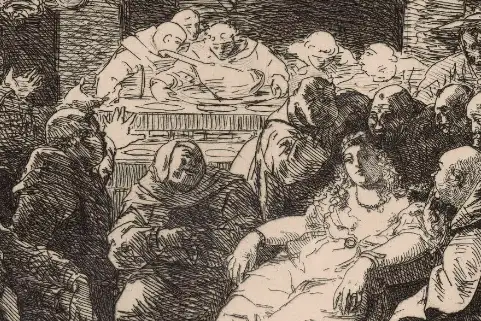

It is not our custom to review a book that has not yet appeared, nor to applaud in the theater "before the candles are lit." But what Mascarille in Molière's play claimed to do to give himself the appearance of a man of consequence, we shall attempt today—without the same ambitions—for a volume whose proofs we have been privileged to see. If it is not published this morning, it will certainly be out next week. Since art and poetry are equally invested in this venture, we have two reasons to speak, even ahead of time, of the book that is about to be released, titled, most simply, Sonnets et Eaux-fortes (Sonnets and Etchings).
The Twin Revivals of Etching and the Sonnet
It is well known how the art of etching, so long disdained and forgotten, has suddenly been rejuvenated. We need not recount this reawakening, which many of us have witnessed and which may yet be destined to deliver more than it has promised. The old journal L'Artiste, in its valiant period, and more recently the Gazette des Beaux-Arts and the Société des Aquafortistes (Society of Etchers), have provoked this renaissance, or at least greatly aided it.
Originally, the group of independent printmakers was small. We saw shining in its front ranks Paul Huet, whose Sources de Royat has the significance of a milestone; Célestin Nanteuil, who created frontispieces for the dramas of Hugo and Dumas; Charles Jacque, whose role was considerable; Eugène Bléry, who was the master of Charles Méryon; Charles-François Daubigny; Edmond Hédouin; Alphonse Masson; Louis Leroy, and still others.
Soon, the group became a legion. New recruits swelled the small army, and there are few painters today who cannot dash off a piquant etching on a small piece of copper. More than one artist who, twenty years ago, would not have considered this means of expression is happy today to be able to add the eloquence of printmaking to that of his brush—especially this form of printmaking which, in its brilliant caprice, so well expresses the spirit of France.
And just as all forms of art share a mysterious solidarity, we have seen the simultaneous reappearance, in a poetry rejuvenated at the sources of a better inspiration, of long-neglected rhythms and melodic combinations that had unjustly fallen into oblivion. Poets have been seized by a fine passion for one of these forms which, quite wrongly, had gone out of fashion: the sonnet. Once the masterpieces of the genre were lovingly studied, our school soon understood its grace and style.
The sonnet is a preoccupation of the poets of the new generation. It is being successfully practiced in that free academy that has established its sessions at the shop of a bookseller in the Passage Choiseul, M. Alphonse Lemerre. Its members, by joining their efforts, have given us the Parnasse contemporain, and, working alone, a whole series of graceful volumes that so well represent the poetry of today, and perhaps even that of tomorrow. These two forms, the new poetry and the new etching, could not long remain ignorant of each other; they met, and they easily came to an understanding. The publisher, M. Lemerre, wished to marry these two youths, and it is said that our colleague Philippe Burty drew up the contract in his capacity as tabellion (notary).
From this union was born the collection we are announcing, which, by the novelty of the spectacle it presents to the eye and the interest it awakens in the mind, seems destined to make some noise in Paris.