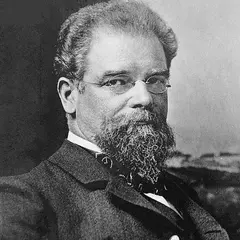
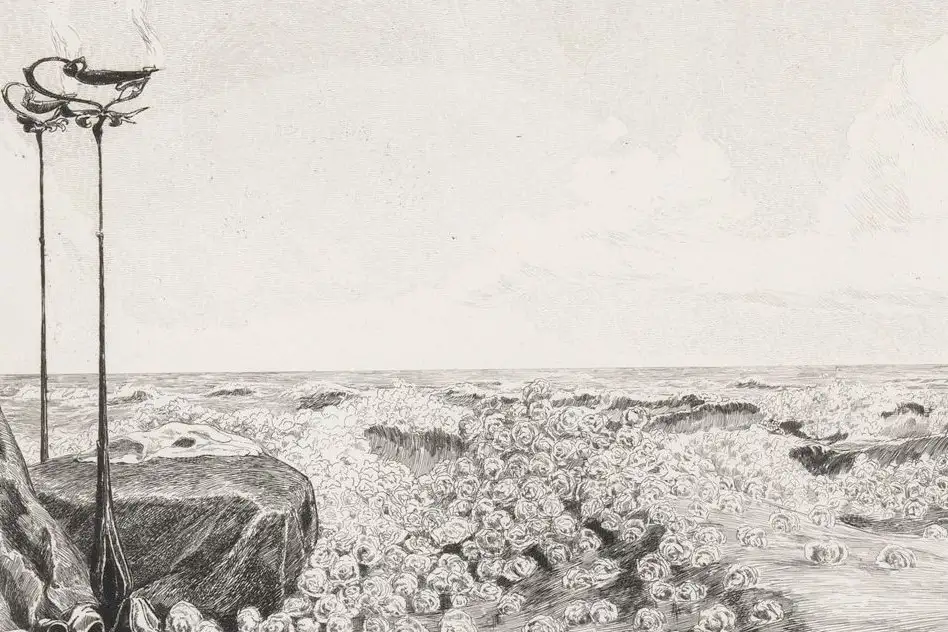
After a long session of study in a painting museum, it is a pleasure to rest one's eyes by looking at drawings or engravings. It is also a way to get to know the artists whose paintings one has just admired more closely, and to enter into their private world. In Germany, museums most often offer these facilities combined in the same building, and by dividing one's day in this way, one can spend almost the entire time, without too much fatigue, in the company of the masters. Last autumn, I had the opportunity to fully savor this pleasure while revisiting the beautiful Dresden gallery, so full of masterpieces, as well as the rich collection of drawings and prints so well installed on the lower floor.
An Encounter in Dresden
One day, in the collection of contemporary painters, I had just noticed a recently acquired painting by Hans Thoma, The Protector of the Valley. It depicted a medieval saint in armor, standard in hand, watching over the entrance to a solitary vale as night thickened its veils and scattered lights began to glow in the windows of the village for which he is the patron. Later, on the walls of the Cabinet des Estampes (Print Room), framed among some engravings by Dürer, I found several plates by the same artist, executed with a very proud and personal style.
It was with similar satisfaction that I was then able to browse the work of a young engraver prematurely taken in the prime of his life, Karl Stauffer. Swiss by birth but settled in Berlin after studying at the Munich Academy, he was an eminent portraitist and draftsman, trained in the school of Holbein and of nature. Alongside the portrait of his mother—a marvel of finesse and insight—and that of the famous novelist Gustave Freytag, I admired other works by Stauffer. Notably, there was a study of a nude young girl, modeled in drypoint with exquisite delicacy, and finally, that witty charge against Darwinism in which the artist brought together monkeys of every species.
Grouped around a table, they offer, with their gaunt hands, their gestures, their airs, and their superb or crestfallen expressions, cruel resemblances to more than one contemporary scientist. While these caricatures of men debate among themselves, citing texts and contradicting each other with acrimony, a female monkey in the foreground seems placed there to summarize and conclude the debate with an argument as unexpected as it is topical. Indeed, while with all sorts of maternal gentleness she bares her chest to offer her simian breasts to a graceful, pink, and plump baby, the infant turns away in horror, thus disavowing all contact and all family affinity with the beast.
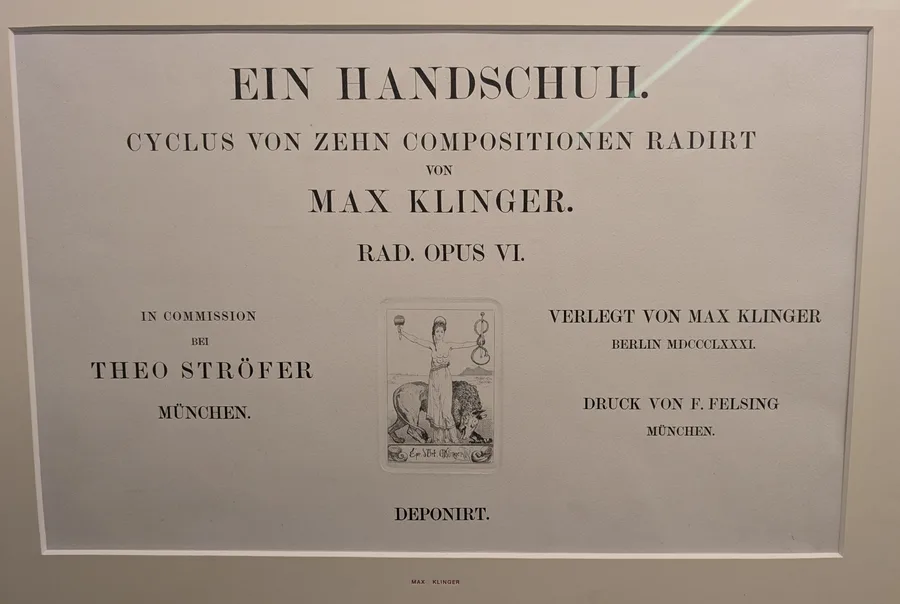
Seeing the interest I took in these various works, Mr. Max Lehrs, the amiable director of the Print Room, began to speak to me of another contemporary artist, a friend of Stauffer. At my request, he immediately had the entire work of Mr. Max Klinger brought to me. I confess, to my shame, that this name was completely unknown to me. For two hours, however, I remained under his spell, leafing through and reviewing at my leisure this already considerable body of work. Mr. Lehrs had the good sense to assemble it, not only by acquiring choice proofs of all the engravings but also by never neglecting an opportunity to collect the original drawings that may have served in their preparation.
The collection revealed a true master, absolutely original, full of talent and poetry. The impression it left on me was such that, obliged to return to France, I departed with a keen regret at not being able to push on to Leipzig to see the artist himself. Eager, at least, to complete my information as much as possible, I turned to the kindness of Mr. Lehrs, and it is to him that I owe the communication of the information and engraved documents that accompany this study. The biographical details, however, are limited to a few dates and a small number of positive indications, as Max Klinger lives apart in voluntary seclusion. I will also borrow some information from an article published in 1890 by Mr. Bode in the Graphischen Künste.¹