
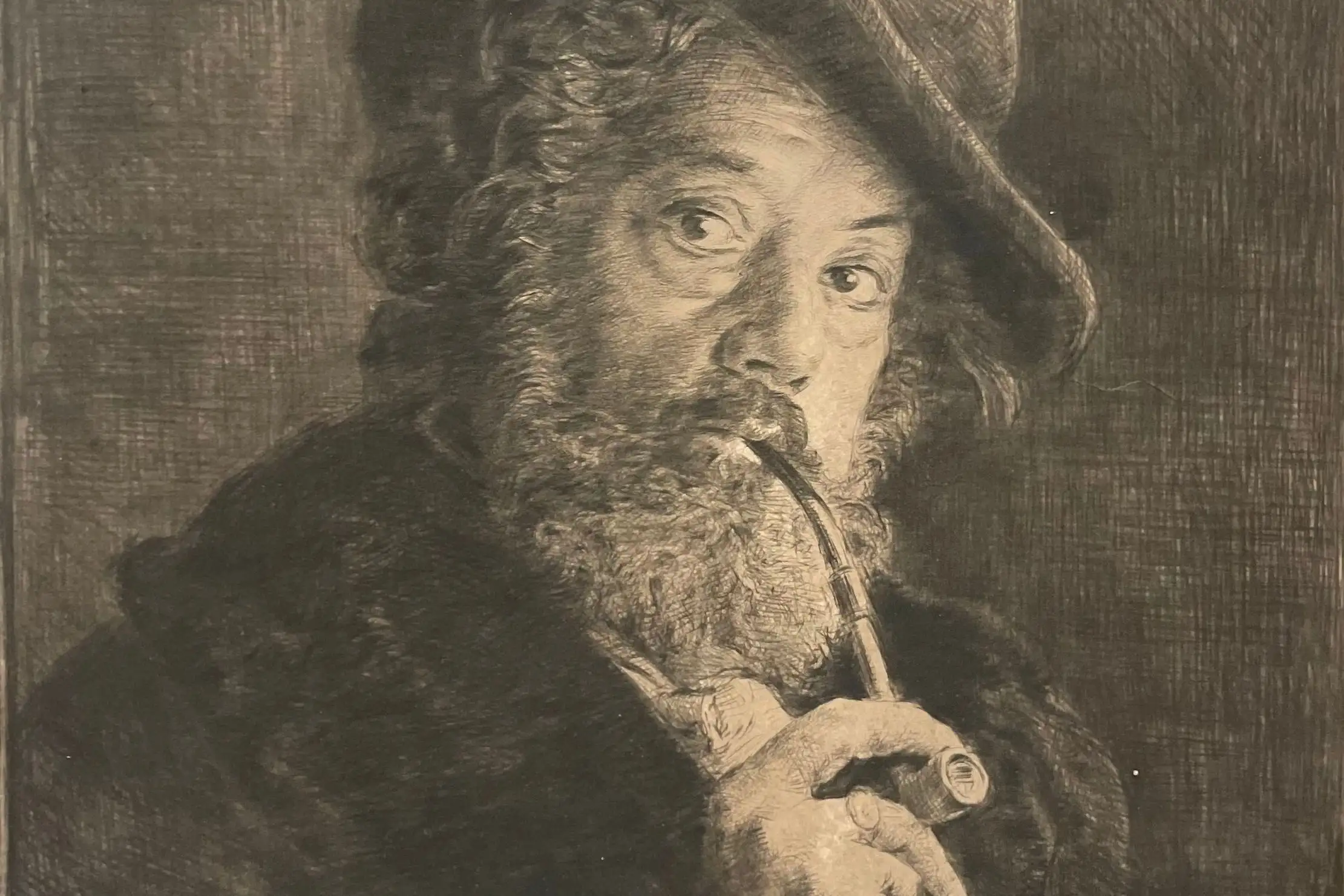
The drypoints and portraits that M. Marcellin Desboutin exhibited some time ago offered a dual interest. There was a historical interest, in that they constituted a veritable gallery of the celebrities of the last fifty years. There was also an artistic interest, since they gave us the flower, the very essence, of the valiant artist's considerable body of work. To analyze them in detail from this dual perspective would require more space than I have; I will therefore content myself with rapidly drawing out their essential features.
The Art of the Psychological Portrait
I have a preference for portraiture that I do not seek to conceal. To capture on canvas or copper the image of a human being—not through a fortuitous and accidental resemblance, but by discerning the features that are truly them and that reveal their soul—seems to me the highest goal and the last word in art. A portrait, in effect, is not merely a work of art, and one all the more difficult to execute as it leaves very little room for brilliant and easy accessories, concentrating all attention on a single subject. It demands from its author a penetration or an intuition that few artists possess.
A painter can often be content with being a technician, whose skill, great or small, is the only thing under discussion. The portraitist must be coupled with a psychologist, capable of understanding the intimate significance of features and forms, and of translating it.
This task becomes more difficult as the human face grows more complex and mobile, as is the case in our time. A portraitist from the era of Louis XIV, for example, did not have to contend with the thousand details of movement and attitude that define the modern individual. His models possessed the calm, majesty, and simplicity of bearing that the manners and costumes of the time entailed. Once he had faithfully painted the lace and velvets of their attire, he had only to reproduce the expression of their faces, which hardly varied. It was almost always calm, meditative, immobile, with something fixed and almost hieratic about it.
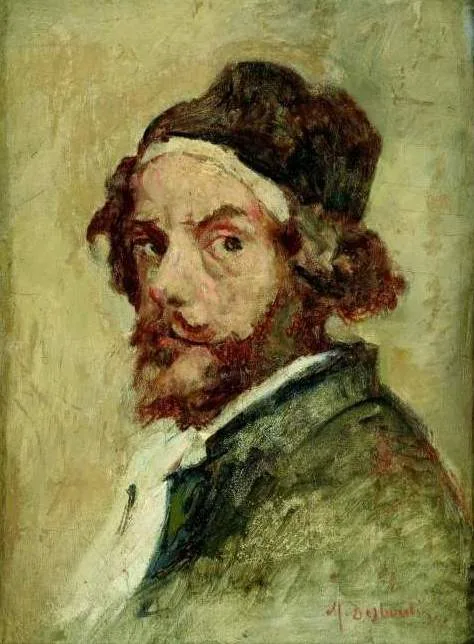
Looking at the majestic canvases of a Van Dyck, for example, one senses that he had before him models who instinctively assumed, in his studio, the same pose they held in life. Even if he had wanted to see them otherwise—freer, more relaxed—he could not have. In essence, he had only to copy them as they were to render them as completely and faithfully as possible.
The modern portraitist, by contrast, has for models people of society, men of letters or business, who are extremely busy, who haggle over their sittings, and whose attitudes in life never resemble the poses of the studio. If the artist is content to seat them in an armchair or have them stand before his easel, he will neither know them nor make them known. He must see them exist. And when he has understood them—when he has grasped on their brow, in their eyes, in the folds of their lips, in the gestures they sketch out and do not always complete, the passage of the fleeting thoughts, so numerous and contradictory, that ceaselessly stir the modern man—he must then manage to fix and translate it.
This is so difficult that, in an age when good painters abound, good portraitists are rarer than ever.
Desboutin's Penetrating Likenesses
Desboutin, who is not merely a technician but also—as he has proven—a man of letters, an observer, and a philosopher, was keenly aware of the difficulties facing the modern portraitist. And he often overcame them. Look at his portrait of Manet, that of M. Zola, that of Charles Bigot, that of M. Edmond de Goncourt, and many others. Sometimes, the likeness is debatable, if by likeness one means the exact reproduction of the face. But how penetrating and explanatory are the portraits I have just cited—and I could easily have lengthened the list! How they make us understand the personalities they present to us!
Manet, caught in a moment of strolling, cane in hand, head slightly tilted, his mouth creased in a smile that is not quite a smile, his eye fixed ahead, so sharp beneath brows furrowed by a thoughtful effort, is indeed the searching and sickly Parisian we knew. And one must have seen M. Zola often to know how natural to him is the reflective and meditative pose in which Desboutin has captured him. Note that this astonishing artist often manages to be just as clear and demonstrative without even resorting to full-body attitudes, in simple medallions where he has contented himself with exaggerating a single feature—a feature so right that this very slight, sometimes barely perceptible, exaggeration is enough to give us the meaning of the physiognomy.
As is always the case, the model Desboutin knew and understood best was himself. In the three principal self-portraits he made, he revealed himself entirely, with all the power of his insight and all the richness of his art. None of these portraits is complete in itself, in the sense that each one endeavors to show us a salient aspect of the model; but they complete one another, and the three together form a most curious analysis, one could almost say a confession of the artist.
A Triptych of Self-Portraits
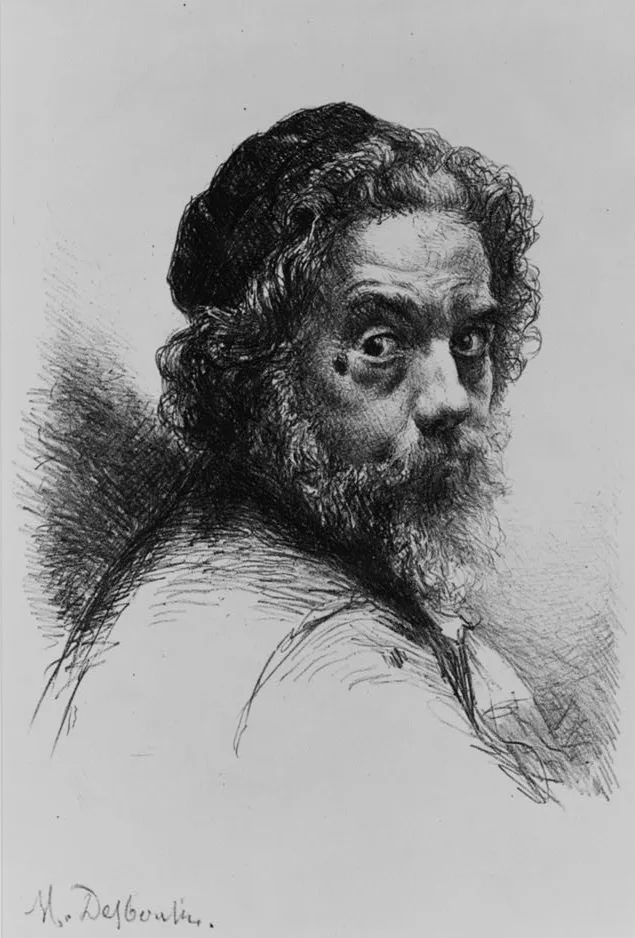
The Bohemian
The first portrait shows us the bohemian. Under a vast, soft, wide-brimmed hat—a sort of utterly fanciful sombrero—Desboutin's face seems to have lost its most distinctive characteristics, as if relaxed in the lazy well-being of the brasserie. This sombrero, set to one side, represents the "pose" inherent to the painters of twenty years ago, the search for a picturesque, eccentric costume that, at first glance, dispels any idea of the "philistine." The placid features and tranquil eyes convey an impression of satisfied and slightly disdainful good nature. It would be impossible to better render, through the arrangement of external features, a state of mind that one immediately divines: the contentment of the artist who has finished his day's work and is heading off to some Montmartre tavern, to the "Grand Pinte" or "Le Clou," to joke with the bourgeois alongside his comrades, in a setting of Henri II-style furniture, more or less authentic tapestries, and paintings by Willette.
He has settled in before his beer and is not yet speaking; he is waking up. But soon, a running fire of comical jests and droll stories will erupt, making the evening fly by.
The Poet
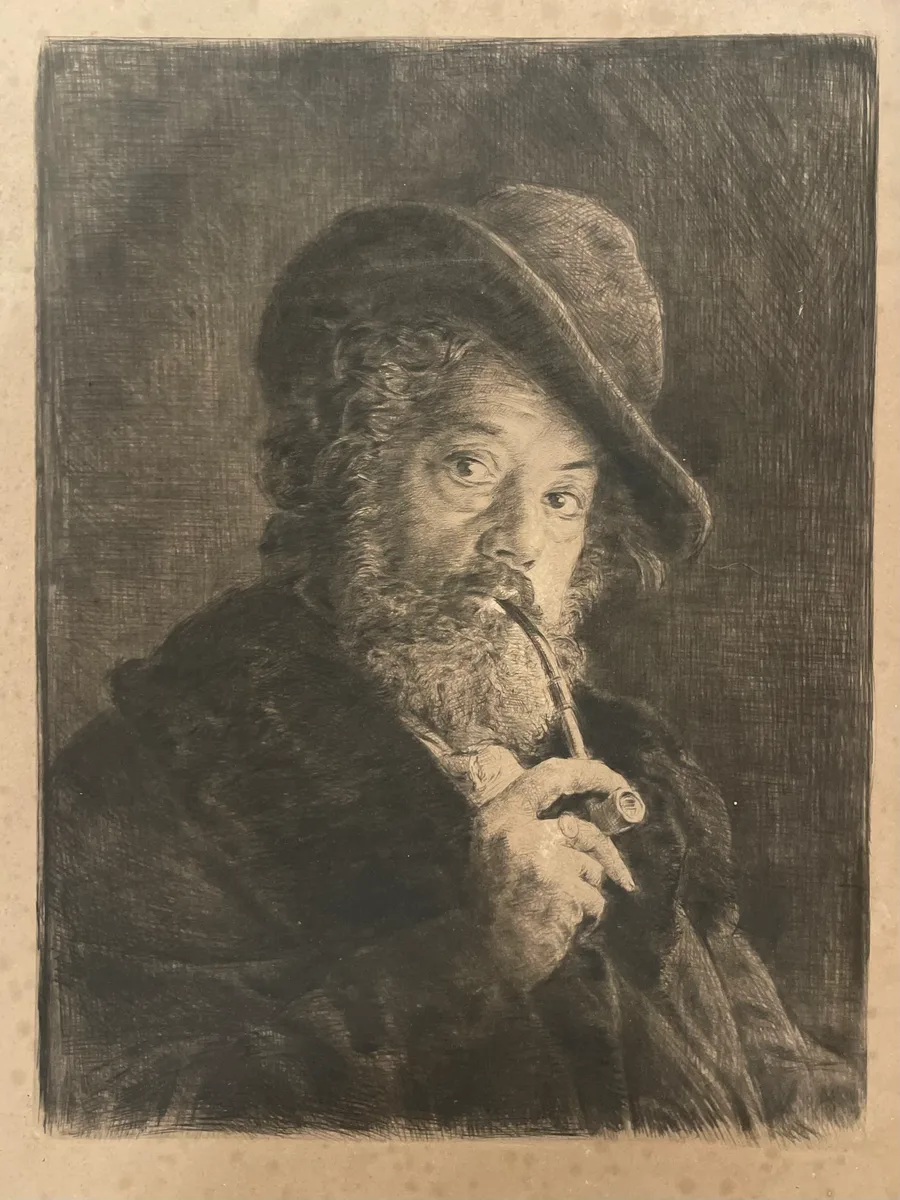
But beneath this bohemian—who, by the way, possesses a great and most excellent wit—there is a poet, and here he is in the second portrait, the one known as L'Homme à la pipe (The Man with the Pipe). This time, only the pipe itself—the small, well-used and blackened clay pipe, the true brûle-gueule (literally, "mouth-burner")—still represents the dishevelment of the studio. The face from before has been ennobled; a profound thought animates his two large eyes, fixed far in the distance on something invisible, on an idea that floats, still elusive, as if on the horizon of a dream.
Gone is the bantering good humor that the brasserie fosters. The same man who last night was chattering with friends without thinking of much is now a meditative figure, withdrawn into himself, unconsciously seeking the obscure connections that unite the visions of his soul with the external world. He is transformed—one might say transfigured, though he is still the same and quite recognizable, possessing those strong features one does not forget after seeing them once.
The Fighter
This bohemian and poet also has a heroic side. His biography, which has often been told, is well known: its vicissitudes of grandeur and misery, his lavish villa in Florence where he received everyone with a name in letters and the arts, his complete ruin, the serenity with which he endured it, his haughty indifference to the question of money that prevented him from using his talent to rebuild his fortune. Well, here is the combatant of these struggles in the third of his self-portraits. He wears a skullcap, from which his old lion's mane of hair flows; he is dressed in a corduroy jacket, more "true to life" than in the other two, and yet very different.
He has brought out all his energy; his robust face evokes the memory of those 15th-century condottieri (mercenary captains) whom Machiavelli admired. Positively, I cannot imagine Oliveretto da Fermo or Castruccio Castracani any other way: they must have had this hard will, this cold decisiveness that suddenly transforms the face of the bohemian and the poet once more, showing us a new trait in him, one that he perhaps never realized in action, but that he surely held in potential in some recess of his being.
For this third portrait, Desboutin changed his usual process. Ordinarily, he sticks to drypoint; this time, he introduced etching, which contributed to the character of vigor and robustness he wanted to give his plate.
There would still be much to say about the entirety of Desboutin's work, and one would need to cite pages that stand out with particular interest—for instance, his portraits of children, which are astonishing in their life and naturalness. He captures his little models on the fly, in their rapid movements and ever-changing attitudes, and one wonders by what miracle of attention he manages to see them so completely and to fix them on the plate despite their continual motion. But, as I have already said, I cannot dwell on the details. I only wished to highlight some of the most striking characteristics of a considerable and powerfully personal body of work.
ÉDOUARD ROD
