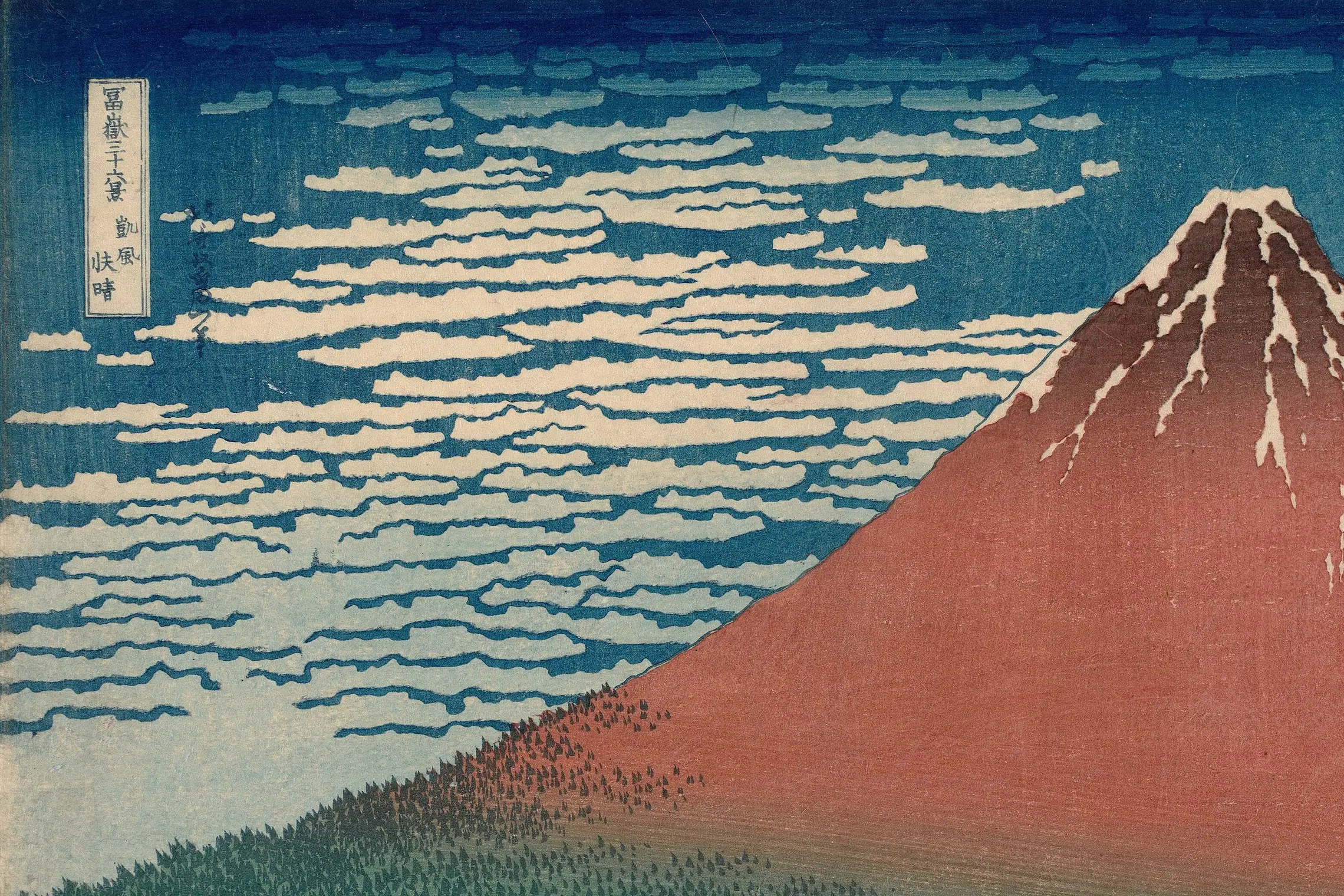
In the arts of drawing and painting, the Japanese initially created and invented nothing; they took everything from China, which, at the time of their debut, had already brought its civilization to the highest point of development. The professional techniques and methods of execution used by Japanese draftsmen, first borrowed from China, have remained uniformly the same and have never varied. All paintings and drawings are executed by the artist with a supple brush, wielded freehand. Any work with a hard, resistant instrument—a point, pen, or pencil—has remained unknown, and printing is done exclusively using woodblocks, onto which the drawing or written page has been cut and carved. It is from this particular technique that the painted or drawn productions of Chinese and Japanese arts derive their distinctive character, the family resemblance one discovers in their execution.
In art, China was to Japan what Greece had been to Rome: the master, the model that one at first simply strives to imitate as best as possible. Japan, moreover, has never failed to recognize the close dependence in which it stood to China. Among Japanese connoisseurs, collectors, and curiosity dealers, it was Chinese objects—bronzes, paintings, porcelains—that, before the country's opening to Europeans, occupied the place of honor and held the first rank. Books and paintings from China have always been common in Japan. Chinese books, in particular, were popularized there through countless reprints. For certain books, it is rather difficult to say whether they were printed in China or Japan. With the reverence they hold for all that comes from China, the old draftsmen of Japan thus applied themselves simply to reproducing Chinese types and figures from Chinese history or legend. When they did venture to render Japanese types with Japanese costumes and arrangements, it was while preserving the methods and style of Chinese art. Although in certain schools and with certain artists one can sense a particular and original manner that might be called Japanese, the detachment from Chinese models is never complete. This Japanese period of imitation and dependence thus extends from the beginnings of its art to the second half of the 17th century.
The Early Development of Woodblock Printing
This first phase of Japanese art is not without interest or merit. It was during this time that the Japanese appropriated, as the organic foundation of their art, the characteristic methods of the old Chinese schools: for example, the supple and decorative way of rendering the foliage of the bamboo, flowers, and birds; the simplified drawing of costume folds with broad brushstrokes; and the manner of painting a landscape as if seen from above, with a perspective that raises the background to the top of the picture and makes figures and details stand out not against the sky, but against the landscape itself.
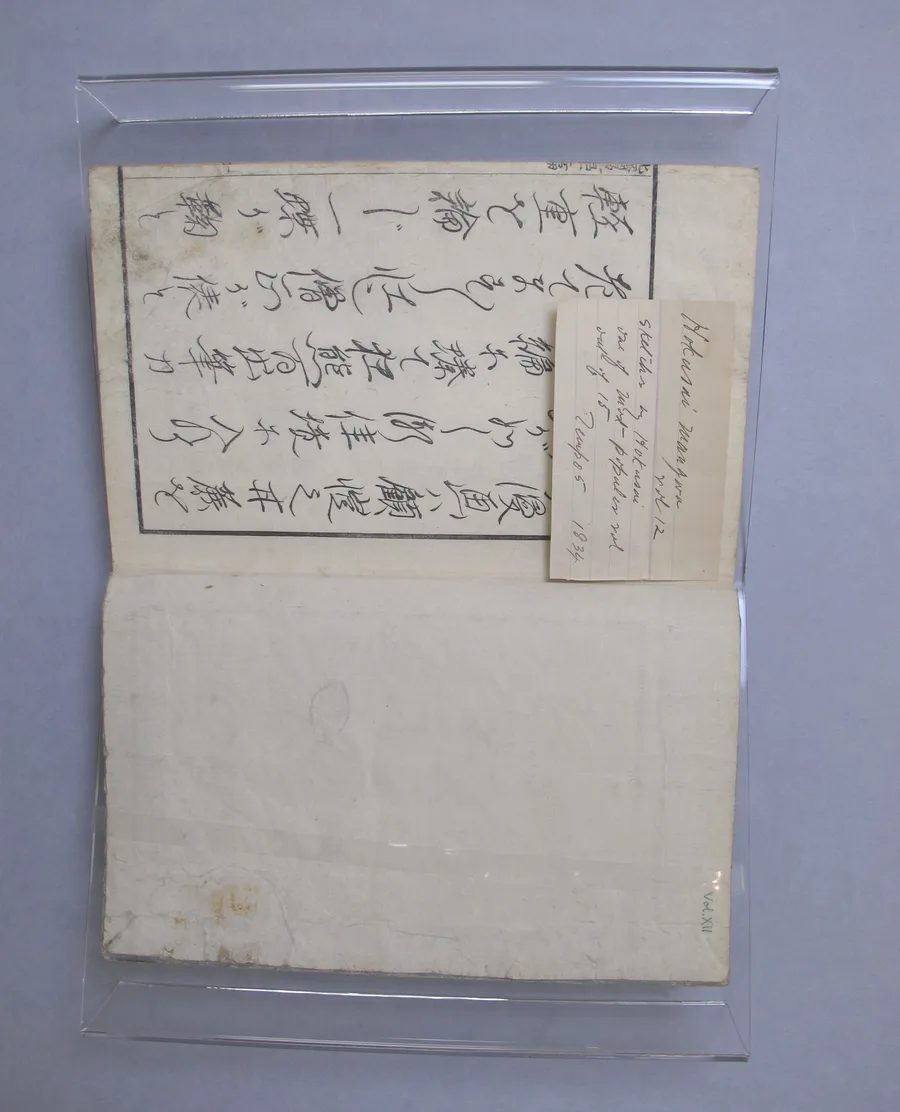
Regarding books specifically, the art of printing in Japan long remained a rather primitive affair. For illustrated books in particular, it was necessary for wood engravers to emerge alongside draftsmen. By examining a series of old books, one can see that it was only after long efforts that the art of wood engraving managed to perfect itself. In the first half of the 18th century, it can be said that wood engraving and printing finally reached their full development, successfully reproducing the particularities of the era's drawing with fidelity and energy. The illustrations in books of that time are almost exclusively printed in a single shade of black—a deep, full-ink black. As the draftsmen of this period worked primarily with broad lines and large brushstrokes, the wood engravers adopted a corresponding style of generally strong lines and large black surfaces. Furthermore, they had already acquired the skill, the particular sleight of hand that their successors would inherit, which allowed them to fix the lineaments and the richness of the brushstroke onto the woodblock, such that the printed drawing reveals the mark of the brush's bristles as clearly as if it had been traced directly onto the page by the artist's own hand.
There exist a number of collections that provide us with reproductions, through engraving, of the paintings of old Chinese and Japanese masters. Such are the Wakan-mei-Gua-yen in six volumes, which dates from 1751; the Yehon-te-Kagami, six volumes, 1751; and the Gua-shi-Kai-yo, six volumes, 1754. In these, one can see that the rendering of flowers, birds, animals, and bamboos had reached a point of perfection that would not be surpassed. In the Gua-shi-Kai-yo, among other things, one finds a page borrowed from the old Japanese school of the 17th century: three birds sleeping on a tree branch, printed in solid black, their silhouettes standing out against a large moon marked on the white background of the paper by a simple black line. This is a drawing of great invention in its simplicity and perhaps the most powerful of all those treating the same subject that we have ever seen. After flowers and birds, the most common subjects are those drawn from Buddhist legend or the history of famous men and Chinese heroes. The reproduction of Japanese subjects by Japanese artists is sparse, which clearly shows that at this time, it was the Chinese schools and masters who represented "high art."
However, in books of a different order from those we have just cited, we find subjects drawn from common life or the history of Japan, rendered in a manner as free from Chinese imitation as the era allowed. The Imbut-su-Sogua, by Kukan, in two volumes from 1722, shows us Japanese people of all conditions and trades. It is the first of those books, which would later become so common in Japan, where popular life is depicted in all its truth. The Yehon-Yamato-hiji, by Nashikawa Sukenji in ten volumes, is an illustrated collection of legends, and the characters' costumes, the arrangements, and the details of the interiors are borrowed from the real life of Japan.