

The Cabinet des Estampes, the French national print collection, does not have an ancient origin. This invaluable repository was established in 1666, when Louis XIV, acting on a proposal from his chief minister Jean-Baptiste Colbert, acquired an initial collection of engraved works for the State. The king understood the value of adding a print cabinet to the already considerable treasures of the Royal Library, viewing it as an indispensable complement to a historical collection.
Alongside the books that record history’s most memorable and most hidden events, the print is often necessary to show the eye what the volume teaches the mind; it confirms and clarifies the narrative. The best description of a particular event or the defining circumstances of a battle cannot be fully understood without knowing the landscape where the combat took place or the event transpired. How can one explain the causes of a victory or a defeat without placing a detailed map or an accurate view of the battlefield before the reader? And of what help, in studying a person’s character, can be the very image of the man, the expression of his face, the outward signs of his temperament?
Furthermore, is not the history of art, which prints allow one to grasp at a single glance, a subject of sufficient interest? When placed beside books on aesthetics or artist biographies, is it not more reliable to find the very works the text discusses, or at least faithful reproductions of them? The utility of the Cabinet des Estampes is, in any case, too universally recognized to require further insistence on its advantages. No one disputes that a collection so interesting on so many counts has its rightful place in the institution to which Louis XIV joined it from its inception.
The Founding Collections
The first foundational acquisition for the department was the collection of Michel de Marolles, Abbé of Villeloin. The Abbé de Marolles assembled two distinct collections of prints, for which catalogues were printed in 1666 and 1672; only the first was acquired by the king, and it served as the initial core of the present-day print department. This collection, which had been enriched with pieces from the cabinets of Claude Maugis (Abbé of Saint-Ambroise), Charles Delorme, and the Sieur Kerver, was further expanded by partial acquisitions made by Marolles himself after he became its owner. It contained the rarest and most precious prints of the era.
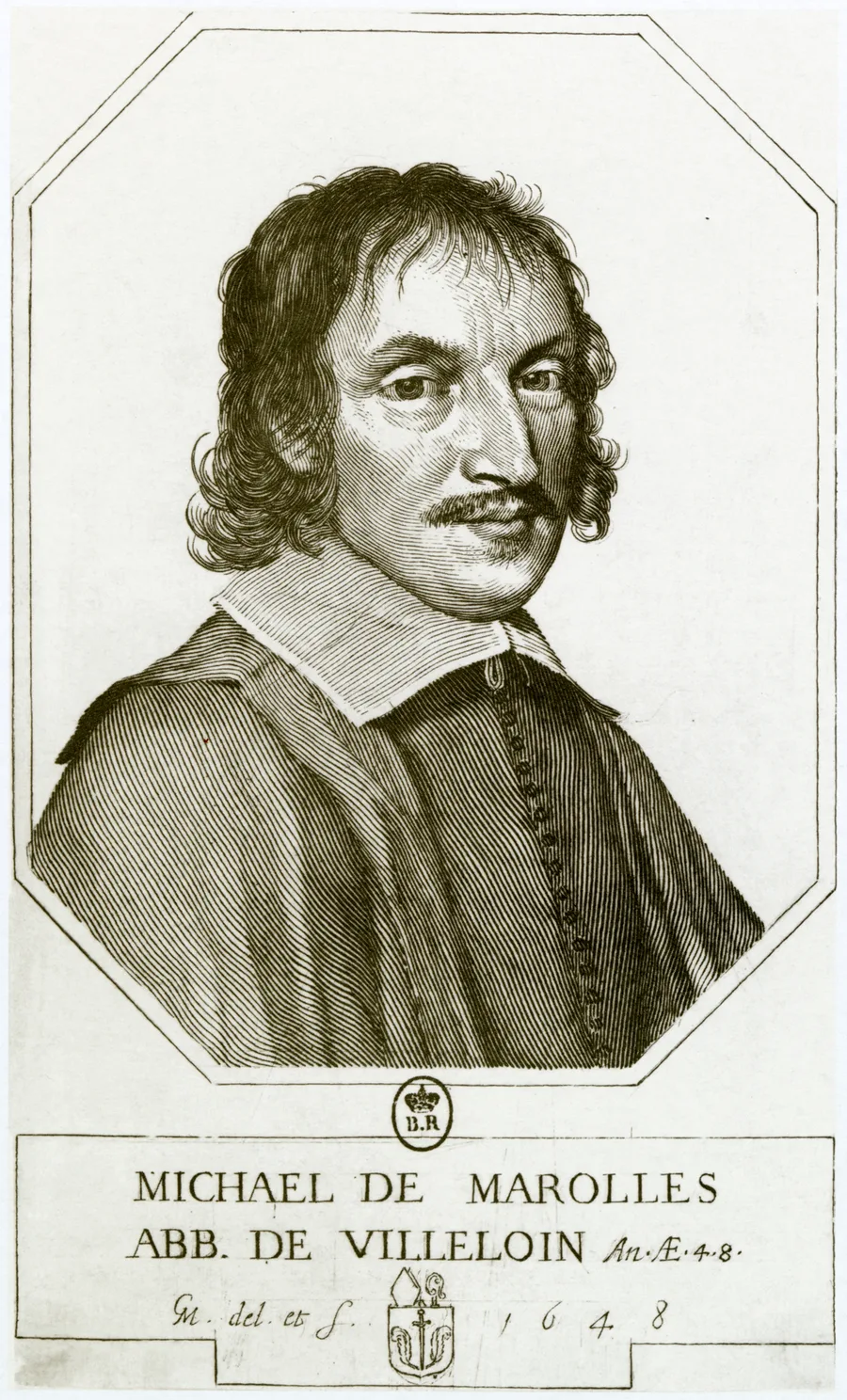
The famous Pax of Florence engraved by Maso Finiguerra, almost all the works of the early masters, and a series of nielli—more numerous in Paris than in any other European cabinet—all originate from the Abbé de Marolles's collection. This acquisition was made with prudence, and the owner himself took care to inform us of the reasons that led him to part with the prints he had gathered.
In the preface to his 1666 catalogue, the Abbé de Marolles proposed his collection to the king in terms that were indirect in form but explicit enough to be perfectly understood: