There is a class of artists drawn to their vocation by a generous gift from nature—a gift that might manifest as a simple taste for color, a natural facility for drawing, or a consummate skill and desire to create something with their hands. This class is far more common than the first; the character of its members' natural gifts assures them a certain success in the world. These artists do not have to endure the painful trial of long years of being misunderstood, nor do they have to struggle against external circumstances. Their only effort is to have ideas worthy of the form they are able to give them.
They must come to see that the greatest conquest man can make is to understand what endures and what moves, for this is the subject of all the arts. When the artist generously endowed by nature has striven to achieve this realization, when he has incorporated into his work the element that was initially missing, he achieves the ideal type.
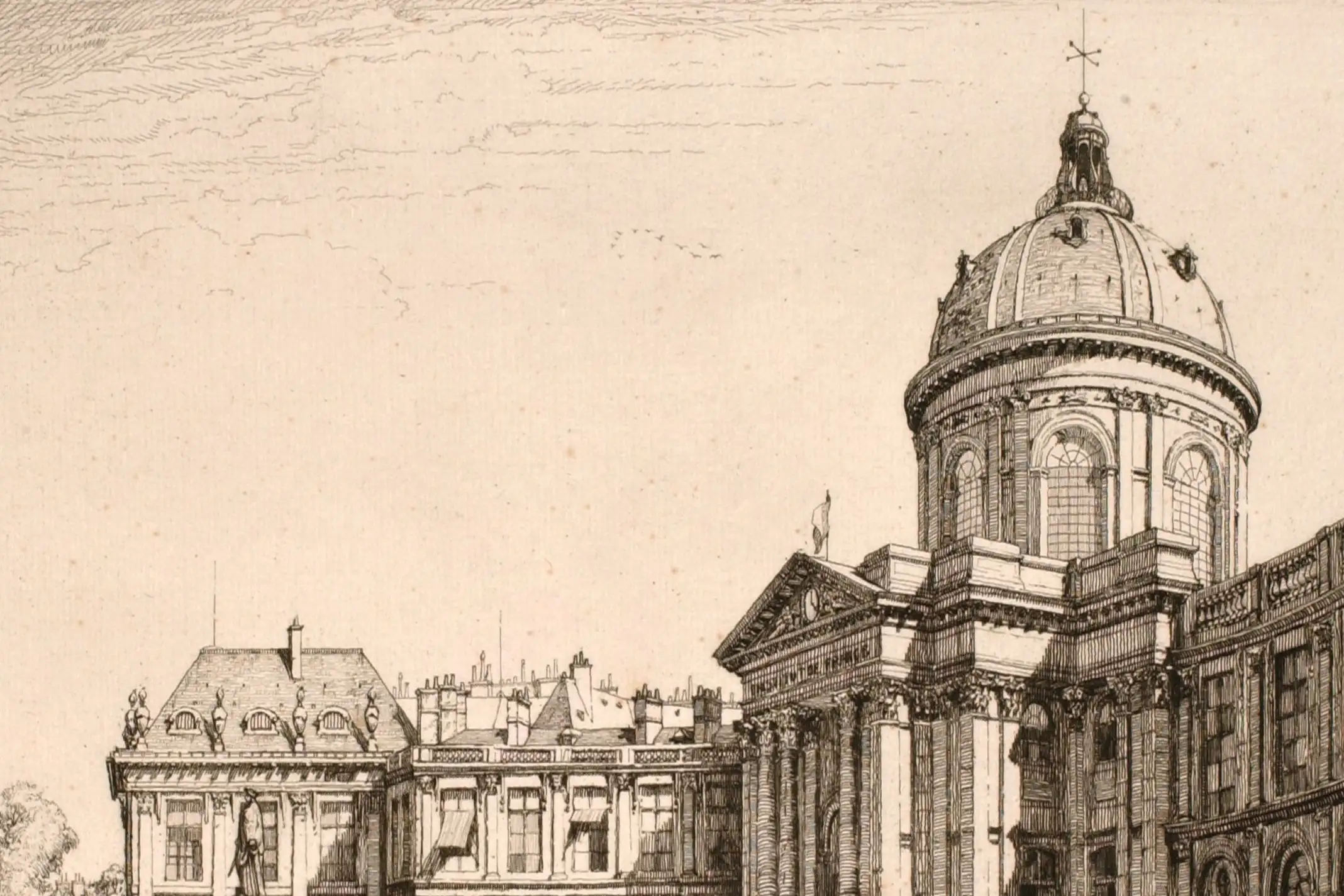
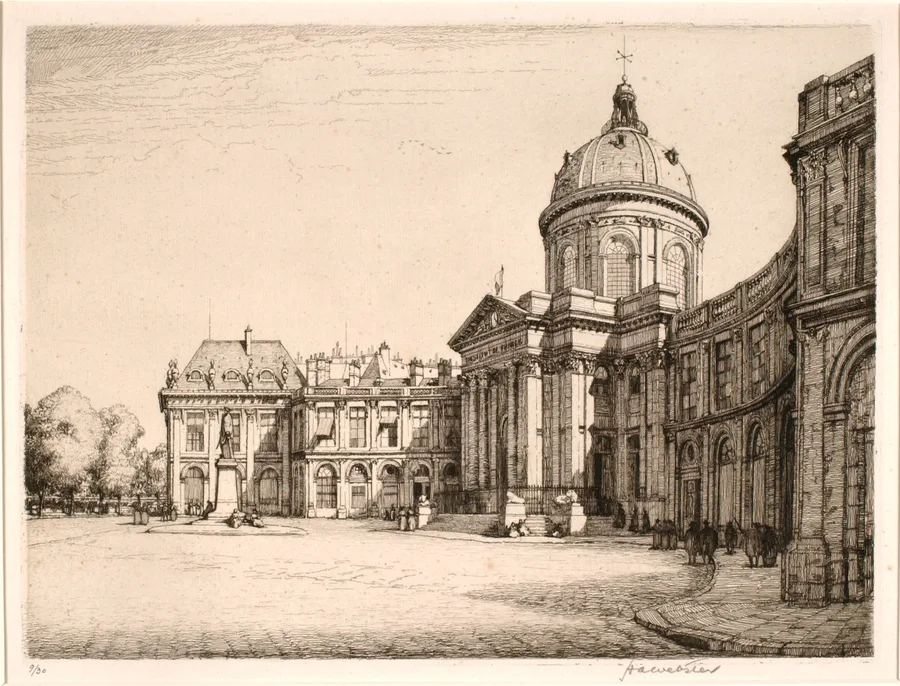
Mr. Herman A. Webster is assuredly in this second category. In less time than many artists take to learn their craft, he has mastered his own and placed himself among the most justly renowned etchers of our time. His debut in the major exhibitions dates from the very first months he began to produce. Since then, Paris, London, New York, and other cities have seen his works in solo or group exhibitions. Collectors and critics have united in praising his work; the plate we present here is the second of his to be published by the Gazette des Beaux-Arts.¹
A Winding Path to an Artistic Vocation
Born in New York in 1878, Webster has had an eventful life. The artist who today dedicates all his activity to the plates seen in exhibitions each year is a graduate of Yale University; he has worked in mines, in a bank, and for newspapers. For several years, his talent for drawing, which he had shown since childhood, manifested only in vague amateur works. A visit to the 1900 Exposition Universelle in Paris and the sight of the capital's artistic activity determined him to become an artist himself—an idea that was certainly not diminished by the trip to China and Japan he took on his way back to America.
Four years later, he finally obtained permission from his family, who had been hostile to his artistic vocation, to come and study in Paris "for one year." On the advice of Jean-Paul Laurens, he drew from nude models for seven months. This is the full extent of his experience inside art academies. However, this period should perhaps be counted as longer than it seems, for the young artist, eager to learn, began his day at dawn and did not finish until ten o'clock at night, continuing to draw by gaslight.
Such an application to work could not be sustained without a break. Mr. Webster turned to etching—partly to rest, and partly to respond to the fascination that the works of Charles Méryon, which he had seen at the Bibliothèque Nationale (National Library of France), had exercised upon him. This time, his only teachers were the prints of the masters he found in our museums.
Mastery of a Demanding Craft
The practical sense that characterizes his entire career, combined with his natural and acquired manual skill, allowed him to produce plates of excellent technique from his very beginnings. Highly uncertain about the outcome of his attempts, he sent some of his first proofs to the Salon of 1905. They were accepted, and this success was followed by others each year. Even more surprisingly, his very first painting—a study he had decided to undertake of some objects grouped in a corner of his studio—was also immediately accepted at the Salon.
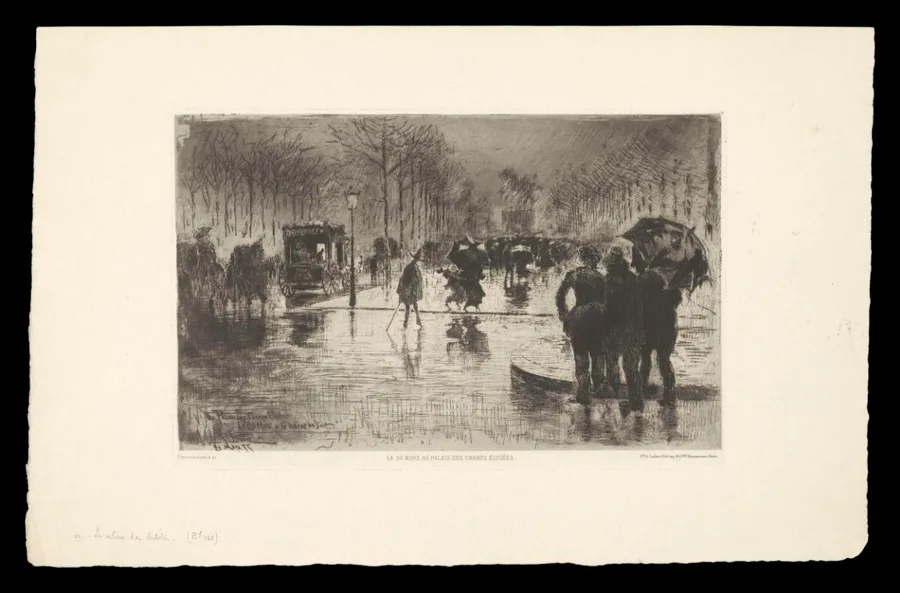
But it was etching, with its freedom of technique, that held his attention. The series of engravings resulting from his visits to the Forest of Fontainebleau and his travels in Spain, Normandy, Rouen, Bruges, and New York form a much more considerable body of work than one might have expected from the seven years that saw its creation. However, it is the views of this Paris, so beloved by artists, that seem to represent the best of his art. Mr. Webster can be counted among those who have fixed in a permanent form some of the Parisian aspects that the future will know only through these documents.
This is not the most essential part of the work that Méryon bequeathed to us, but it is one against which even the most rigorous criticism could find nothing to reproach.
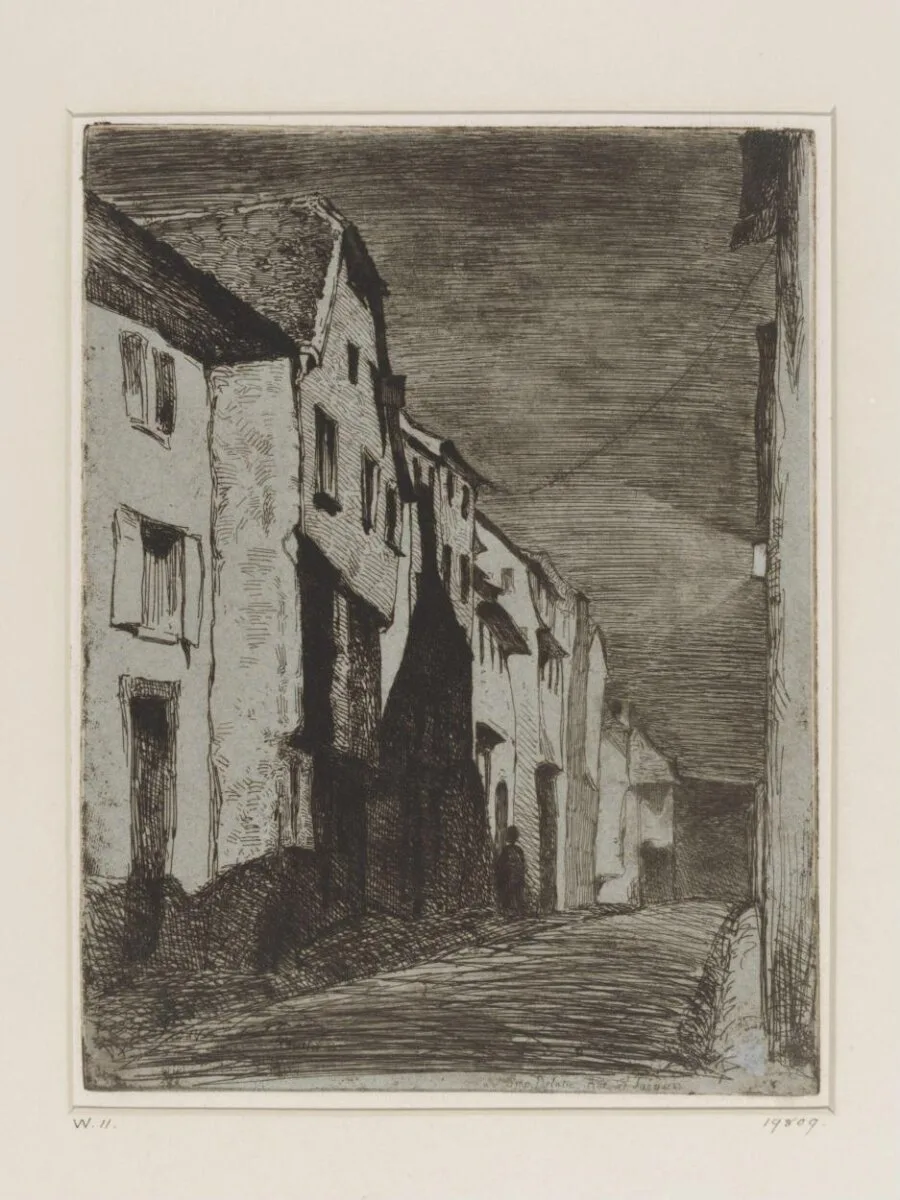
The lessons of the "métier" (craft), of which the French master etcher is so fecund, have been well studied by his admirer from across the sea. His plates also recall Whistler at times. But his attitude towards these masters has always been one of wise discretion; he has recognized the truth that no work can be continued by anyone other than the one who first conceived it. Thus, the influence of these two great artists on Mr. Webster has been that of a preceptor from whom one learns the means of expression, not that of a master whose disciples do nothing but repeat his words.
A Constant Progression
The path that the art of Mr. Herman A. Webster has followed, from 1904 to the present, is a constant progression towards mastery of the art of etching, where each quality is acquired at the price of patience, work, and a deeper knowledge of the smallest details of the technique. The artist continues to draw every corner of nature, every figure that interests him; his notebooks and portfolios contain several hundred drawings, ranging from the lightest indications to large, detailed studies. But he also continues to study the craft itself, noting in writing the time required for the acid bites on his plates and printing each proof himself.
One will therefore have no difficulty in explaining the difference that exists between a plate like that of Saint-Ouen (1906) and Sur le quai Montebello, acquired by the State in 1912. The first offers a well-rendered effect of perspective and light, with an indication of the particular appearance of the houses, their age, and so on. But the superiority of the second plate is evident even to the least trained eye: everything is at once more precise and more interesting. The contrasts between the distance and the foreground, between the varieties of lighting, and between the degrees of interest in the different parts are more clearly marked; the whole has gained much in both variety and harmony.
Thus, one can affirm that Mr. Webster's current works are those of a man who possesses his craft in an admirable fashion, knowing how to express in their fullness the sensations he receives from nature and, with them, the pleasure he feels in rendering them.
A series of plates made during the summer of 1911 in Frankfurt shows a continuation of his progress. The same can be said of certain recent views of Paris, including La Rue Saint-Jacques. In these, as in the etchings of the picturesque city on the banks of the Main, one finds a clearer ability to retain the effects of light and to make use of secondary figures.²
Will he now turn his attention to the qualities we have identified as belonging to that class of artists who struggle to realize an ever-higher ideal? It would be a presumption to predict an artist's future, as much as to dictate the path he should follow. We simply pose this question, with full confidence.³
WALTER PACH