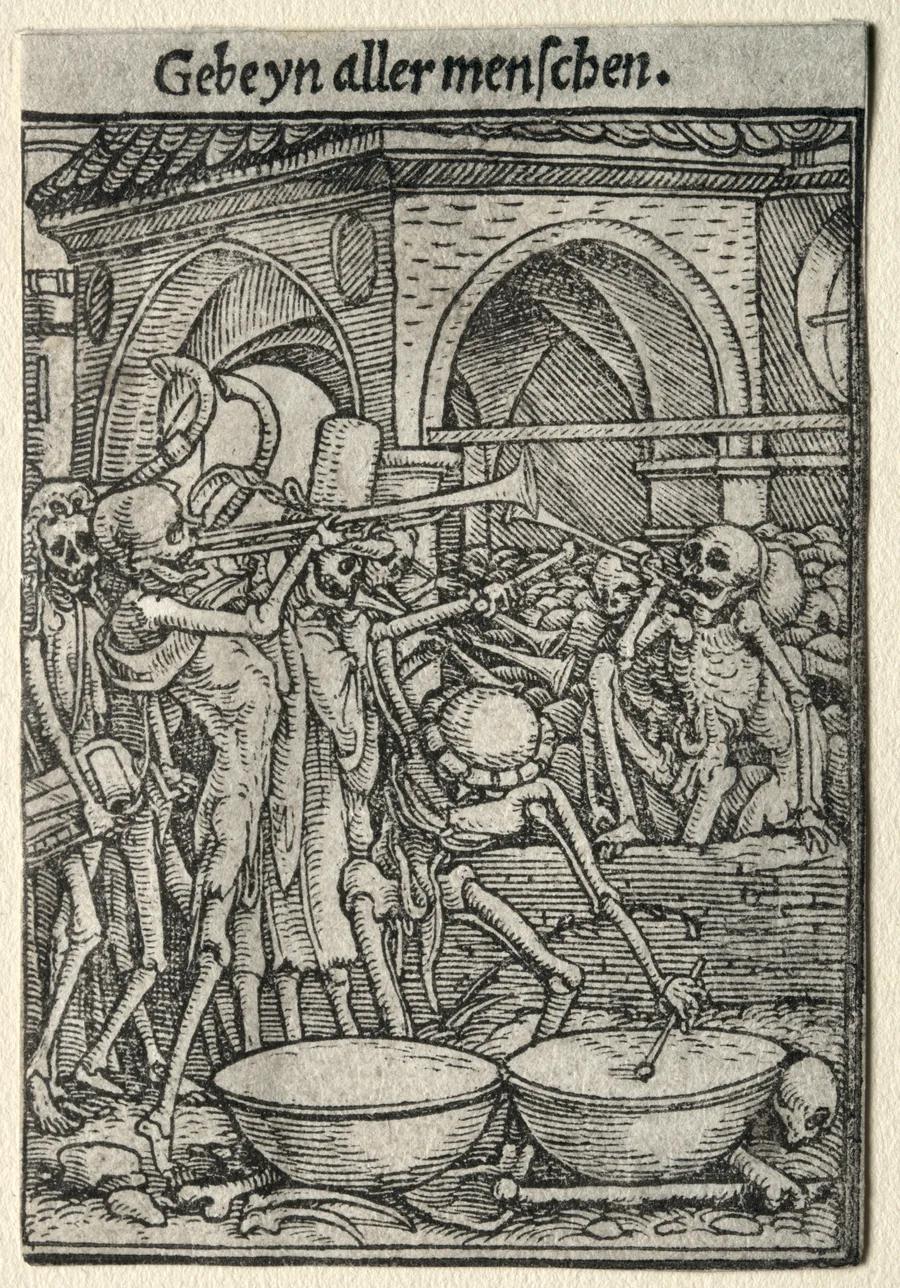
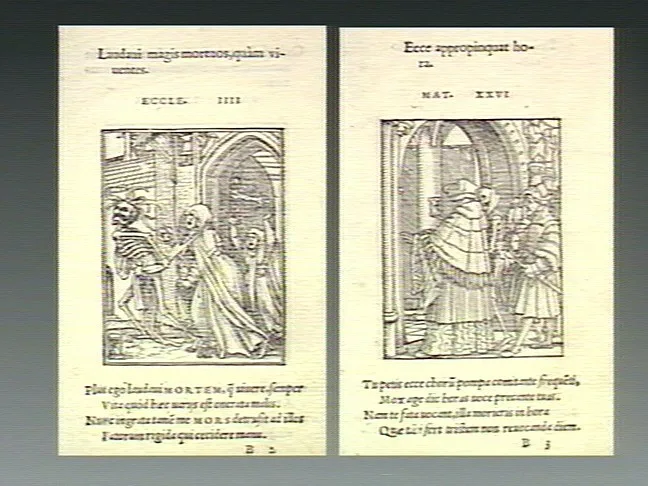
The precious suite of wood engravings, published for the first time in 1538 under the title Les Simulacres de la Mort (The Images of Death), has long been a delight for iconophiles. Issued in Lyon by the brothers Melchior and Gaspard Trechsel with a text in French quatrains, ten editions were printed from the original blocks over the span of twenty-four years. The work is celebrated not only for the originality and satirical spirit of its compositions, in which the genius of Holbein has been unanimously recognized, but also for its marvelous execution, which secures it the foremost rank among the masterpieces of xylography.
The artist's intention is rendered with such complete understanding, and the cutting shows such fine gradations corresponding so perfectly to the demands of the drawing and perspective, that we seem to be looking at the inventor's own line, without the intervention of another's hand.
Faced with this perfection, skilled connoisseurs have not hesitated to attribute both the design and the engraving of the plates to Holbein himself. The Baron von Rumohr, an authority on art in his time, wrote an entire book in support of this opinion.1 There is, however, one detail whose significance this scholar tried in vain to deny. In the engraving that shows Death seizing the Duchess, one can see the monogram "HL" carved into the center of a shield on the base of the bed.
These initials correspond to a name printed as a signature on two copies of the Alphabet of Death, a series of twenty-four subjects analogous to the Simulacres but in a much smaller format, serving as backgrounds for the twenty-four letters of the alphabet. Holbein is again the undisputed creator of the designs. As for the engraver, who achieved the nec plus ultra of finesse in cutting these xylographic miniatures, he took care to reveal his name at the bottom of the four rows of letters: Hanns Lützelburger, formschnider, genant Franck (Hans Lützelburger, wood engraver, known as Franck).
The Signature of the Master
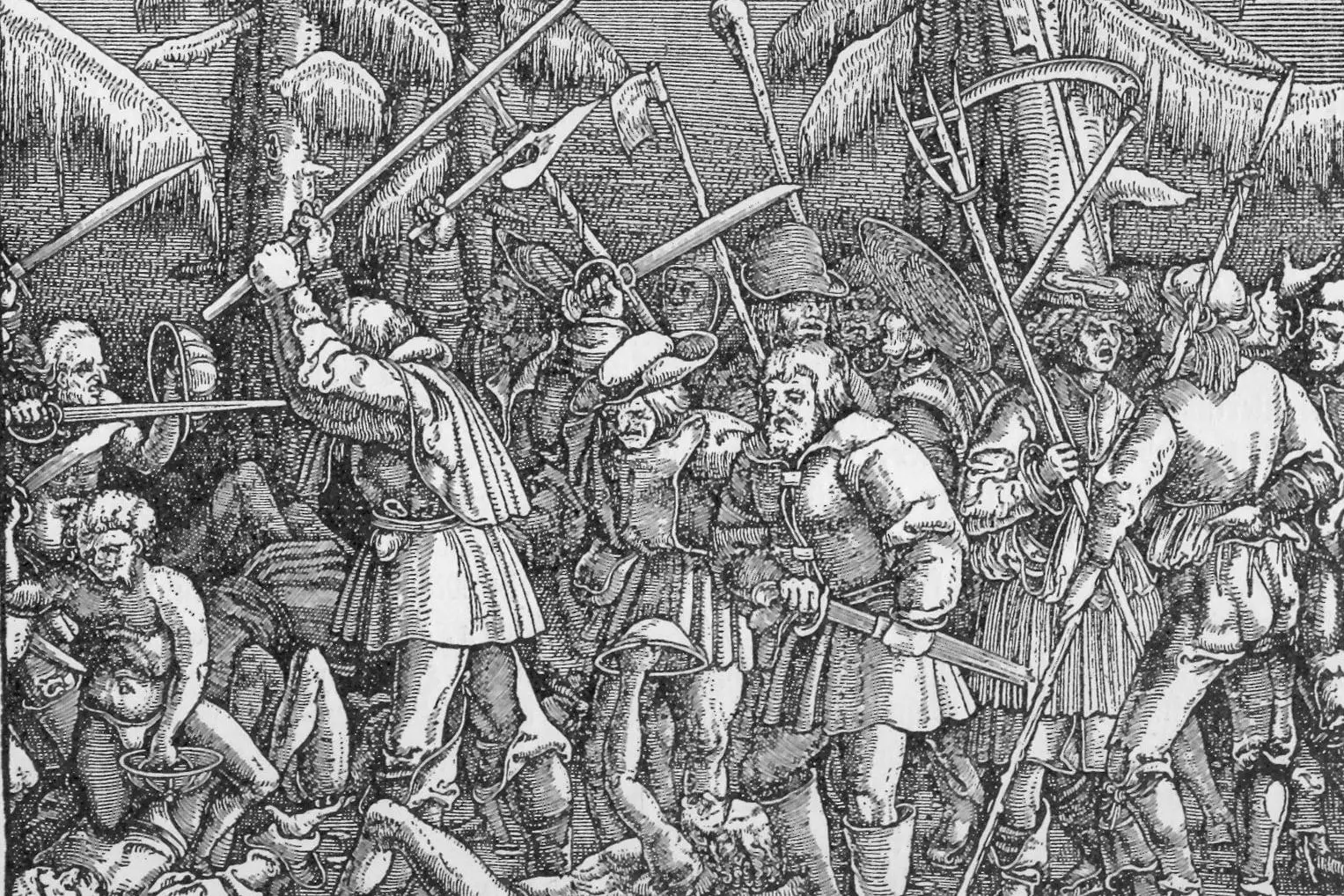
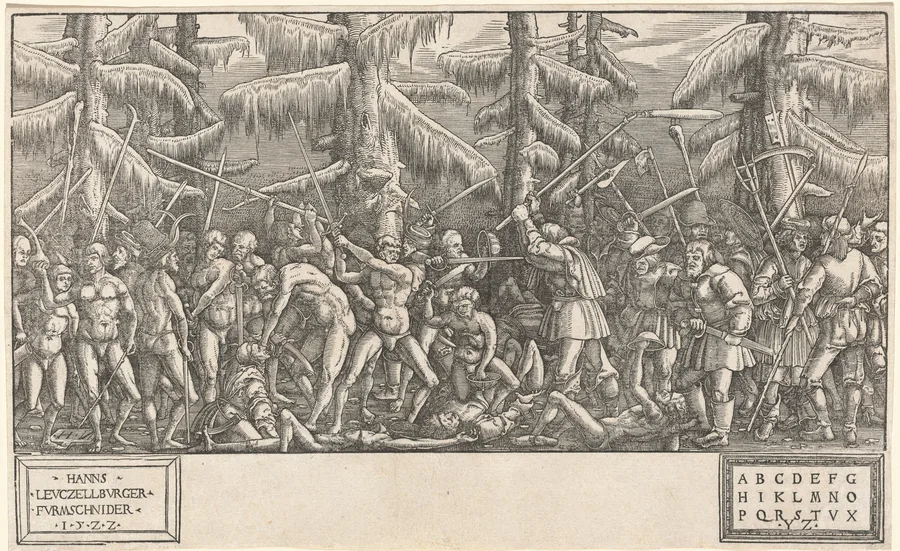
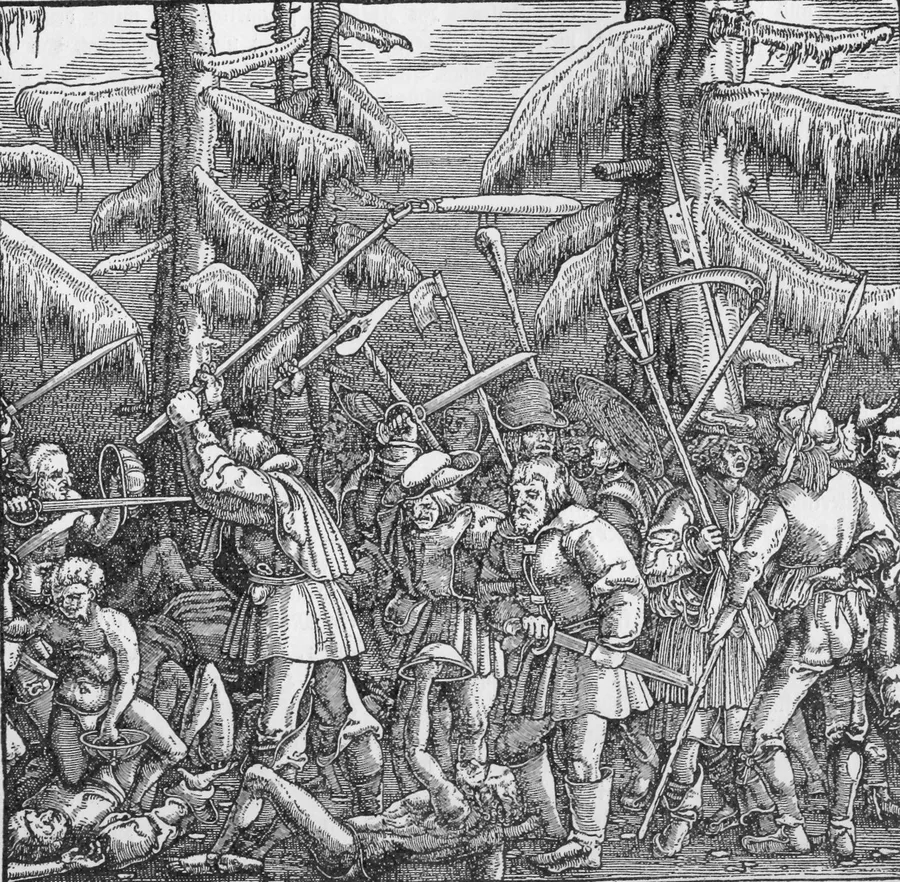
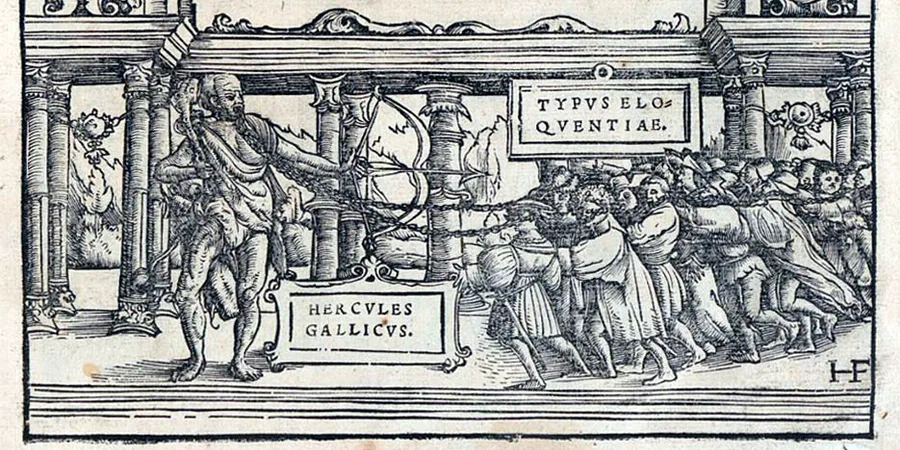
The same name, with a slight difference in spelling and without the surname, appears at the bottom of a rather curious wood engraving. This print, whose execution is no less masterful than that of the Simulacres, depicts a battle between nude men and peasants in a pine forest.2 The drawing bears no resemblance to Holbein's style and seems rather to belong to an emulator of Dürer. The monogram "HN," doubtless indicating the painter, is on a tablet to the left of the print. In the bottom margin, one can read: "HANNS LEUCZELLBURGER FURMSCHNIDER 1.5.2.2."
Furthermore, the mark "H.L.FVR." appears on the historiated title page of a New Testament printed in 1523 by Thomas Wolff in Basel. This wood engraving, admirably executed from a design by Holbein, is composed of four subjects drawn from the Gospels and the Acts of the Apostles.3 The mark certainly signifies none other than the same name: Hans Lützelburger, furmschnider.
This concordance between the name Lützelburger—found on several woodcuts of a perfection and delicacy unprecedented at the time—and the "HL" monogram on the Duchess's bed in the Simulacres de la Mort has led the principal historians of engraving to address the matter. Scholars such as Christian von Mechel, Langlois, P. Visscher, Brulliot, Passavant, A.-Firmin Didot, and Woltmann have attributed not only this precious series to the skilled engraver but also a number of other woodcuts after Holbein that approach this masterpiece in quality.
This opinion has not been shaken either by the ill-founded arguments of Rumohr or by the attempts of Hegner, Holbein's biographer, to strip the poor Lützelburger of his credit and bestow it upon his hero. Nor should one be discouraged by the fruitless searches for this name in birth and death registers, a problem already mentioned by Karel van Mander in his Schilder-Boeck (1618 edition) and later confirmed by Christian von Mechel and Hegner. It is important to know that in Basel, the oldest baptismal registers do not predate 1529, and the death registers were not regularly established until the 18th century.
An Archival Breakthrough in Basel
During the course of my investigations in the Basel council archives, which I undertook in 1865 and 1866 to gather materials for Woltmann's work Holbein und seine Zeit (Holbein and His Time), I redoubled my efforts to find the name Lützelburger. While I noted a Michael and a Jacques Lützelburger mentioned as fathers in the baptismal registers in 1531, the name Hans was absolutely nowhere to be found. I was no more successful during my recent research in the court archives. But if the engraver's name once again eluded me, I had the satisfaction of discovering a document that establishes the man's identity irrefutably and, moreover, provides the solution to the problem that had so long divided scholars.
This interesting document is found in a book titled Vergichtbuch, used for the registration of debts secured by mortgage or surety, under the date of the eve of Saint John the Baptist's Day, 1526 (June 23). Here is a literal translation:
"Melchior Trechsel of Lyon has furnished and presented as surety Jean-Luc Iselin on account of the plates received from the estate of the late master..... wood engraver, so that if anyone should raise a claim concerning these plates, the aforesaid surety may answer for it and give an account before this jurisdiction, which both parties, namely Jean-Luc Iselin, by virtue of the oath sworn to my Lords to be surety, as is written above, and Melchior Trechsel, by virtue of the oath sworn to his superiors to indemnify the guarantor, have sworn and promised to my Lord the bailiff."
While the name that concerns us was omitted through the clerk's negligence, another document has preserved the first name. It is found in a file bearing the following title: "Sequestration of immovable property for rents due and unpaid, debts and poor maintenance, and of immovable property belonging to fugitives, seizures made on the assets of others, sequestrations and attachments on the property of fugitives and persons deceased without heirs."
In this book, the entries are not dated; at most, the change of years is indicated by the year number. Among the entries for the year 1526, we read:
"On the movable property of Hans Formschnider: [The following creditors place a lien.]"
- "André de Yer for 1 lb 3 s, for wine."
- "Hans Brasel for 1 lb 10 s, for rent."
- "Jacob, the grocer of Basel, for 4 lb 14 s."
- "Melchior Trechsel of Lyon, for 17 lb 15 s, in cash, for a debt."
- "Master Hans zum Sessel4 for 3 lb 10 s."
- "Adam Stump for 10 s 10 d, for shoes."
- "Wentz Purenkind, armorer, for 19 s 1 d, plus 9 s."
- "Nicolas Vissler, cloth merchant, 4 lb 10 s 10 d."
- "Hans Wat In Schnee, 16 s 8 d."
- "Emerich the surgeon, 15 s."
- "Master Mathieu, 8 lb 4 s."
From these two documents from 1526, we learn that a wood engraver (Formschnider) named Hans, who died in Basel around that time, had received advances from Melchior Trechsel of Lyon (the first publisher of the Simulacres de la Mort) for certain plates he had undertaken to engrave for him. Upon learning of Hans's death, Trechsel had the plates claimed. They were handed over to him on the condition that a solvent person from Basel would act as surety, in case another creditor asserted a more valid claim.
The Testimony of the First Edition
This coincidence, however, is not the only indication of the identity of this engraver Hans with Hans Lützelburger. The agreement of the two documents in mentioning the engraver as deceased clarifies the following passage, found in the preface to the first edition of the Simulacres, the meaning of which had until now been sought in vain. The author of this preface, whom we know to be Jean de Vauzelle, prior of Montrottier, wrote:
So, returning to our figured faces of death, greatly to be lamented is the death of him who has here imagined for us such elegant figures, surpassing all those patterned heretofore as much as the paintings of Apelles or Zeuxis surpass the moderns. For these funereal stories, with their severely rhymed descriptions, give such admiration to the beholders that they judge the dead to appear therein most livingly, and the living most deathly represented. Which makes me think that Death, fearing that this excellent painter might paint her so vividly that she would no longer be feared as Death, and that for this he himself might become immortal, for this reason so hastened his days that he could not complete several other figures already drawn by him: namely that of the carter, crushed and broken-shouldered beneath his ruined chariot.
The wheels and horses of which are there so frightfully fallen, that there is as much horror in seeing their precipitation as there is grace in contemplating the delicacy of a Death, who furtively sips with a straw the wine from the stove-in barrel. To which imperfect stories, as to the inimitable celestial arc called Iris, no one has dared to apply the final hand, because of the audacious lines, perspectives, and shadows comprised in this masterpiece...
It is evident that the author of this preface, by "the artist whose premature death he laments," means the one who executed these "figured faces of death" in engraving. The passage where he speaks of the "imperfect stories, to which no one has dared to apply the final hand," leaves no doubt on this subject. But it is also certain that he conflated the engraver and the author of the designs into a single person, speaking of him as an "excellent painter" and stating this idea even more clearly with the words "that he could not complete several other figures already drawn by him."
Since Holbein, the undisputed author of these marvelous compositions, was still alive at the time of their first publication, this passage certainly cannot allude to him. It even proves that not only Vauzelle but the Trechsels themselves were unaware of the true author of the drawings. It shows that no direct relationship existed between Holbein and the publishers of his work, but rather between the publishers and Hans Lützelburger. We must conclude that this excellent engraver did not work for Holbein, but that Holbein, on the contrary, worked for Lützelburger, just as he also supplied designs to glass painters, goldsmiths, and other secondary artists.
Establishing a Timeline
Nevertheless, it is surprising that Trechsel, who had the plates in 1526, let twelve years pass before making use of them. Perhaps the reason lies in the futility of his efforts to find an engraver skilled enough to cut the already-traced blocks on par with Lützelburger.5 It is also possible that the era did not seem favorable for the publication of a satirical book that spared the clergy no more than the laity.
A circumstance to which Woltmann drew attention establishes that the Simulacres already existed as engravings before 1527.6 The Royal Cabinet of Prints and Drawings in Berlin possesses pen-and-wash copies of twenty-three of these compositions. In the one representing Death seizing the Emperor, the year 1527 is visible above the emperor's throne. This is undoubtedly the date of the copies and not of the original drawings, for it is known that Holbein was in England that year. These copies, which are considerably larger and have a rounded format, could only have been made from proofs of the engravings.
If the copyist had used the original drawings as models—which would necessarily have been in reverse of the prints—he would have undoubtedly copied them in the same orientation, which was not done.
Furthermore, we are justified in assuming that the monogram "HL" seen in the engraving on the Duchess's bed was added by the engraver, whose name it indicates. The copyist, by reproducing it in his copy, has provided us with new proof that he had the engravings, and not the drawings, before his eyes.
The absence of Hans Lützelburger's name from the Basel archives will no longer surprise us if we keep in mind the short duration of his stay in that city, where he probably did not arrive before 1522. The Combat in the Forest, which we cited as bearing his name and that date, appears to have been executed in Augsburg, as the copy in the Dresden Cabinet of Prints contains German verses printed at the bottom whose spelling indicates the pronunciation peculiar to that city:7
Ain Insel haisst Utopion
Die leyt nit ferr von Morion
Da geschah ain sollichs schlagen, etc.
This manner of pronunciation and writing was not customary in Basel.
It remains for us to refute the conjecture put forth by Passavant, Nagler, and others, according to which Hans Lützelburger—who, as we have seen, took the surname Franck in the Alphabet of Death—might be identical with the painter Hans Franck, whose name appears in 1515 on the roll of the painters' guild in Basel. According to the council's expense ledger, this good man was sometimes employed to paint or whitewash public buildings. One must agree, however, that whoever handled the engraver's knife with the delicacy and feeling for drawing that characterize Lützelburger's works could not have pursued that art alongside such an ordinary trade; he must have been an engraver in body and soul.
Nothing is more suited to overthrow this conjecture than a deed, preserved in the court archives, which establishes that the death of the painter Hans Franck occurred before April 1, 1522. This date precedes the period when Lützelburger, if he was already living in Basel, was only at the beginning of his remarkable activity.
ÉDOUARD HIS.