
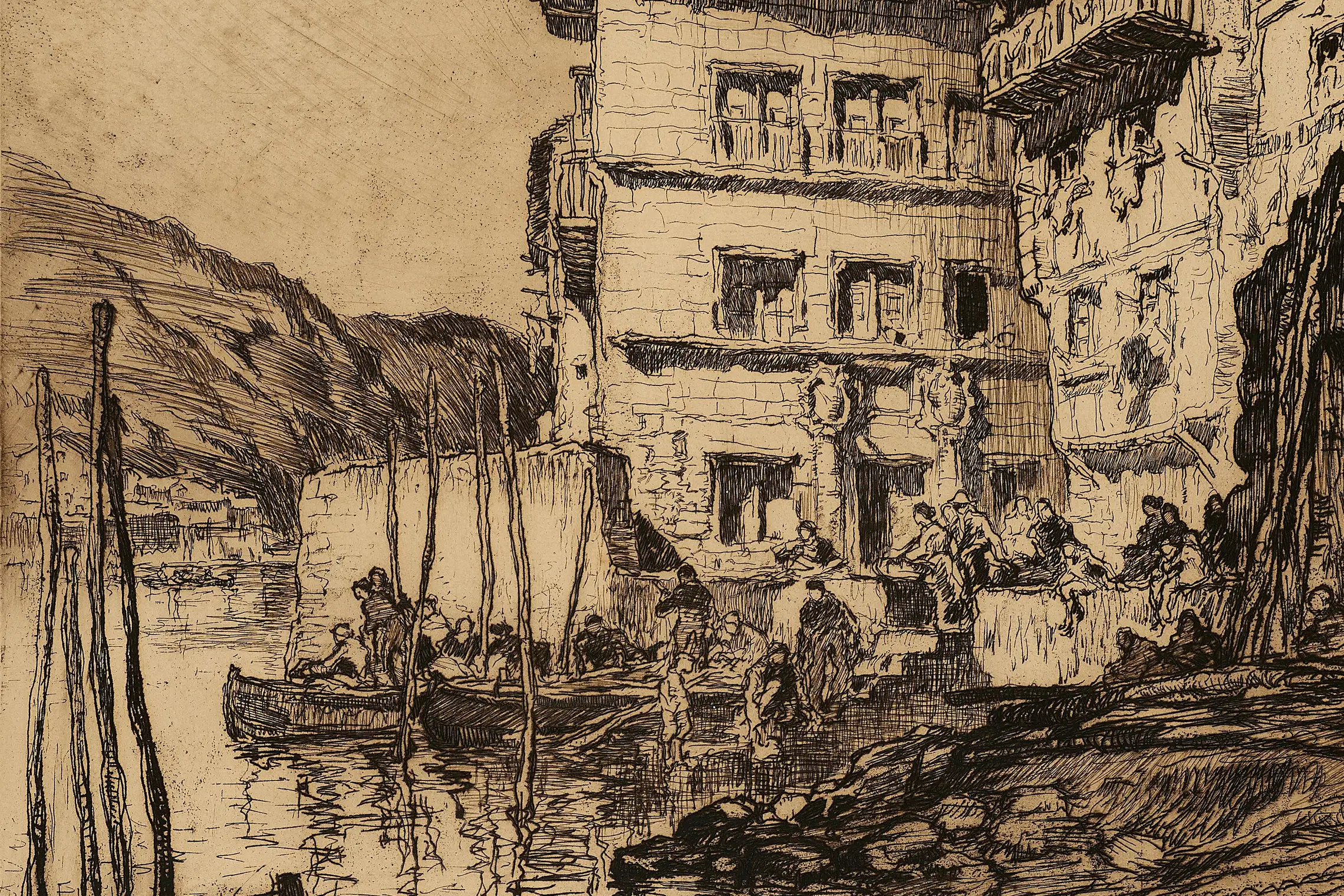
It is a widely held opinion that black-and-white etching holds little interest for the French public. It is certainly true that, at present, dealers hardly bother to show buyers anything other than color prints of rather vain pretension, often sold in pairs, whose mass production is much more a matter of industry or commerce than of art. Are we truly incapable of appreciating the charm of "black and white," as our neighbors across the Channel do? Is this indifference not due, rather, to the fact that most of the etchings offered to us lack the great qualities that always allow a work to assert itself: a decorative sense and human interest?
This is precisely what strikes us at first glance in the etchings of Mr. Gobô, and what gives them their very particular value.
Early Life and Self-Taught Artistry
Georges Gobô was born on June 18, 1876, to French parents in San Francisco and came to France as a young child. Around the age of seventeen, he began to learn the art of lithography from a printer. The routine commercial work to which life's necessities constrained him, while giving him precious manual dexterity, did not satisfy his burgeoning artistic temperament. The young man therefore passionately devoted himself to drawing, but he did so freely, without any master. With the greatest sincerity and a tenacious will, he sought simply to translate his vision of things and people.
He painted in oil, washed watercolors, and above all, practiced relentlessly the rapid, life-like sketches that he would later use to such great effect. He wanted drawing to become as easy and swift for him as unadorned handwriting, and little by little, he succeeded. From these early years, we will mention only for the record, and especially as a point of comparison, his illustration for an article on picturesque Chinon in Le Monde moderne (April 1901). What a journey he has traveled between the drawing of the Cave peinte (Painted Cave) there and the one he etched in 1914.
At that time, Mr. Gobô lived in Angers, whose old quarters captivated him with the picturesqueness of their winding streets lined with highly decorative 15th-century wooden houses. He delighted in these populous corners, teeming with types whose features were well-characterized. It was there that he found his models, whom he was careful, moreover, not to ask to pose. He would sketch them in a few seconds, abandoning all superfluous detail to retain only the necessary features. This is how he managed to create a style all his own, a very personal script.
From his sketchbooks of that period, Mr. Gobô possesses all the necessary elements to remarkably illustrate a future book on old Angers. Such a project was conceived a few years ago, then abandoned; one can only hope to see it take shape.
First Forays into Etching
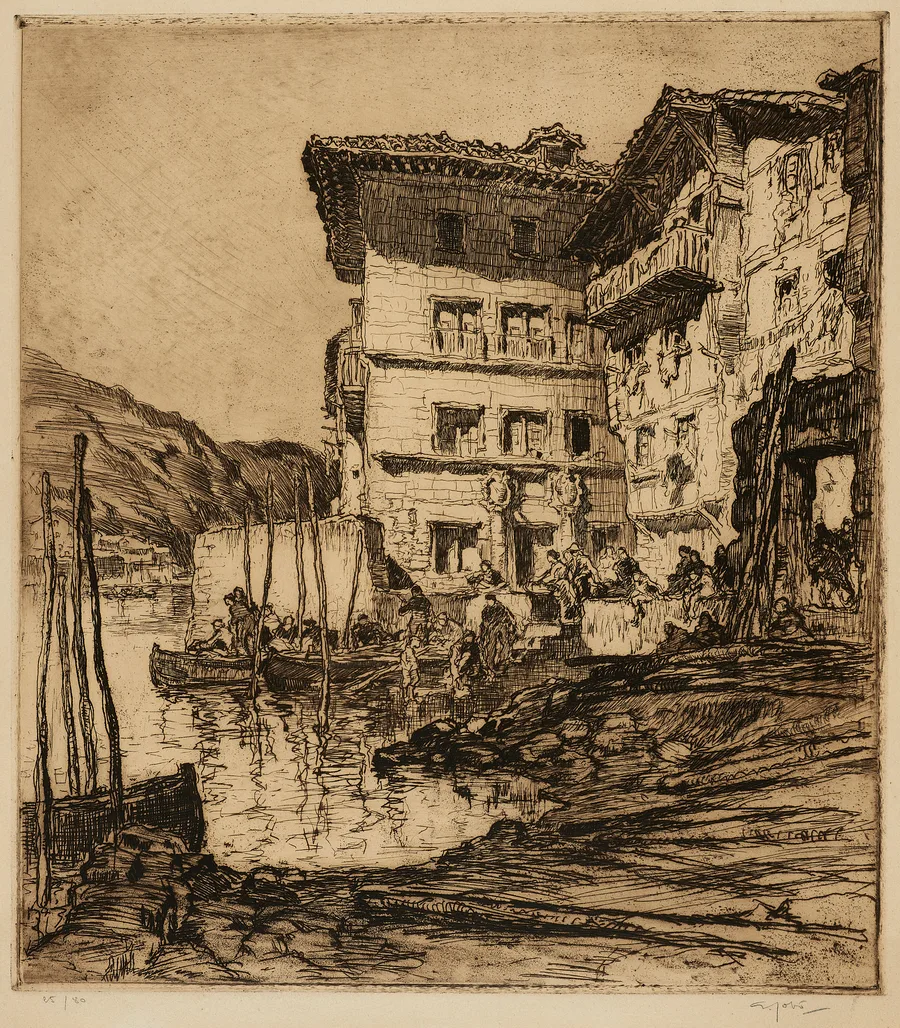
Since 1901, Mr. Gobô had been participating in the local exhibitions of the Société des Amis des Arts, showing drawings, lithographs, watercolors, pastels, and oil paintings. It was not until 1907 or 1908 that he attempted his first forays into etching. He made a ball of varnish according to the old recipe of Abraham Bosse, coated a piece of zinc guttering with it, and drew boldly on his plate. He had received no lessons; he had confidence in himself, and he was right to do so.
His practice of lithography was of some help; furthermore, he had long looked at and admired the prints of Rembrandt and Piranesi, his only masters. With almost no hesitation, he achieved excellent results from his very first etchings, which allowed him to exhibit Maisons à Port Thibault (Houses at Port Thibault) and Barques aux Sables (Boats at Les Sables) at the Salon de la Nationale in 1908. His Vieilles maisons au Tertre à Angers (Old Houses on the Tertre in Angers) also dates from the same year, exhibited at the "Amis des Arts" of 1908 along with a Pécheur breton (Breton Fisherman).
In essence, it was the pursuit of the picturesque, in a decorative sense, that tempted him most at that time. He was already choosing fairly large plates, and he was much happier to see them framed than to know they were buried in respectable portfolios.
His first etchings having been met with critical acclaim, in the original sense of the term, Mr. Gobô worked tenaciously at this process, which suited him marvelously, for in it he could freely develop his qualities as a draftsman. He also formed a personal conception of etching that he would never abandon. For him, it was merely one means of expression among others he practiced, to be used according to the situation. He in no way considered the perfection of a technique, whose secrets he would eventually master, as an end in itself; his ambition went further. He realized that etching, long confined to being merely a process for reproducing a drawing in large numbers, also offered a particular attraction more suited to seducing a painter: the possibility of obtaining, through the quality of the blacks, a wider range of values than that of pencil or charcoal, and consequently, of giving a much better impression of color.
Rapid Development and Recognition
As early as 1908, Mr. Gobô became a founding member of the Société de la gravure originale en noir (Society of Original Black-and-White Engraving) and took part in its annual exhibitions. The following year, he returned to the Salon de la Nationale with La Rue Lionnaise à Angers (Lionnaise Street in Angers), a work in which his qualities were powerfully affirmed. The state acquired it for the Musée du Luxembourg. His progress had been swift and significant. From then on, he was recognized as an artist of generous and personal temperament; he now possessed a vigorous style that would only become more assertive and expansive in the following years.
Also in 1909, he exhibited color prints at the Société de la gravure en couleurs, held at the Georges Petit galleries, with pieces such as Vieux pont de Segré (Old Bridge of Segré) and La Galette de blé noir (The Buckwheat Pancake). However, he subsequently abandoned this process, which he judged inferior to the simple line and which did not allow enough freedom for his draftsman's ardor. While agreeing with Mr. Gobô's assessment and believing he acted very wisely, we wish to note in passing the undeniable merits of La Galette de blé noir. In it, a Breton peasant woman is bent before the hearth, cooking her pancakes on a bright fire that illuminates her with vigorous reflections.
This etching was prepared from a study painted from life in Brittany, where the artist began to make trips during which he amassed documents and sketches.
From 1910, let us also mention Le Marché place Grégoire Bordillon (The Market on Grégoire Bordillon Square), prepared from a pastel drenched in sunlight, which also clearly shows Mr. Gobô's desire to no longer limit himself to the purely picturesque character of things, but to render with intensity the impression of life and movement.
A New Focus on Life and Movement
From this point forward, this preoccupation would take center stage for him, as his subsequent works would testify. Before following him further, we will also cite Clair de lune à Rablay (Moonlight at Rablay), La Mansarde (The Attic Room), La Rue de la Poissonnerie à Saint-Malo (Fish Market Street in Saint-Malo), and Le Marché de la place des Halles à Angers (The Market on the Halles Square in Angers). But we are eager to arrive at a new series of plates, prepared by trips the artist made in 1911 to Belgium and Holland.
He did not abandon Brittany, which he loved so much and from which he brought back Sardiniers (Sardine Boats) and La Charrette de goémon (The Seaweed Cart), exhibited at the 1911 Salon de la Nationale. These were broader, firmer studies than his previous ones. But from Bruges, Rotterdam, and Antwerp, he returned with a wealth of canvases, studies, and superb sketches that allowed him to engrave such masterful plates as Le Port de Rotterdam (The Port of Rotterdam), shown at the 1912 Salon de la Nationale, and especially La Grande Brasserie à Bruges (The Large Brewery in Bruges), at the same salon, and Le Déchargement à Anvers (Unloading in Antwerp).1
Here, Mr. Gobô began to use his largest formats—La Grande Brasserie measures 0.46 by 0.54 meters—and, very much at ease, his line became even freer and more vigorous. He bit his zinc plate quite deeply to obtain, in certain parts, true impastos of ink that give the range of values the maximum possible extension. While a decorative sentiment still dominated Mr. Gobô's work, there was now a more apparent will to render movement and life. He would achieve this more completely the following year, when he took full possession of his abilities.
Mastery and Mature Works
Mr. Gobô had, in fact, left Angers in 1911 and given up his commercial work. Aided by fortunate circumstances, he was able to gain his freedom and devote himself completely to his art. Now settled in Paris, he traveled every year. Brittany always drew him back, and from there he brought plates such as Le Dépeçage du porc (The Butchering of the Pig). In this piece, one hardly knows what to admire more: the truth of the observation or the execution of the etching itself, with the figures standing out in the light against the foreground of a cellar, where the chiaroscuro of the background hints at people seated at a table.
It was also in Brittany that he drew his Thoniers à Douarnenez (Tuna Boats at Douarnenez), shown at the 1914 Salon de la Nationale and acquired by the State for the Luxembourg; his Moulin de Rothéneuf (Rothéneuf Windmill), reproduced here; his Vieille maison à Dol (Old House in Dol); and his Mont Saint-Michel (also in the Luxembourg). Apart from a few etched sketches like Les Mendiants (The Beggars) and Les Chanteurs (The Singers), Mr. Gobô now rarely undertook anything but vast plates, on which he literally painted with the needle on the metal.
From the same period date L'Ardoisière (The Slate Quarry Worker), a souvenir of Anjou, which he did not forget, and Le Tisserand (The Weaver), which was another step forward in the expression of true movement and which would soon allow him to create Les Tanneurs (The Tanners). In this chronological essay, I do not want to go further without mentioning a drypoint trial, printed in only a few copies: La Danseuse (The Dancer). A nude young woman, her torso forward, throws the veil that covered her behind her. It is a simple linear sketch, with no pretense of modeling, in which Mr. Gobô sought to capture a charming gesture on the fly.
He worked on the nude primarily to give his drawing the desired firmness and confidence. La Femme au manteau (The Woman in the Cloak), an etching, is another solid academic study.
This was, however, merely a diversion from his major works, which were revealed to us in various exhibitions in 1914. At the Salon de la Nationale, we find, along with the aforementioned Thoniers, Le Grand Carroi à Chinon (in the Luxembourg) and La Procession à Saint-Guénolé (The Procession at Saint-Guénolé).2 At the Société des Peintres-graveurs français, he showed Les Tanneurs. These plates must be considered alongside La Cave peinte à Chinon (The Painted Cave in Chinon), Le Rialto à Venise (The Rialto in Venice), and Le Marché aux Herbes à Vérone (The Herb Market in Verona), which is in the Luxembourg.
Together, they summarize the artist's finest qualities.
In Le Grand Carroi, Le Rialto, and Le Moulin de Rothéneuf, Mr. Gobô indulged his love of the picturesque and his preference for architecture that asserts its full importance as a dominant mass in relation to man. In La Procession and Le Marché aux Herbes, his goal was to render the impression of a crowd coming and going in dense, surging waves. He achieved a surprising result with a kind of impressionism of line, which, incidentally, he did not invent, as it can be found in Rembrandt. Les Tanneurs is simply a study of movement reduced to three workers in a small, low-ceilinged room with a floor streaming with water; it is, we believe, one of the artist's most powerful etchings.
The Method of Capturing Movement
It is important, in this regard, to understand how Mr. Gobô works and achieves these results. He starts from the principle that movement cannot be posed; a posed gesture is nothing but a frozen attitude. The impression of movement, it seems to him, can only result from an interpretation, for which one needs a very practiced eye and a hand capable of silhouetting moving masses in rapid strokes.
Look, for example, at his Procession, his Ouvriers tuiliers (Tile Workers), his Barque tirée au rivage (Boat Pulled Ashore), and also his landscape study, L'Église de La Rochefoucauld (The Church of La Rochefoucauld), treated with the same boldness. It is with documents of this kind, with these sketches captured in just a few minutes, that Mr. Gobô executes his etchings. He transcribes them onto the metal, striving to preserve the freshness of impression that is their charm. It is understandable that, under these conditions, he does not seek to fuss over details or overwork his drawing.
There is neither weakness nor looseness on his part; on the contrary, he constructs solidly, but his construction remains in a raw state. Mr. Gobô's etchings are therefore, above all, sketches, but sketches to which the art of the painter-engraver adds a further layer of interest: there is, indeed, a whole play of resources to suggest color in this extended range of values, from pure white to the most intense black.
We left the artist in 1914. When the war came, he had to leave his studio and suspend his work. Since his demobilization, he has only been getting back into the swing of things, getting his hand back in, before undertaking new projects that will be finalized this winter. For the Gazette, he has kindly engraved specially the plate presented here as a supplement, Un Coin de marché à Venise (A Corner of a Market in Venice). In its reduced format, it recalls the composition and movement of his largest etchings, which one must see to properly appreciate the fine talent of Mr. Gobô.
M. VALOTAIRE