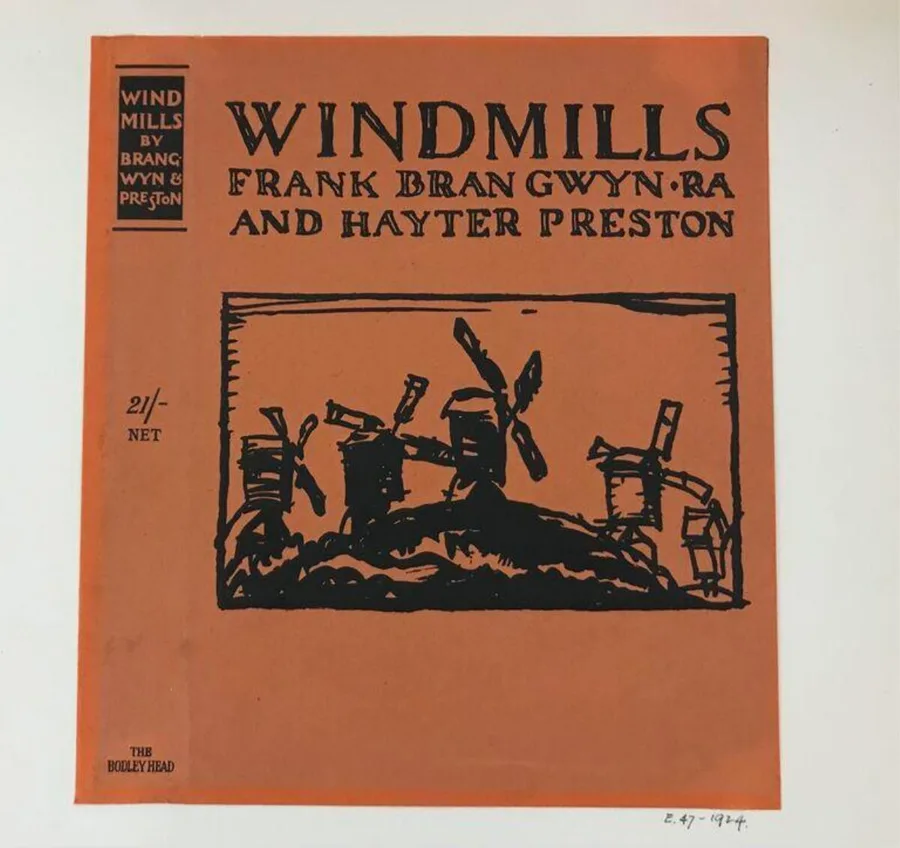

Frank Brangwyn began his career twenty-five years ago in The Graphic with maritime scenes. One of them, which accompanied a tale by Rudyard Kipling, recalled the style of The Buccaneers, the painting that gained notice at the Salon of 1893. These initial studies of sailors and ships were soon followed by other artistic explorations, and gradually, Frank Brangwyn built the complex body of work that everyone knows today. He periodically continued his work as an illustrator, and his decorative taste, once developed at the school of William Morris, guided him in this often-delicate task.
Planned before the war, the illustrated edition of Les Villes tentaculaires (The Tentacular Cities) allows us to appreciate a new effort made in this direction. But above all, one must praise the choice that governed the unity of the work. Too often, similar publications, undertaken for the pleasure of connoisseurs, hide a regrettable conflict between text and image beneath a showy cover. Have we not recently seen a volume of Baudelaire adorned with compositions by Georges Rochegrosse? Elsewhere, a concern for innovation masks a poor desire to be noticed, as Abel Hermant wittily denounced in connection with a recent fantasy by Blaise Cendrars.4
It is therefore not insignificant to encounter, amidst so much incoherence, a book that one can open without unpleasant surprise and understand without risking a headache. In this volume, the publisher, inspired by the French traditions we inherit from figures like Jombert and Laurent Prault, has skillfully provided the necessary pauses for the mind's relaxation and the eyes' rest.
A Fated Collaboration
In 1912, during an exhibition of Frank Brangwyn's work at the Durand-Ruel gallery, Emile Verhaeren discerned in this collection of etchings an epic vision very closely related to his own and an expressive power that immediately won him over. For the poet, it was an occasion to celebrate once more the force that creates or renews, for which he showed a natural inclination until his final hour. Encountering it by chance in the etcher's work, he wished for this unique interpreter for his Villes tentaculaires.
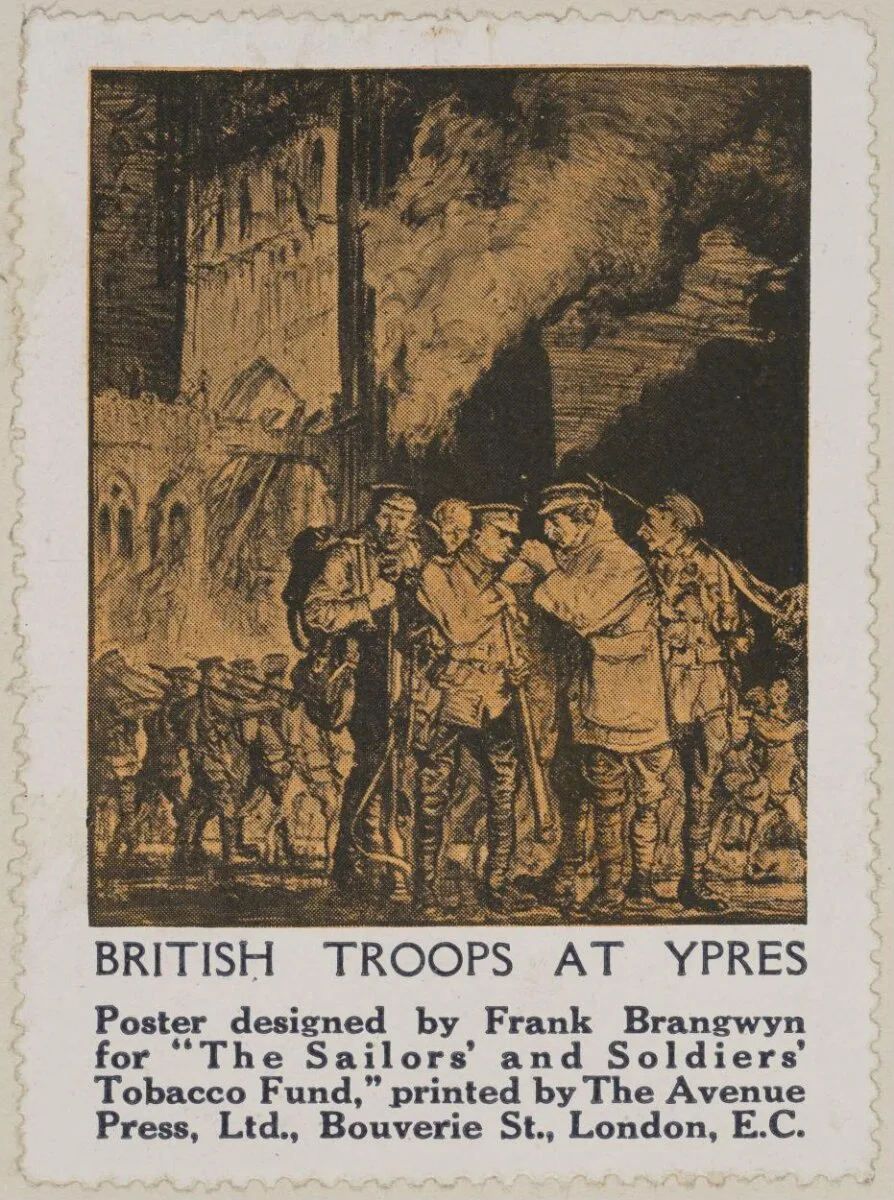
Brangwyn was familiar with Flanders. He was even born there, without, however, being of the "tenacious race" of which the poet was so proud. He lived in a great, fog-shrouded city, had traveled extensively, and his intellect inclined him to condense facts, dramatize sites, and exalt the musculature of the worker with sinuous, profound lines. High society did not interest him. All of this established important points of contact between him and Emile Verhaeren. It is worth recalling in this context that his printmaking was praised here by Roger Marx who, well-versed in these affinities, had noted that some of Verhaeren's titles seemed like "the lapidary definition" of Frank Brangwyn's work.5
This body of work, of which very fine pieces were recently seen at the Musée du Luxembourg, was constantly growing. A good carpenter and skilled builder, Brangwyn erected scaffolding, raised monuments, constructed bridges, and amassed an incredible quantity of materials and merchandise that represented collective life—its demands, its traffic, its appetites. He also set in motion compact crowds from which he would suddenly single out the archetypal individual in the street, the workshop, or the docks. With the same ardor and enthusiasm, he also demolished, giving the giant hull of the Duncan the pathetic accent proper to the essentially English character of the naval epic, defined with such mastery by Turner when he towed the Téméraire on an orange sea, and later by F.
Seymour Haden, who meticulously detailed every aspect of the Agamemnon.
The Architectonics of the Modern City
There is nothing more crushing and more unyielding than Frank Brangwyn's walls. They are citadels that prove the indisputable genius of man, while simultaneously making one forget his ephemeral nature. Their height is characteristic. One need only look in Les Villes tentaculaires at the portal of "The Cathedrals," the nave of "The Bazaar" and that of "The Spectacles," or the cyclopean foundations of "The Stock Exchange" to immediately think of certain buildings along the banks of the Thames. One can undoubtedly see equally gigantic structures in Brussels, Berlin, or Munich. But Brangwyn did not look at the South Kensington Museum in vain, and he seems to have drawn inspiration from the heavy, massive pillars of the Holborn Viaduct for the frontispiece of Les Villes.
What might he have conceived if he had been born on the other side of the Atlantic?
Large edifices have always attracted him. Previously, in his works on the devastated city of Messina, he magnified the ruins—not in the manner of a romantic, as has been too often written, but rather as if pursued by the monumental apparatus of Imperial Rome. It has been said time and again that Brangwyn worked after Piranesi. That does not explain this architectural quality, which slightly disrupts the laws of proportion. It belongs exclusively to him. The same cannot be said for the oblique lighting dear to the Primitives, nor for the radiant focal points of Rembrandtesque origin, already adopted by Rodolphe Bresdin.
Yet certain exaggerations have their own seduction; while dominating a Lilliputian humanity from such a height, a piece like "A Statue" becomes as accessible as a symmetrical image.
It is because Frank Brangwyn saw in cities their obsessive past, their feverish work, their unhealthy agglomeration, and their incessant agitation that he was able to follow Emile Verhaeren through his Villes tentaculaires—cities that exhaust some, crush others, and exert on all a formidable and profound magnetism. In the modern world, decentralization is almost a utopia. Struck throughout his life by this attractive force that drains energies, Verhaeren described—to the detriment of the particular harmonies of each city—the symbolic Capital. It appeared to him above all with its vices and iniquities, its miserable suburbs, and its soot-laden skies:
Its soul, in these haggard mornings,
Circulates in every atom
Of heavy vapor and scattered veils;
Its formidable and convulsed soul:
Its soul, where the past sketches out
With the clear present the still-clumsy future.
Verhaeren generalized the harsh existence of the urban common folk, which Frank Brangwyn was necessarily tasked with defining. And as the latter had before his eyes the capped men of Whitechapel, he drew them, along with prostitutes, drunkards, and groups reading the Evening News in front of public houses. These are scenes that might have astonished a dreamer like William Blake but which Thomas Rowlandson would not have disavowed. One is therefore in England without truly being there. For the illustration of poems with such a general scope, this persistent specificity could have been perilous.
Fortunately, it is only fleeting; the image for "The Port" recalls Flanders. But in the end, what does it matter? It is always the universe that Emile Verhaeren pitied, chastised, and loved as much a sociologist as a poet.
The Woodcuts: A New Expressive Mode
This collection, Les Villes, dates from 1895, the period when the poet, darkened by physical suffering, often contemplated death. It closes the painful cycle of Les Soirs (The Evenings), Les Débâcles (The Debacles), and Les Flambeaux noirs (The Black Torches), for which Odilon Redon had originally composed three frontispieces that succinctly revealed the essence of the assembled poems.
In the difficult task of illustrator for this part of Emile Verhaeren's work, Frank Brangwyn thus succeeds Odilon Redon. By creating his frontispiece on the lithographic stone, he seems to fortuitously align himself with the prestigious art of his predecessor. The etcher's line softens, and Brangwyn brings such great delicacy to his handling of the crayon or pen that in places he seems to barely graze the very fine grain of the stone. He thus gives an incomparable lightness to the half-tones and achieves a phosphorescence that is light itself.
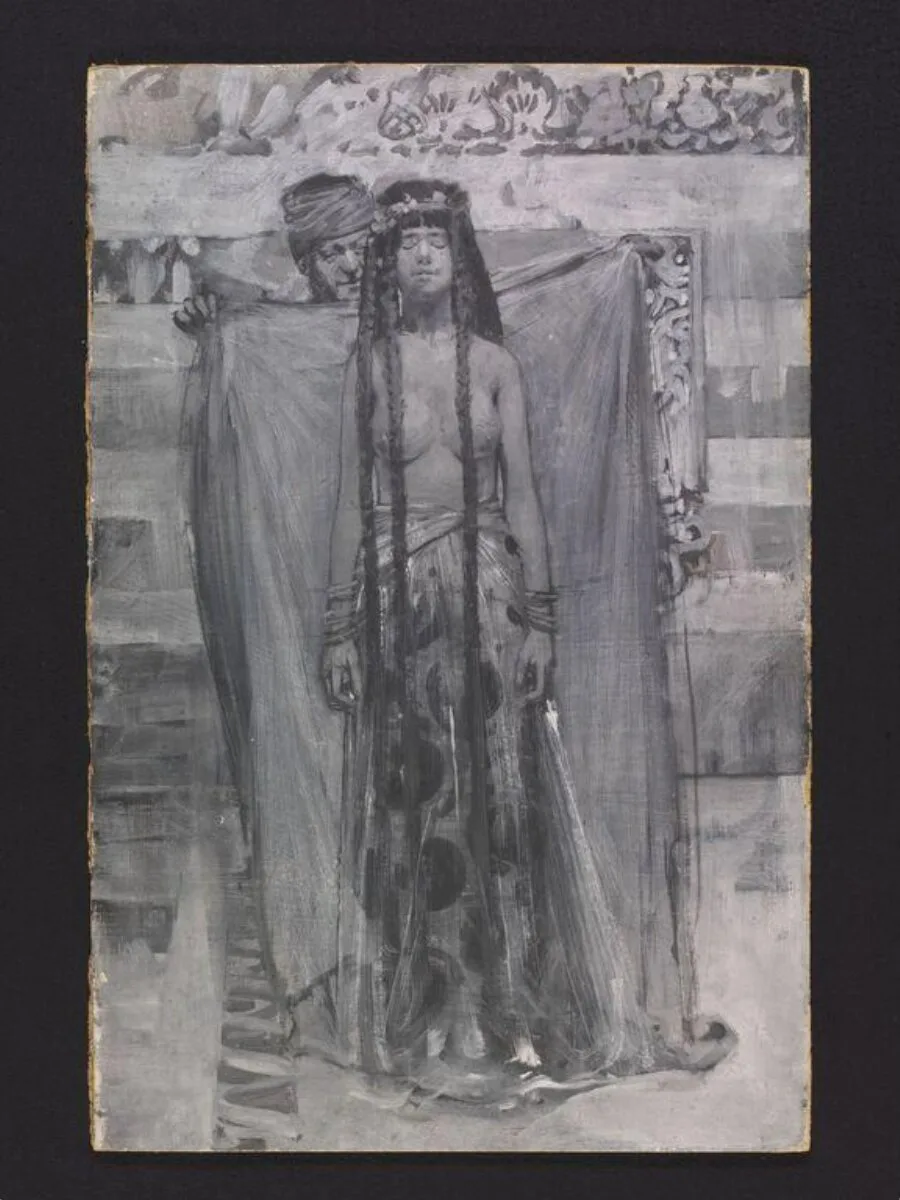
The fifty compositions that follow are woodcuts. Brangwyn has no single method; his techniques change from one plate to the next. This constant renewal is due to the medium, which is rather rarely used and which, by its novelty, inspires continual research. From what we know, it appears that Brangwyn stands very far from our French school; he cannot be affiliated with Auguste Lepère, P.-E. Colin, or even less with Emile Bernard. Instead of inciting the artist to deep, clean cuts, the wood has made him somewhat circumspect. It is with a kind of very curious and moving contemplation that he has captured the visions brought to life by Verhaeren's poetic and impassioned verse.
The factories and mills suggested superb blacks to him, while the "Promeneuses à falbalas" (Strolling Women in Frills) inspired a frieze of provocative and hieratic silhouettes. In "La Révolte" (The Revolt), there are terrible whirlpools where the weak must infallibly perish. "Le Port" (The Port) brings him back to motifs of yesteryear. But perhaps he showed the most sober and original art in celebrating a funeral mass, and elsewhere in drawing the vacant lots at the city's edge, or in finally giving "Les Idées" (Ideas) the appearance of smoke that the wind disperses at will, like the downy tufts of flowers.
These tufts carry a seed that sometimes falls on fertile ground. In this way, Emile Verhaeren's ideas touched, by analogy, the artist's sensibility, and the work was accomplished according to the immanent law to which all things obey.
JEANNE DOIN