
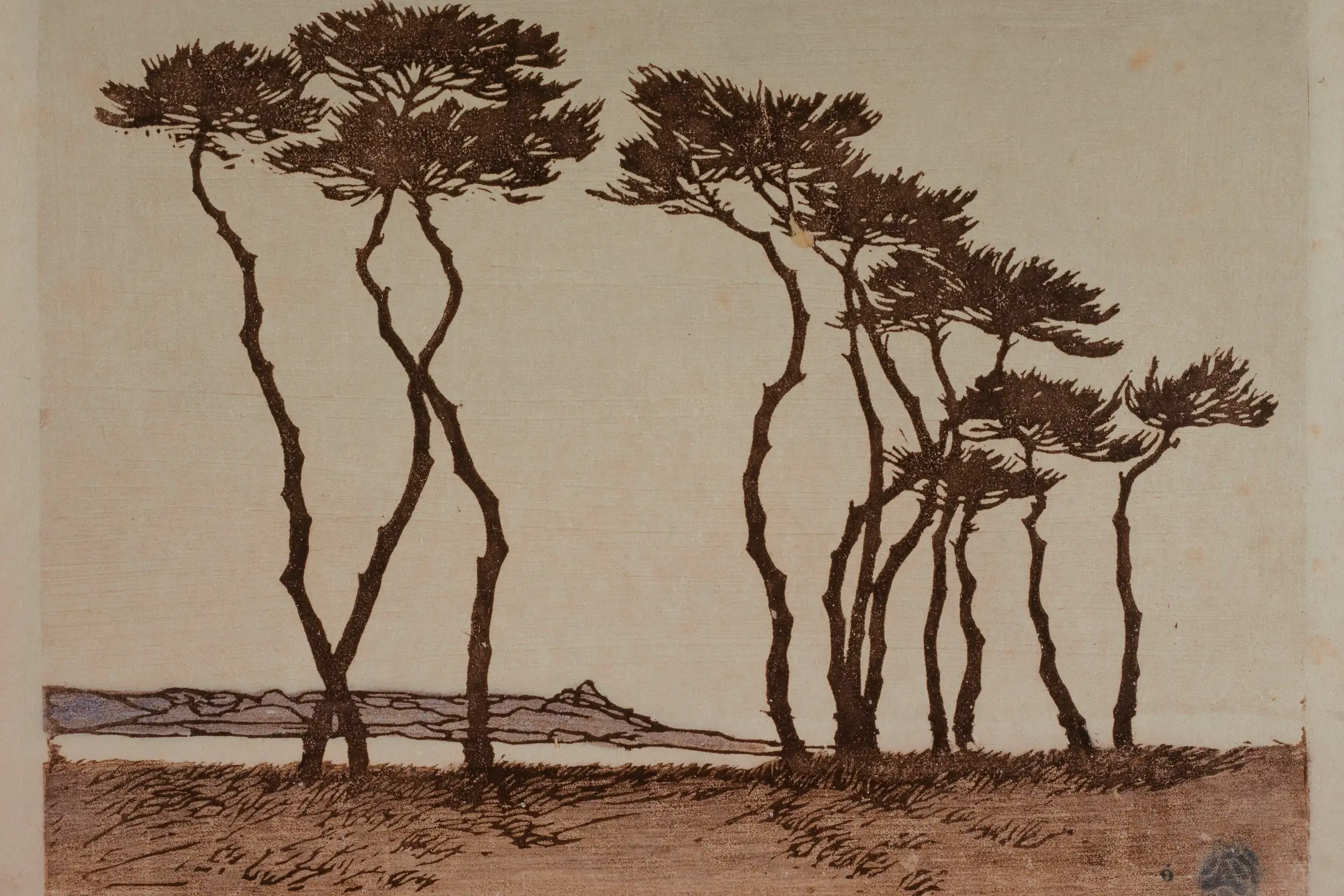
Arthur Jacquin, Wood Engraver
This title may, at first glance, seem strange. A wood engraver! Scarcely twenty years ago, wood engraving was still a prosperous art, yet it now seems almost extraordinary to meet one of its practitioners today. The name sounds to our ears like one of those ancient and antiquated trades, long since disappeared, which our grandmothers speak of with a certain mystery.
This past is still very near to us, however. It has been little more than twenty-five years since photogravure—with the speed, reliability, and economy of its labor—swiftly brought about the disappearance of the once-thriving guild of wood engravers. Yet it was they who, with patient, small cuts of the burin into boxwood blocks, engraved the images in the books that filled our childhood with wonder. Indeed, some of those publications have remained true artistic monuments.
But fashion turned. How could one compete with rapid, mechanical production? Art was undoubtedly harmed, and extensively so, but art is not the only consideration in the world of publishing. And so, wood engraving found itself gradually abandoned, until it almost completely vanished.
The Artistic Revival of a Medium
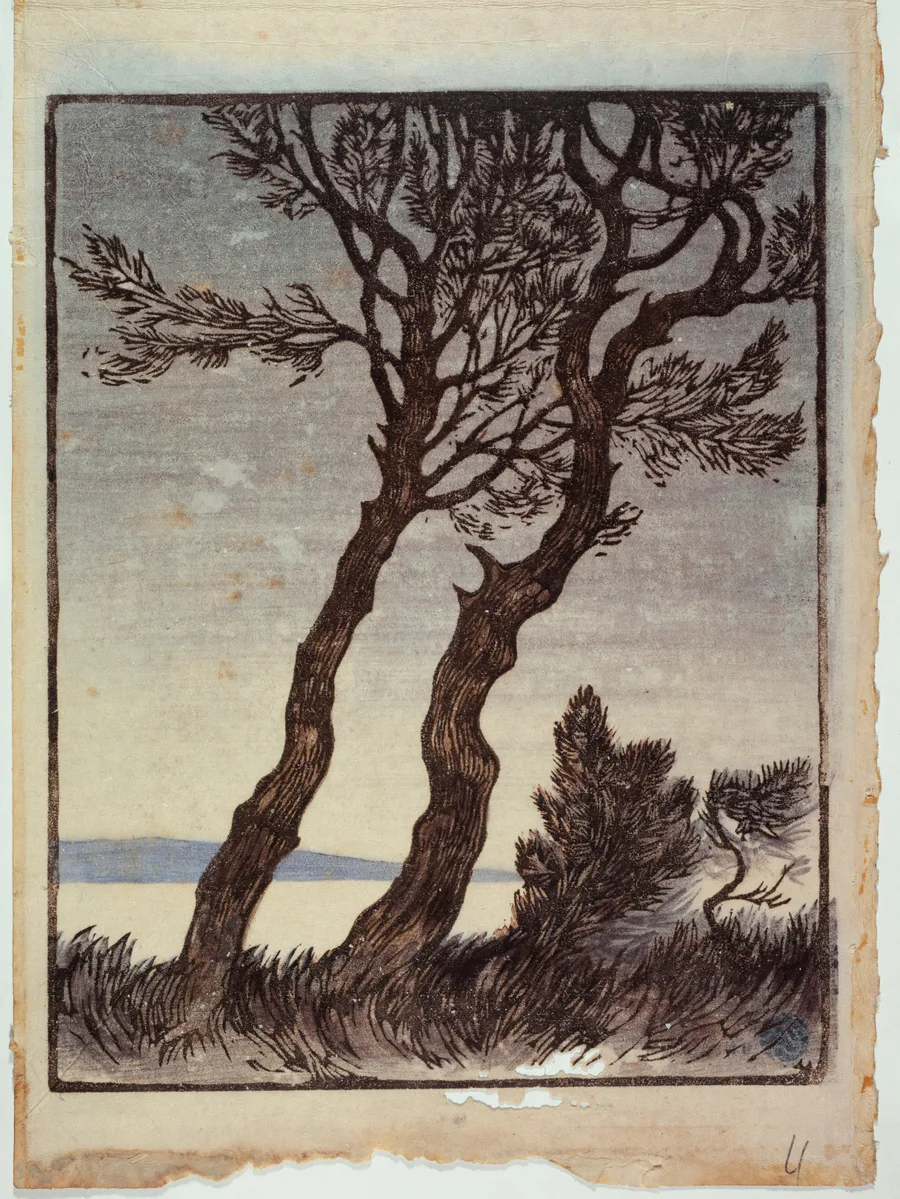
A few artists, however, remained faithful to this beautiful process. They did so with a difference, however: they no longer considered wood engraving as a simple means of reproduction, capable of printing an indeterminate number of copies of a black-and-white transposition of a successful painting or a drawing for a newspaper or book. They believed, quite rightly, that wood engraving was a medium, and one rich in resources, for expressing their own artistic thoughts, on the same level as lithography, painting, or etching.
It is with pleasure that we recall the beautiful woodcut plates by Lepère or Henri Rivière. But not content with the usual monochrome process, artists began to demand polychromy from the woodblock. This is how Rivière's prints, such as his Pardon, became famous.
When one speaks of color wood engravings, the memory of Japanese prints forcefully comes to mind. The Japanese were masters of this admirable printing process; whether in their individual prints or their albums, they knew how to extract effects of great beauty that are difficult to equal.
The Challenge of Japanese Technique
Much of the Japanese technique remains unknown to us—not so much that of the engraving itself, but that of the printing. Certainly, their style of engraving bears little resemblance to the one that translated the drawings illustrating publications from barely fifty years ago. Gone are the clever, carefully aligned little strokes; a single line and flat areas of color are enough to produce admirable effects. Whether the wood is boxwood or pearwood, whether it is cut with a burin, a knife, or a gouge, matters little. What remains somewhat mysterious is the method of printing these blocks, as well as the inks—or rather, the colors—used for these impressions.
Gone are the greasy, heavy inks so dear to our printers, replaced by light, transparent, and harmonious water-based tones. To the layman, this seems quite simple; printing with water, what difficulty could there be in that? This idea changes after the first attempts. Difficulties arise, innumerable and, at first glance, insurmountable. The Japanese, who master the most meticulous and delicate processes with ease, seem made for these surprising feats of patience and skill. We, on the other hand, seem ill-prepared to adapt to them.
It fell to Arthur Jacquin to demonstrate and prove that ingenuity and patience, combined with a rare artistic sensibility, could overcome these difficulties. Little by little, patiently, he reinvented this process, which was unknown to us. He chose and compared woods at length, considering their grain, their porosity, and their affinity for water. One by one, he discovered his colors—no longer superficial inks, but rather dyes that penetrate the paper and stain it through, giving these transparent tones a depth and a velvety quality that our reproductions cannot convey.
He sought out the best methods for inking and printing the blocks, and the most beautiful, softest papers that were most receptive to the color. And gradually, he rebuilt for his own use a complete and perfect technique. With this process now secure, he can freely express his artistic thoughts.
Jacquin's Mastery and Method
We will say little about the process itself; apart from the search for colors, it is more a matter of sleight of hand and skill. Jacquin possesses it completely and wields it like a master. And like any artist in full command of his art, he manages to give his prints an appearance of effortless and easy execution that is most pleasing. One does not sense the multiple investigations and repeated trials that each one requires.
To make the color vibrate, blocks are superimposed without the viewer's knowledge. The amateur might believe that only two tones, two impressions, were necessary. This is a mistake! There were seven, or eight. Only the result matters to the artist; the effort is nothing. Jacquin does not spare himself any trouble, but he achieves the result he dreamed of. That alone is important to him.
His color schemes are sober but harmonious. Is it necessary to have multiple tones when two or three well-chosen ones suffice, and do better than the garish medleys where novices lose their way? A brown, an indigo, a black, a white—that is enough to translate admirable effects. The important thing is to distribute their values well, and Jacquin excels at making a white sing through its carefully considered placement next to other tones.
His print of Le Moulin (The Mill) conveys a sense of grandeur that singularly exceeds the dimensions of the frame, in its somewhat tragic simplicity. This quality is also found in his Calvaire de campagne (Country Calvary), which we reproduce on this same page.
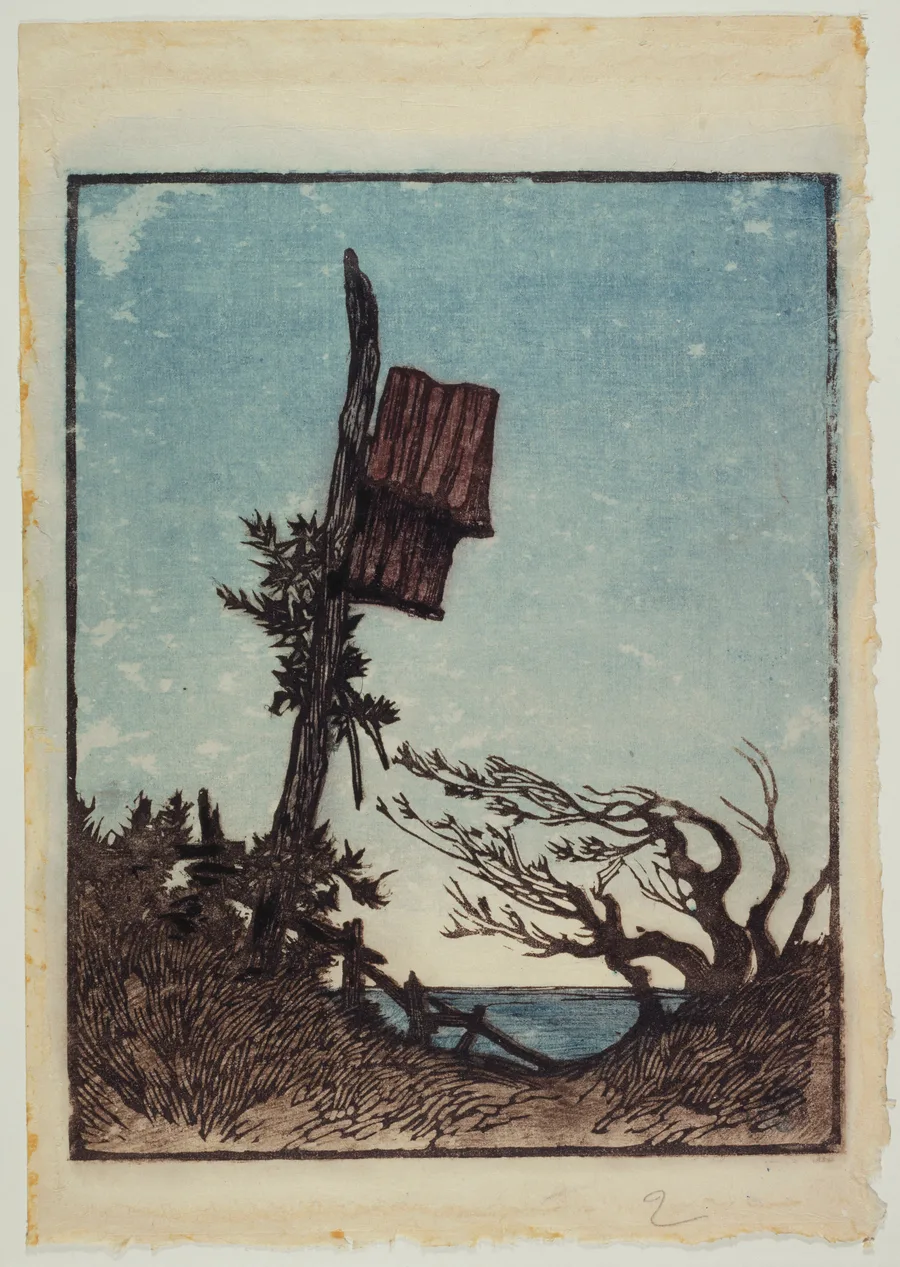
The execution of these engravings is of the simplest kind; a broad, firm, expressive line, a few flat areas of color, and sometimes gradations are all our engraver needs. It is fascinating to see the artist, with these meager resources, interpret nature and extract its quintessence. He suppresses every useless detail that would hinder or diminish its character, leaving only the very principle that gives nature the quality that the artist perceives, understands, and strives to render. It is this simplification that Jacquin achieves in his prints, giving us a singularly true impression of nature and its character of broad, strong grandeur and simplicity.
Jacquin's prints are already numerous and of very different characters. They can, moreover, be divided into two series. The first is that of the Gueux (Beggars). The other, more numerous and, in my opinion, the one containing his most perfect plates, is that of the Paysages (Landscapes). In each, the artist demonstrates an admirable flexibility of talent, effortlessly showing his diversity. From a very simple natural scene, he draws out a scene of definite character, which at times reaches the tragic—a character that is truly his own and quite particular.
M. P.-VERNEUIL.