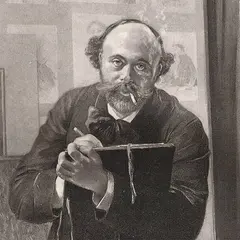
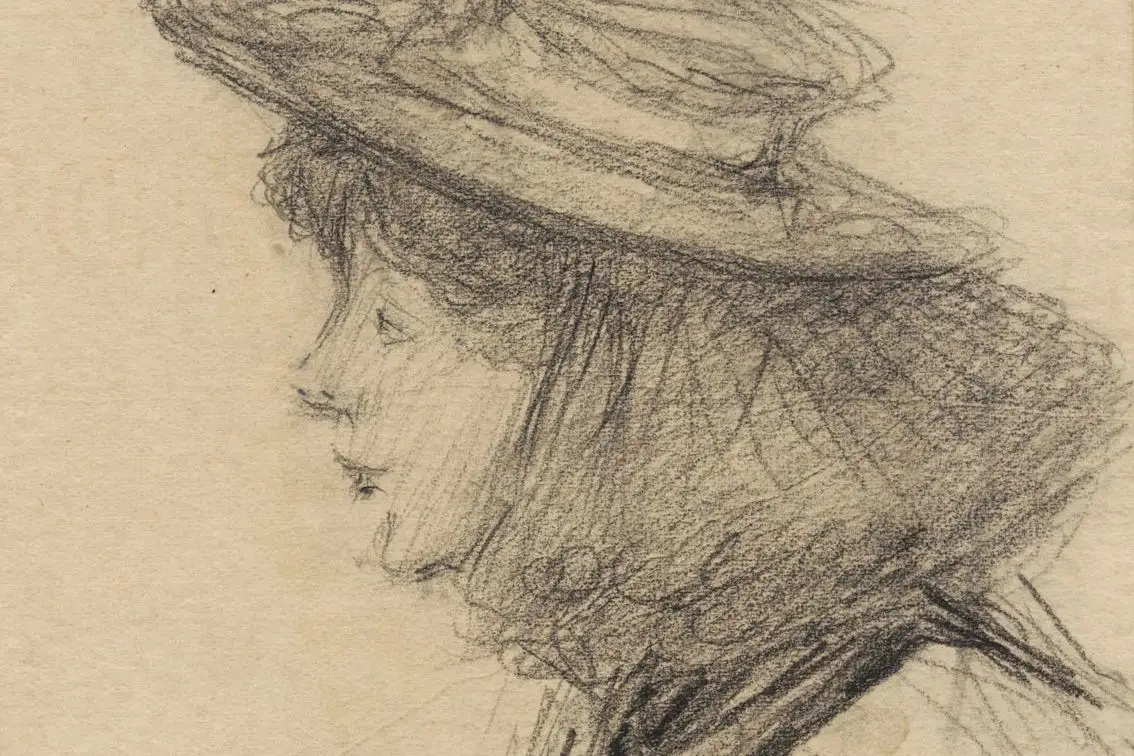
For nearly forty years, Paul Renouard has been documenting the events of his time, capturing day by day the notable aspects of society and the portraits of illustrious or unusual figures. It takes him but a moment to grasp the character of a public event, and mere seconds to fix the features of the individuals participating in it. His drawing is active, expressive, and vibrant, for this tireless observer is not only a marvelous technician but also a man of feeling who sometimes takes a side—a witness whose sincerity does not preclude passion. This gives rise to his discreet ironies and, at times, his tenderness.
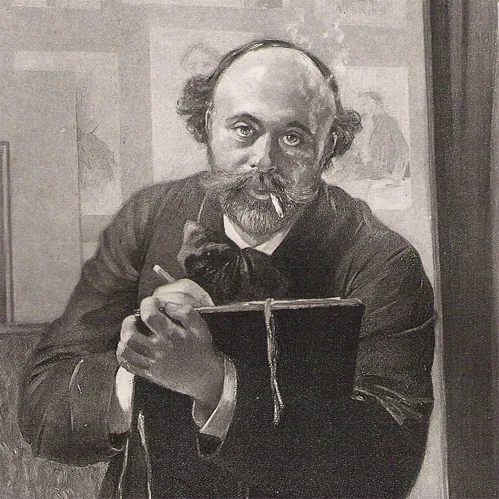
Through the series of drawings published in L'Illustration and in several delightful albums, the French public was already familiar with the great talent of Paul Renouard. However, it was primarily in English magazines that the artist was able to fully assert his admirable qualities. England has had its share of famous illustrators, and its newspapers have known how to facilitate their success. But for a country that reads a great deal, a country of great passion beneath the apparent phlegm of its inhabitants, this was not enough.
Consequently, England welcomed and celebrated the best illustrators from other nations, particularly from our own France. Constantin Guys was retained for a long time in London by the Illustrated London News. One cannot fully appreciate Gustave Doré, especially his best works, without having leafed through the Musée Français-Anglais, Coleridge's The Rime of the Ancient Mariner, and The Wandering Jew, all of which were first published in London.
The same is true for Paul Renouard. The Graphic gave him the most prominent position. For this illustrated journal, he visited the United States, Belgium, Germany, and Russia, sending back thrilling pages from his travels. To satisfy the curiosity of his readers, he moved among the great and frequented the most diverse social circles to bring back characteristic portraits.
The Art of Observation and Synthesis
Endowed with a remarkable memory, Paul Renouard, though primarily an analyst, also possesses the facility of a synthesist. He can thus extract a moving ensemble from a single incident. Nevertheless, whenever circumstances permit, he will add finishing touches to the initial memory-based sketch, transforming one or several silhouettes into true portraits. What is remarkable is that the harmony of the overall composition is never disturbed by these additions.
Moreover, all of this is accomplished with great speed. These portraits, which lend the work its definitive character, are achieved with a few rapid pencil strokes applied with surprising confidence, however precise they may be. This velocity is the result of the thousands upon thousands of sketches that this indefatigable draftsman has accumulated at all hours of the day and night.
Many of these sketches are well known. A number have been revealed through exhibitions—held too infrequently for his admirers' taste—and in published collections. But now, in the midst of his work as a chronicler, he has undertaken to engrave an imposing collection of them, much like Hokusai with his Manga (a collection of sketches). The title of this collection is significant: MOUVEMENTS, GESTES, EXPRESSIONS (Movements, Gestures, Expressions).
These three words, in effect, encapsulate the entirety of Renouard's art. A rigorous early education enabled his eye to analyze the most peculiar movements, the most characteristic gestures, and the most fleeting expressions, and his hand can instantly record the observed phenomenon. He does so without approximation, never shying away from the difficulties of line or color.
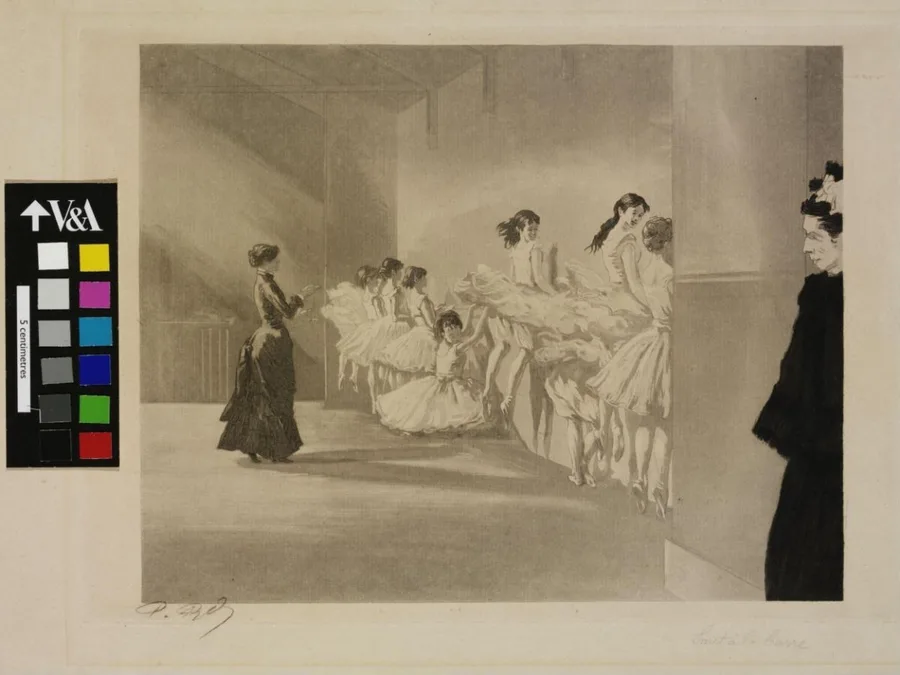
Paul Renouard's observations encompass the most diverse social categories and beings. The ballerina, all light and grace, appears alongside the slumped figure of a London pauper. On his paper, dogs, cats, kangaroos, pigs, and wild beasts coexist peacefully. Only Coppée—the hen—is permitted to swallow an adventurous frog with a thousand contortions. Then there are children, with their fresh charm and light grace. A little girl playing with a hoop is captured in the unstable equilibrium of her run. As swift as her course is, it cannot match the speed of the artist's pencil, for he can, in a series of sketches that suggest motion and almost tire the eye with their variety, seize the particularities of the little one's posture and fix them with a fine, sure, and curiously colorful line.
Here we have three sheets that evoke famous evenings. They depict the Maestro Arturo Vigna in Monte Carlo, captured in the full fire of his duties as an orchestra conductor. Portly and satisfyingly paunchy, with a strong head and a prominent skull, he bends, lunges, slims down, and shrinks, only to spring forth again, tensed like a bow whose arrow is the baton he brandishes—much like Kléber with his saber at the Battle of the Pyramids. This fantastic, dazzling scene brings to mind another: that of Rameau's nephew, who likewise mimes all the passions and mimics the sounds of every instrument before an amused Diderot.
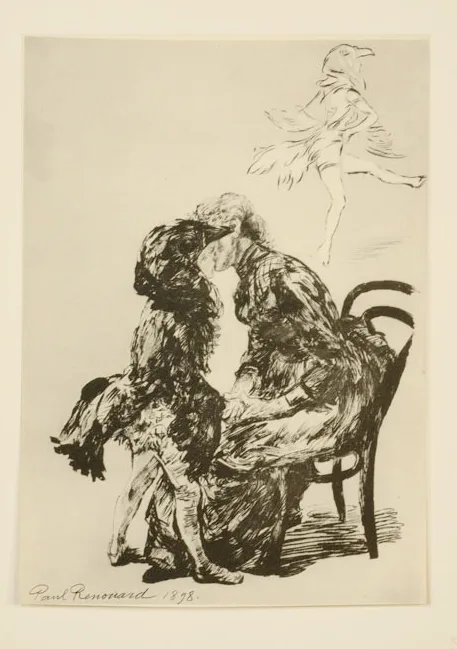
Elsewhere, we see ballerinas, very young rats (apprentice dancers at the Paris Opéra), who are both amused and amusing. Mischievously, they perch on a bench like a family of fledglings, or they submit to the demands of the dresser, who outfits and feathers them to make them look even more like true sparrows.
These Movements, Gestures, Expressions not only testify to the draftsman's marvelous gifts of observation; they will also be regarded by connoisseurs as a perpetual commentary on the definitive pages he contributed to L'Illustration and The Graphic. Others have attempted similar evocations of current events, but despite recognized skill and piquant inventive qualities, they have most often produced only laborious reportage, mere snapshots of a moment. Paul Renouard's pages achieve the level of great art, for they possess atmosphere, movement, and everything that constitutes lived life.
A Chronicle of Contemporary Life
To be convinced of this, one need only visit the exhibition of some five hundred pieces currently on display for six weeks in the grand hall of the Pavillon de Marsan, under the auspices of the Union Centrale des Arts Décoratifs. They stand as the most suggestive recapitulation of contemporary activity one could wish for. The intimacy of the home is juxtaposed with the energy of the crowd.
The 1900 Paris Exposition
Several large compositions recall the development and victorious blossoming of the Exposition of 1900. From the gutted earth, the carcasses of palaces emerge. The great spans of the metal frameworks threaten the sky, overturning our notions of stability and perspective. In the Grand Palais, for example, the central dome rises so high that the lower sections are lost in the haze. Meanwhile, workers toil away, moving about, immune to vertigo.
Nearby, a vista of palaces creates a festive halo, dominated by a bronze rhinoceros posted, impassive, at one end of a basin in the Trocadéro waterfall. Then comes the procession of the Maharajahs, where the artist's skills are on full display, deftly identifying characteristic types within the most complex ensembles.
Scenes from Belgian Festivals
Among the very beautiful drawings of the Belgian festivities of 1905, for instance, the face of a young woman on a platform, surrounded by a hundred other people, catches the eye. She is not pretty, perhaps even a little too plump, but the smile, accentuated by a dimple, is so genuine. Examining her neighbors, one finds they are just as "Flemish," just as typical in their highly diverse faces, all carefully rendered by the artist's pencil.
Impressions of English Life
The interest of all these works is surpassed still by the impressions of English life. Here, one gets the vivid sensation that Paul Renouard not only possesses observational gifts that allow him to truthfully capture an incident wherever it occurs, but that he is also able to very quickly assimilate and penetrate the habits of a people. This ability played no small part in the extraordinary renown he enjoys across the Channel.
And yet, he was frank. Great Britain, so full of noble qualities, so attractive with its concept of liberty and the intellectual refinement of its elite, also has its brutalities—notably, a tyrannical form of charity, effective but devoid of gentleness. Renouard conveys this very well.
The Harsh Realities of Charity
Consider one harrowing scene. In a kind of shed, poor old women, and some young ones made haggard by hardship, are seated on a wooden bench. Opposite them, lying in boxes that resemble coffins, are other slumbering faces, sometimes masked by an open hand or a fist at the end of a gaunt forearm. Above this misery hangs an inscription, a brutal reminder of ever-imminent Death. Where is this scene taking place? Is it a hospital morgue, or the shed of a mining company after a disaster? Not at all. It is simply a Salvation Army shelter. Oh, the odious Charity!
Perhaps this is the moment to insist on the superiority of human vision compared to mechanical documentation. A photograph would certainly render this scene in all its minute detail. But the camera, requiring only a hundredth of a second, would have fixed only a hundredth of an impression. The intensity of the light would diminish or "burn out" certain details, dramatizing or embellishing the whole according to the dominant colors. It would be the truth, but a skeleton of the truth. The artist, in contrast, enters, takes in the scene, subordinates its parts; his heart is moved, his intelligence intervenes. It takes him a minute to see, a few seconds of reflection to compose himself. How superior the result is!
Furthermore, Paul Renouard's facility for recording is such that, upon returning to his studio or hotel room, he can sketch a half-glimpsed scene with a rare sense of effect. Such is his depiction of London employees, freed from business, storming suburban tramways. In the rapid lines supported by masses of color, the eye has no trouble reconstructing the episode in its multiple phases.
The Charm of Youth and Education
Fortunately, London is not just Salvation Army shelters and rushes for the tram. There is also elegance and cheerful schools. In an exquisite book, Dans les Jardins et dans les Villes (In Gardens and in Cities), Mr. Edmond Pilon recently revealed to us the charm of English parks and the beautiful gardens surrounding the colleges of Oxford, their walls laden with wisteria and Virginia creeper. Paul Renouard found the same cheerfulness, the same wholesome atmosphere in the classrooms of young girls.
He shows us schoolgirls studying, at recreation, or equipped with dolls, taking their roles as little mothers seriously. Graceful and curly-haired, in their light-colored aprons, they sometimes seem ready to leap from the school's threshold onto a music-hall stage without losing any of their innocence, to appear in those children's ballets which, when refined, purified, and stripped of all ambiguity by the mind of a delicate writer, produced that tender work: Peter Pan, the Boy Who Wouldn't Grow Up.
Some of the pieces on display at the Pavillon de Marsan are prints taken directly from The Graphic. All of them were wood-engraved without losing their intensity of effect or the artist's personality. The whites are therefore pure and the lines, whether light or dark, are sharp and nervous. As Mr. Loys Delteil informed us some time ago in a study published in L'Estampe et l'Affiche (1898), it was at Renouard's request that his drawings were given to wood engravers. They, in turn, took all necessary care and respect in interpreting them, "the image-makers wishing to respond to the protection that the French artist voluntarily offered them by supporting their art with the authority of his name." It is fitting to recall in this context that in France itself, Renouard had in the engraver Florian an interpreter who was more than faithful—at times, almost a collaborator.
The Courtroom as Theater
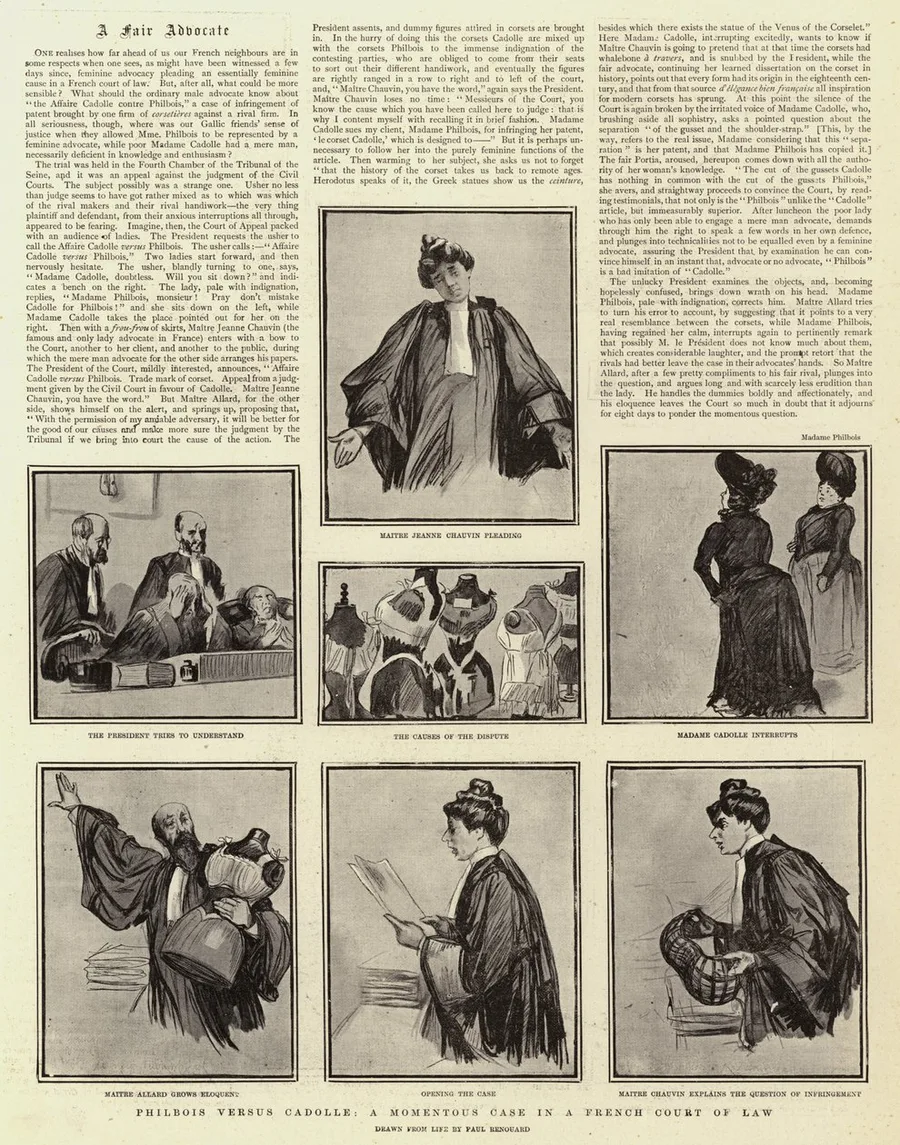
To fully appreciate Renouard's talents, however, we must look at the series of admirable portraits he drew during the Rennes trial and, more recently, the Steinheil trial. Here is a whole suite of living, anguished faces, some crying out the truth, others sweating lies.
The Steinheil Trial
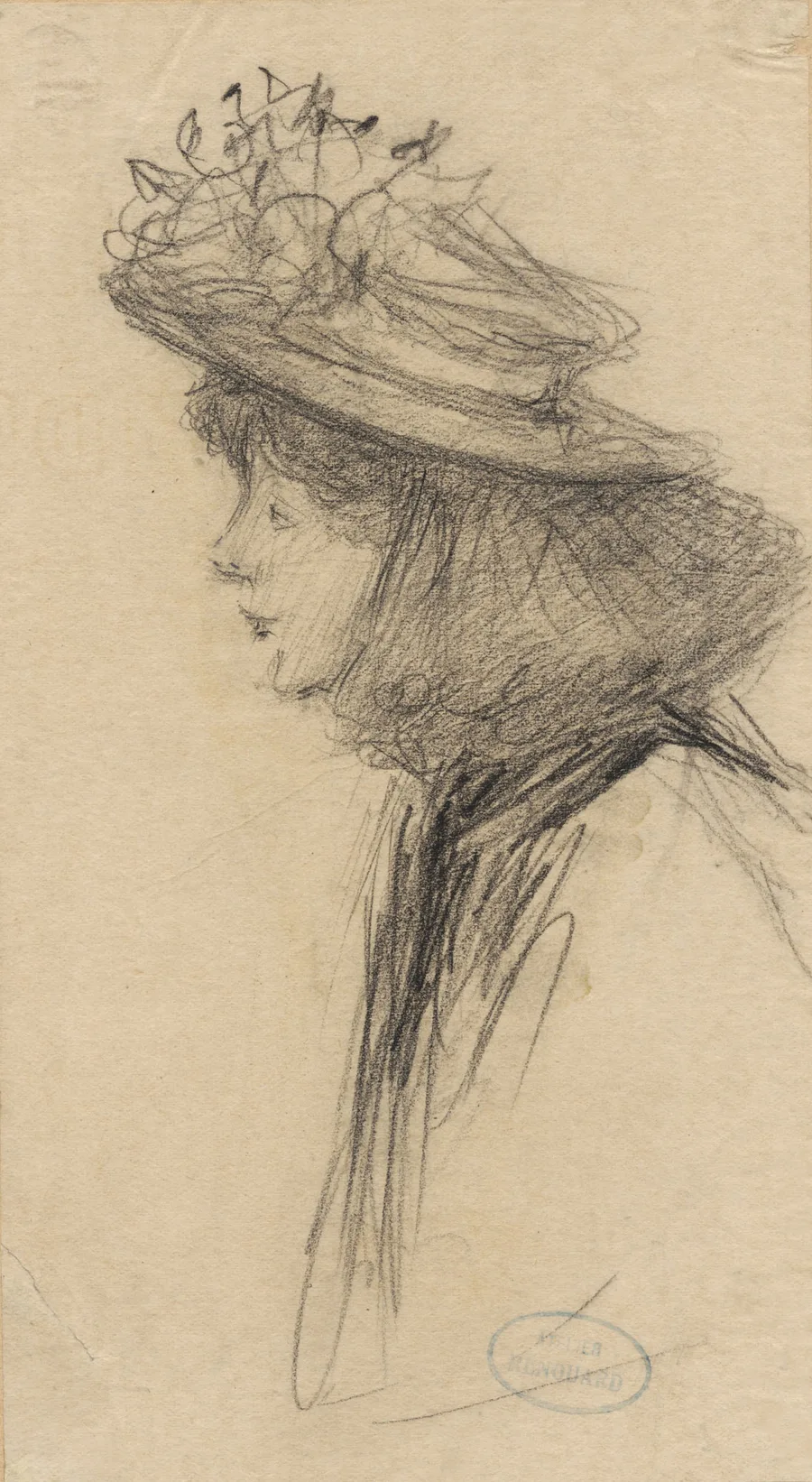
Madame Steinheil is presented in a hundred different ways: her pale face framed by black veils, at times indifferent with the astonished gaze of a young girl, at other times combative, adopting the air of a great tragic figure. She masterfully directs a theatrical scene that culminates in her fainting into the arms of four borrowed municipal guards.
The Rennes Affair and Maître Labori
But what is that compared to the Rennes trial! Here, castes, intellects, habits, and ingrained traits confront one another. One witness, captured in the posture of a schoolboy caught in a fault, nervously picking at his fingers as he considers the arguments against him, is unforgettable. But rising above all these figures is Maître Labori. A furious gesticulator with a congested face and an anguished voice, he at times suggests a figure from Rude's sculpture Le Chant du Départ (The Song of the Departure).
Oh, what a marvelous artist of the spoken word! By turns haughty, pleading, moving, and contemptuous, he falters only to rise again and proclaim in a stentorian voice: "Proof? You want proof? Here it is!" There is the word, but there is also the gesture. And Renouard was there to capture it.
The Painter's Touch
Paul Renouard received the training of a painter. Although the demands of his profession often forced him to abandon the palette, he never forsook it completely. His eye was delicate enough and his brush supple enough that his master, Pils, once employed him to create small-scale reproductions of his decorations for the grand staircase of the Opéra. This project was being completed at the time by two other of his students, Georges Clairin and Émile Boilvin—the latter a very fine colorist whom circumstances compelled to trade his brushes for the engraver's burin.
Paul Renouard has not lost his former qualities, but his technique and tonalities naturally show the effects of long, forced absences from painting. Nevertheless, one can see excellent pieces at the Pavillon de Marsan, solidly constructed and executed with a light and smooth touch. An example is the Danseuse feuilletant un album (Dancer Leafing Through an Album). The quality of the pinks and grays is exquisite. One understands, then, that driven by the demon of painting, he was tempted to test his abilities not just in an incidental piece, but in an ensemble that would showcase his talents as a decorator and painter.
This led to the Seize figures d’un Ballet idéal (Sixteen Figures for an Ideal Ballet), conceived for execution as a tapestry. The subject has the freshness of Verlaine's Chansons galantes (Gallant Songs): in a park, a tender heart sighs. The Tempter arrives in the most pleasing guise and quickly conquers the delicate creature. But the seducer flees with another, less candid companion. And the innocent child is left to languish near the desecrated temple of love.
Paul Renouard, for whom the Opéra is something of a second home, has infused these sixteen scenes with the best of the grace of the ballerinas whose agility he has so often admired. Indeed, women of flesh and blood could perform this pretty fantasy very well. However, it is not in that direction that he sets his hopes. A translation into wool and silk would satisfy him far more.
His past, and his present efforts, certainly merit this satisfaction.
CHARLES SAUNIER.