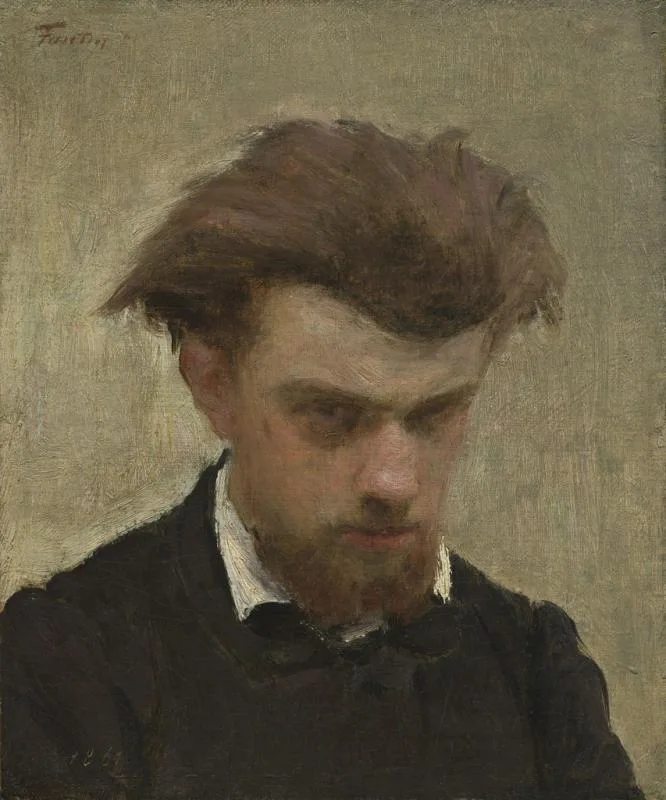
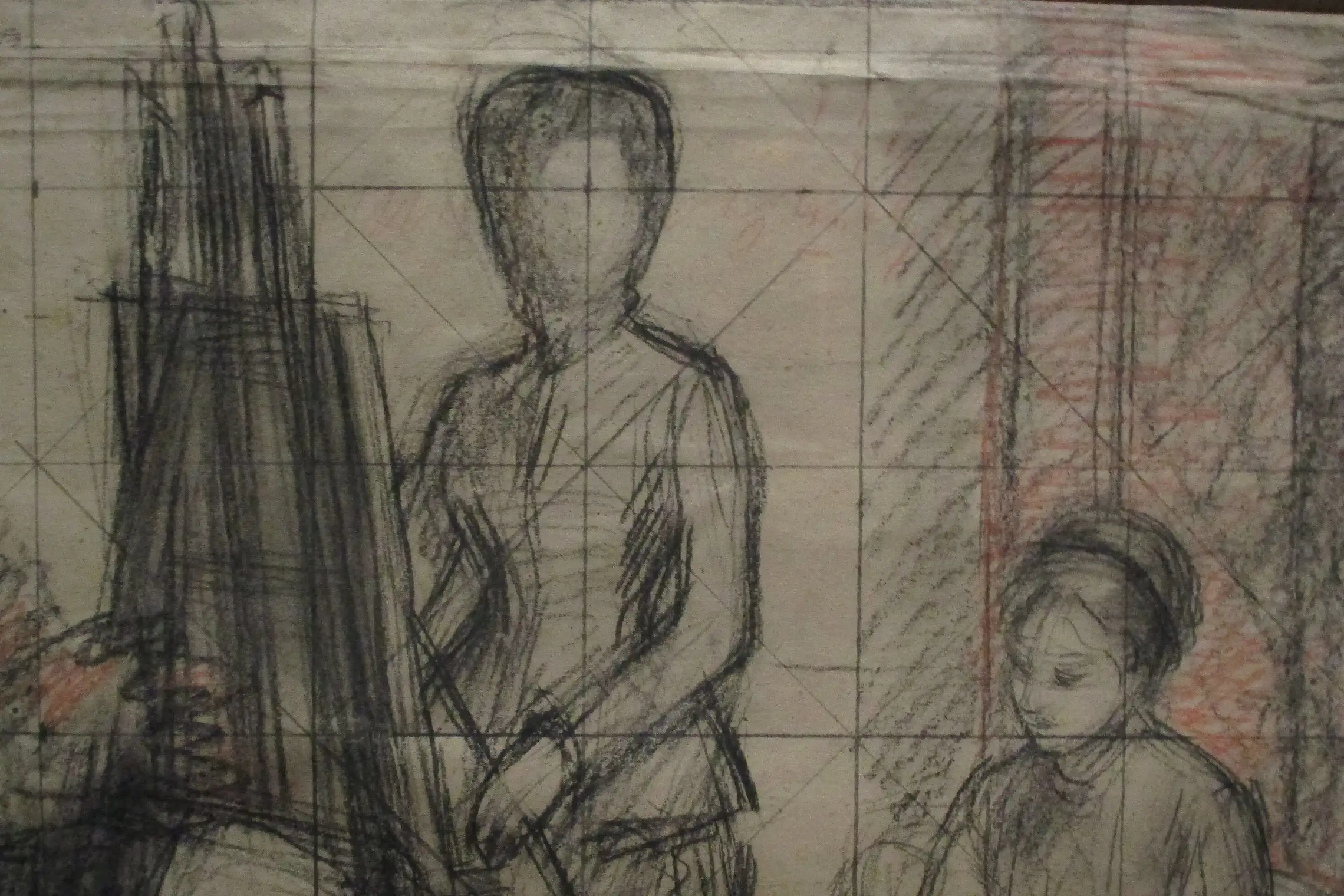
If the conversation ever turned to the subject, Henri Fantin-Latour would tell you that he never had a taste for sketching with a pencil. His brush is the tool he prefers; instead of beginning with pencil drafts, he almost always executes a painted study from the outset. However, at every stage of his career, he also produced drawings. Among them are some very important works that are now, and rightly so, attracting significant attention. The circumstances that gave rise to them are varied and allow, as we shall see, for a kind of classification to be established among them.
The Early Drawings
Fantin-Latour's drawings from his youth are relatively numerous. In that era, drawing was considered part of an artist's discipline. As late as 1864, at the age of twenty-eight, Fantin was still attending the Académie de Jacques on the rue Lamartine. These pencil exercises were regarded as excellent training. A particular reason led him to draw even more than his peers: he worked a great deal in the evenings. It should be known that for many years, until about 1870, Fantin spent all his days at the Louvre making copies of the masters. Consequently, the only time left for him to paint his own original compositions was on Sundays and Mondays.
On other days, once the lamp was lit or about to be, he had no choice but to close his paint box and turn to his pencil. He sometimes did so with fierce determination. One winter, during a severe cold spell, he was determined to keep working late in his small room on the rue Férou. He resolved to get into bed, piling all his blankets over his legs, wearing all his day clothes, with his scarf pulled up to his mouth and his top hat on his head, thus defying the hour and the season. His friend Whistler, arriving one evening to ask if he could share his lodging, found him in this attire. Amused, Whistler made a sketch of the scene, adding the date, "20 December 1859," and the caption: "Fantin in bed. The pursuit of his studies under difficulties: 14 degrees."
Subjects and Models
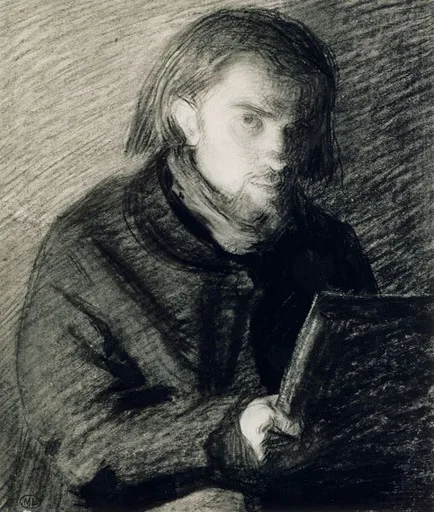
The subjects of these drawings from before 1870 were of several kinds. In addition to academic life drawings and studies, one finds ideal compositions conceived with exactly the same intentions and based on the same principles as the paintings and lithographs of his later period. For example, a Venus Wounded by Cupid is dated March 1862; a depiction of bathers in a landscape, Baigneuses, and a Hylas are from around the same time.
Nevertheless, subjects drawn from reality were by far the most common. As the young artist had neither the time nor the means to seek them out far from home, he took them from his immediate surroundings, as family life provided them. His two sisters became his customary models. In the almost complete stillness of their industrious existence—embroidering by the window, sewing, or reading—he drew them tirelessly, contenting himself with slight changes in posture, light, or viewpoint. One of the most complete of these drawings, dated 1855, entered the collection of Mr. Heseltine a few years ago. Another, of a charming delicacy, is part of the album of the painter and draftsman Cuisin, which his heirs recently ceded to the Musée du Luxembourg under particularly generous terms.
In these studies, Fantin almost always focused exclusively on the picturesque qualities of the scene, neglecting to capture a precise likeness. Sometimes, however, he did practice creating true portraits. A life-sized head of a young girl, which he kept, apparently reproduces the features of his second sister with the most exact fidelity.
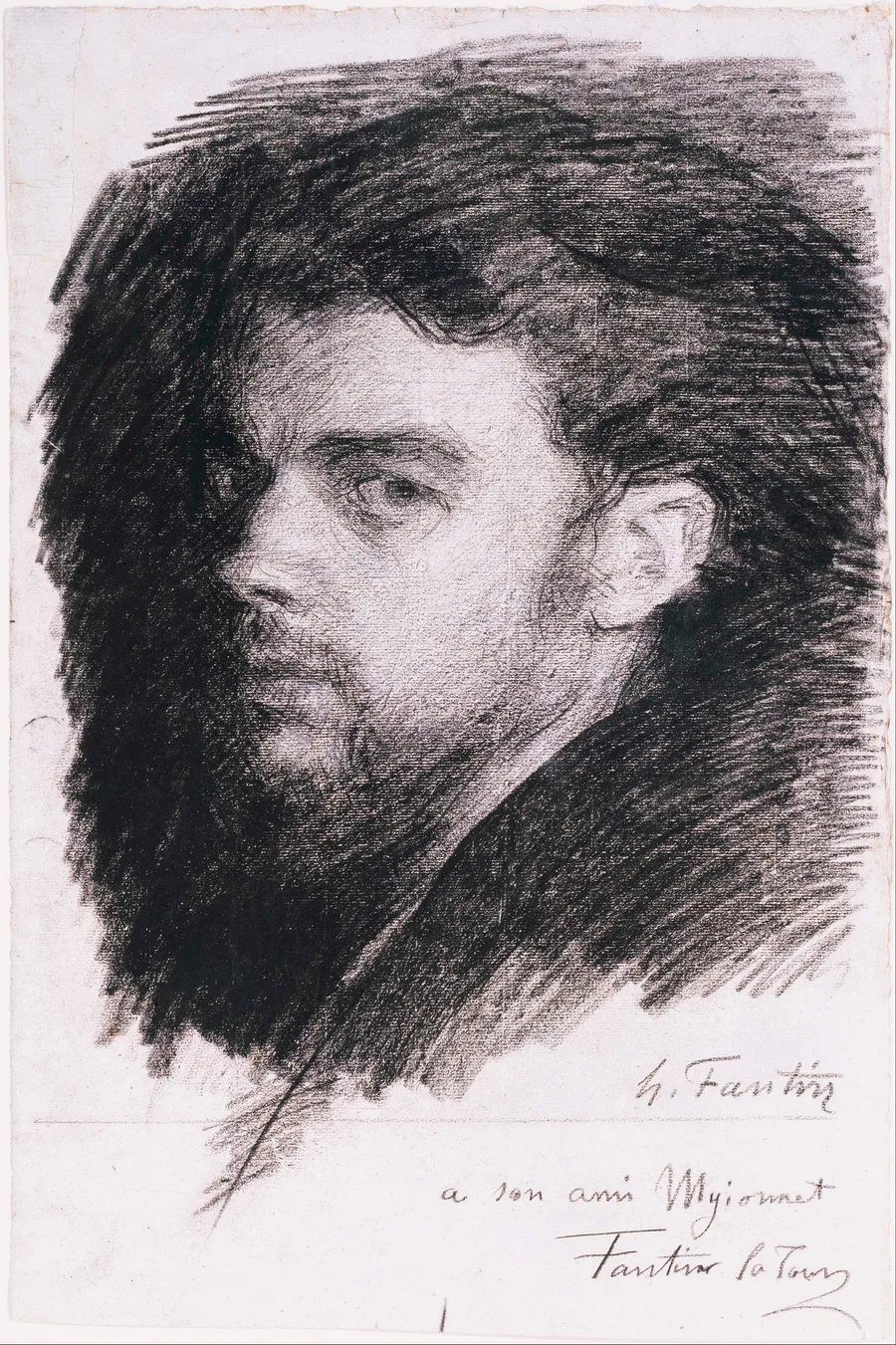
But the model he turned to most often—because this one never tired of posing and was always available at any hour—was himself. Whether half-length, bust-length, or just the head, large or small, in paint or pencil, he used his own image to experiment with every form of artistic inquiry. Most of these self-portraits were almost immediately given away to friends. The artist Félix Bracquemond owns one from around 1860, executed, rarely for Fantin, in pen with flat washes of ink. In it, the artist depicted himself with a pencil in hand, though he appears to be holding it in his left hand—an effect caused by the inversion of his reflection in the mirror. Another very important drawing, executed with a most noble air, once belonged to a friend named Myionnet, to whom it is dedicated, but has since returned to the artist's possession.2
Drawings for Lithography
I have explained elsewhere3 how, starting in 1876, Fantin developed the habit of having a few lithographs printed each year and how useful autographic transfer paper was to him for this type of work. The softness of this paper under the grease pencil and the ability to scrape out white areas on it with a scraper, just as on a stone, so captivated him that from that date forward he used almost no other paper or pencil for his drawing.
At the same time, a close link was established between his drawings and his lithographs. "My drawings are my lithographs," I have heard him repeat more than once, and the statement is doubly true. Indeed, if one considers his lithographs in themselves, the more one examines them, the more one finds that they are—and this is precisely where their merit lies—true drawings, a painter's drawings. Conversely, if one focuses on his drawings from the last twenty or twenty-five years, one notices that all, or very nearly all, were begun with the intention that they might eventually become lithographs.
Those that did become lithographs were naturally destroyed in the transfer process, and it was a source of great regret for his friends to see such fully realized works sent to be destroyed. For here, another trait of the artist's character must be revealed: once he is engrossed in a drawing that interests him, he never tells himself that he has done more than enough for a simple transfer that the printer's press will flatten. He never thinks to save time and effort by reserving the final touches for the stone itself. Instead, he immediately pushes his idea to its limit, achieving the utmost delicacy of execution, even if it means he must start over when the stone is returned to him. I once had the occasion to help save one of these most perfect drawings by suggesting he exhibit it. This was the work that appeared at the Salon of 1896 under the title Inspiration.
Moreover, the Gazette des Beaux-Arts has the good fortune of presenting to the reader, along with one of the artist's original lithographs, one of his drawings ready to be transferred to the stone: it is the study of a reclining nude woman that accompanies this article. Nothing could more clearly show the link that connects Fantin's drawings to his lithographs, and the genesis of the latter.
The Portfolio of Unused Works
Fantin's working method was to give form to an idea when it came to him, then often let it rest for months or even years, until, after judging it anew, he felt the urge to take it up again. One can understand how a reserve portfolio soon accumulated in a corner of his studio, filled with drawings at various stages of completion. This portfolio also held a number of drawings made by mistake on the reverse side of the autographic paper—the side without the gum coating—and which were therefore useless for transfer. Others, having been excessively scraped and redrawn, inspired justifiable fears in the printer.
Still others had been started so long ago that it became risky to continue them, as the old crayon marks lose much of their lithographic virtue as they dry out. For all these reasons, the portfolio in question had become quite full a few years ago. It is well known how brittle and prone to curling tracing paper is in portfolios. To avoid these accidents, Fantin sorted through all the drawings he had given up on transferring and gave them to a framer to be mounted flat onto white Bristol board.
Whether mounted or loose, the drawings on tracing paper whose origins I have just explained form a group of exceptional importance in Fantin's body of work. I will not elaborate on their subjects, which are naturally of the same order as those of his lithographs; that is, they consist almost exclusively of ideal compositions, borrowed either from music or from pure imagination. As for their execution, the lithographs can still give a fairly close idea to those who have not been able to see any of the drawings themselves. However, as one might expect, the difference in medium also produces a distinct quality in the results. Let us add that among the drawings, some are more finished than others, and often the less finished ones are not the least seductive.
Drawings for Publication
Another category of drawings includes those that Fantin made to be reproduced in various publications. Twenty or twenty-five years ago, photographic processes had not yet reached the perfection we see today. Attempting to reproduce a painting directly would have yielded results that were too defective. To accompany articles that discussed their paintings, artists were therefore approached and asked to provide a sketch, whose lines would always appear with sufficient clarity on the printing plate.
Always an enemy of the approximate, and always careful never to sign his name to anything he considered unworthy of being shown, Fantin produced drawings for this purpose that were extremely tight and complete. The reproductions would be models of interpretation of his painting, if not for the fact that the printers were too often unequal to their task, and especially if they had refrained from retouching the plates.
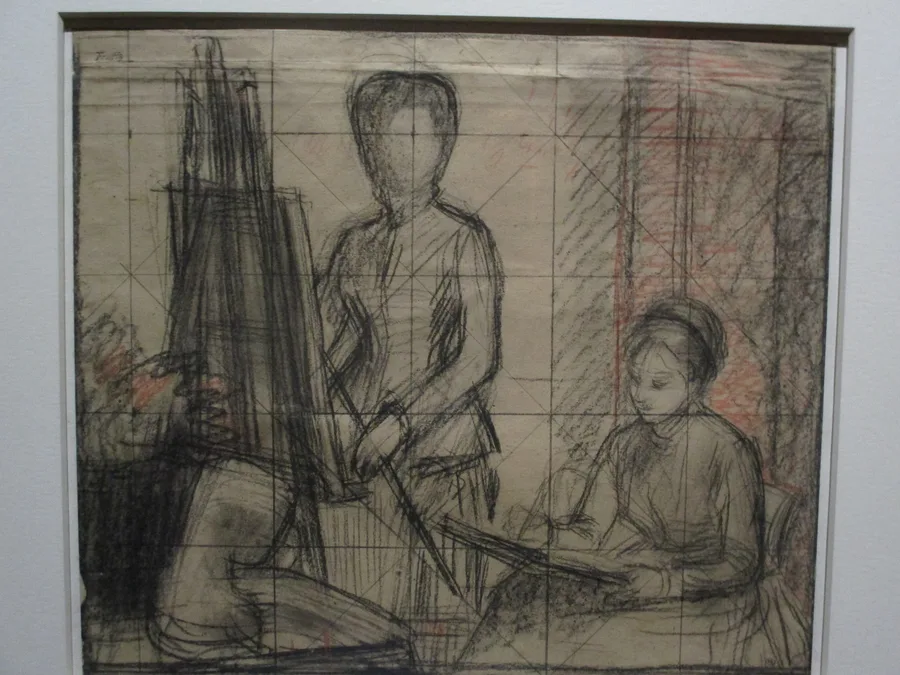
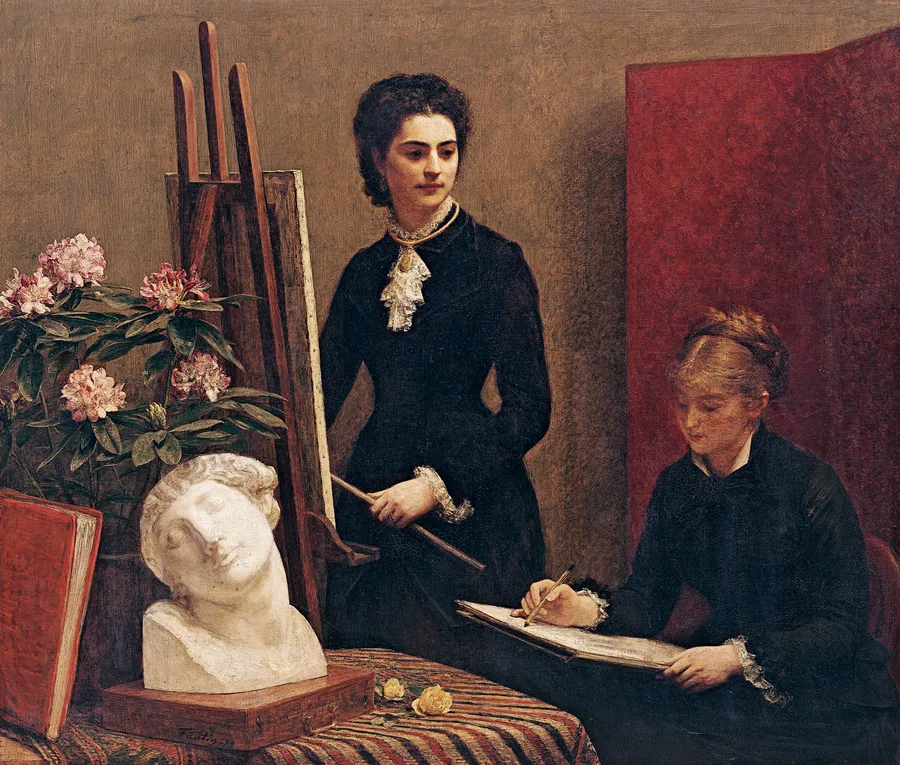
The first, I believe,4 and one of the most beautiful drawings in this category, was that of L'Anniversaire (Hommage à Berlioz), which appeared in Le Monde illustré in 1876. In 1879, the review Les Beaux-Arts illustrés, directed by Duranty, published the no less important drawing of L'Atelier,5 as well as a Bacchante, after the painting by Riesener belonging to Alexandre Dumas fils. Around the same time, La Vie Moderne published the portrait of Edwin Edwards and that of Manet. In 1883, an Hommage à Victor Hugo found a place in L'Univers illustré.
All these reproductions, and many others I do not mention, were printed typographically. To appreciate the difference between the original and the reproduction, one can compare La Liseuse (The Reader), which appeared in the Revue des Jeux, des Arts et du Sport (issue of October 23, 1880), with the beautiful original drawing that Mr. Charles Hayem recently donated to the Musée du Luxembourg. I should add that this same Liseuse has since been suitably reproduced in Les Maîtres du Dessin published by Mr. Roger Marx.
More recently, a very noteworthy drawing titled L'Aurore et la Nuit (Dawn and Night) was given by Fantin to the journal L'Artiste, which published it as a photogravure. Another drawing, titled Immortalité (Immortality), was given to L'Estampe moderne; the reproduction of this latter work is truly excellent and has more than once been mistaken for an original lithograph.
But it is the Gazette des Beaux-Arts that has received the greatest number of these drawings. Besides those we reproduce today, I will mention only three:6 L'Étude (The Study) and Sara la baigneuse (Sara the Bather), after a painting and a pastel exhibited at the Salon of 1884, and Andromède (Andromeda), after a painting from the Salon of 1898.
Traced Sketches and Studies
Finally, there is a last category of drawings that must be set completely apart from the others. These would be very numerous if Fantin had not destroyed many of them: his sheets of traced sketches. In the evening, when it is no longer possible to paint, he often opens one of the portfolios that make up his very rich collection of pictorial documents and begins to leaf through it. But merely looking is not enough for him. To see more closely, to examine more thoroughly all the elements of a piece that interests him, he takes a sheet of vegetable parchment and his pencil and traces a section of it, such as a figure.
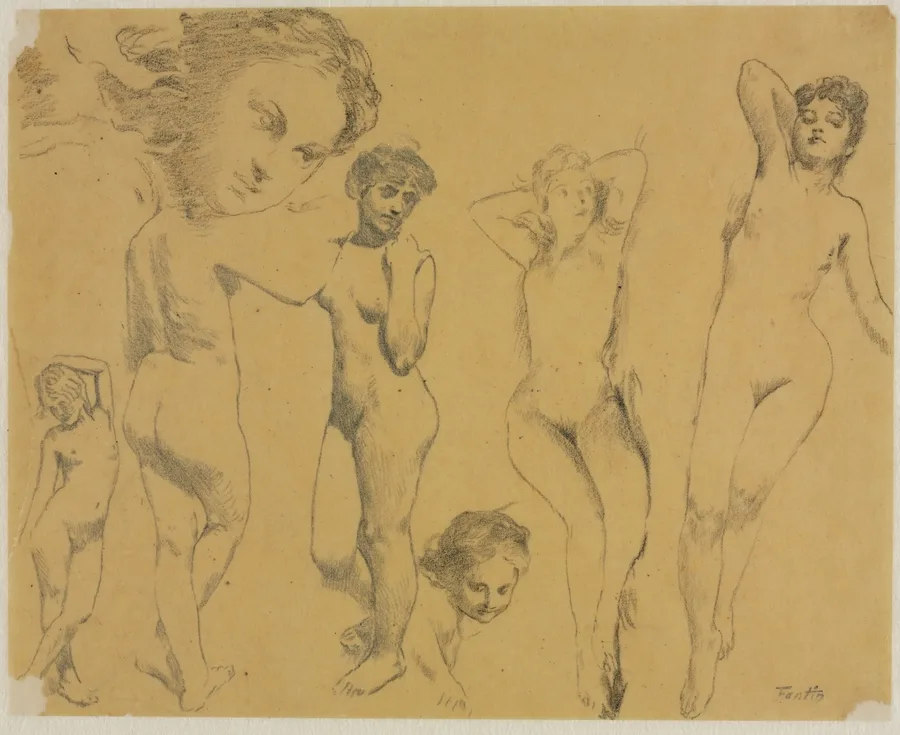
It goes without saying, however, that he does not always trace with a concern for exactitude. On the contrary, he takes liberties with his model. Where the original ceases to please him, he corrects it; where his own thought, after following that of another, takes a different direction, he adds something of his own. It is these infidelities, more or less subtle but continuous, that would give these sketch sheets a keen interest, if he allowed them to be seen. As an example, here is one where heads by Raphael and Ingres are mingled; another is covered with fragments of the little genii from the Abbess's Room in Parma; a third consists of a row of female nudes. In all of them, one can perceive, to varying degrees, that necessary work of transformation by which everything a superior artist borrows—whether from the masters who preceded him or from nature—is immediately imbued with his own recognizable mark.
The Nature of Fantin's Drawings
The details I have just provided, perhaps a little meticulous, allow one to see clearly the nature of Fantin's drawings. There is almost nothing in common between the intentions that dictated them and those one recognizes, for example, in the drawings of a Puvis de Chavannes or a Delacroix. The drawings of those masters were, almost without exception, the raw materials for their painted works. This, principally, is what makes them so precious. In them, we see the first revelations of their still-fluid thoughts, then the labor they undertook to bring those thoughts into being. We find all the studies they had to resort to in order to establish, part by part, their definitive results. We follow them, so to speak, step by step, up to the accomplishment of the public manifestations of their genius.
One would be mistaken to search for similar information in the drawings of Fantin. First, studies of individual parts are completely absent. It is a remarkable thing that this artist, who in his works of reality knew how to capture truth so closely and translate it in such a striking manner, never used drawings specifically made for that purpose to aid him. Nor, in his ideal compositions, did he ever use this method to refine the final execution.
Secondly, while he more than once sketched a summary outline of a painting he was about to begin, these sketches are also distinguished by something very particular. They were never for him simple notes, taken for the sole purpose of developing and correcting his thought. However unfinished they may have remained, they are always recognizable as being of a nature to be continued to completion. No one returns more willingly to his own idea, but not while it is still in the process of realization. On the contrary, it is after having fully formulated it that he likes to take it up again to give it another, related but different, form.
Thus, it happens that Fantin's drawings are relatively few in number, and they are by no means an intimate commentary on his painting. They possess, in themselves, the value of distinct manifestations of his thought. The link that connects them to his painting is the same as that which would connect one painting to another: there is a commonality of origin, and nothing more.
GERMAIN HÉDIARD