
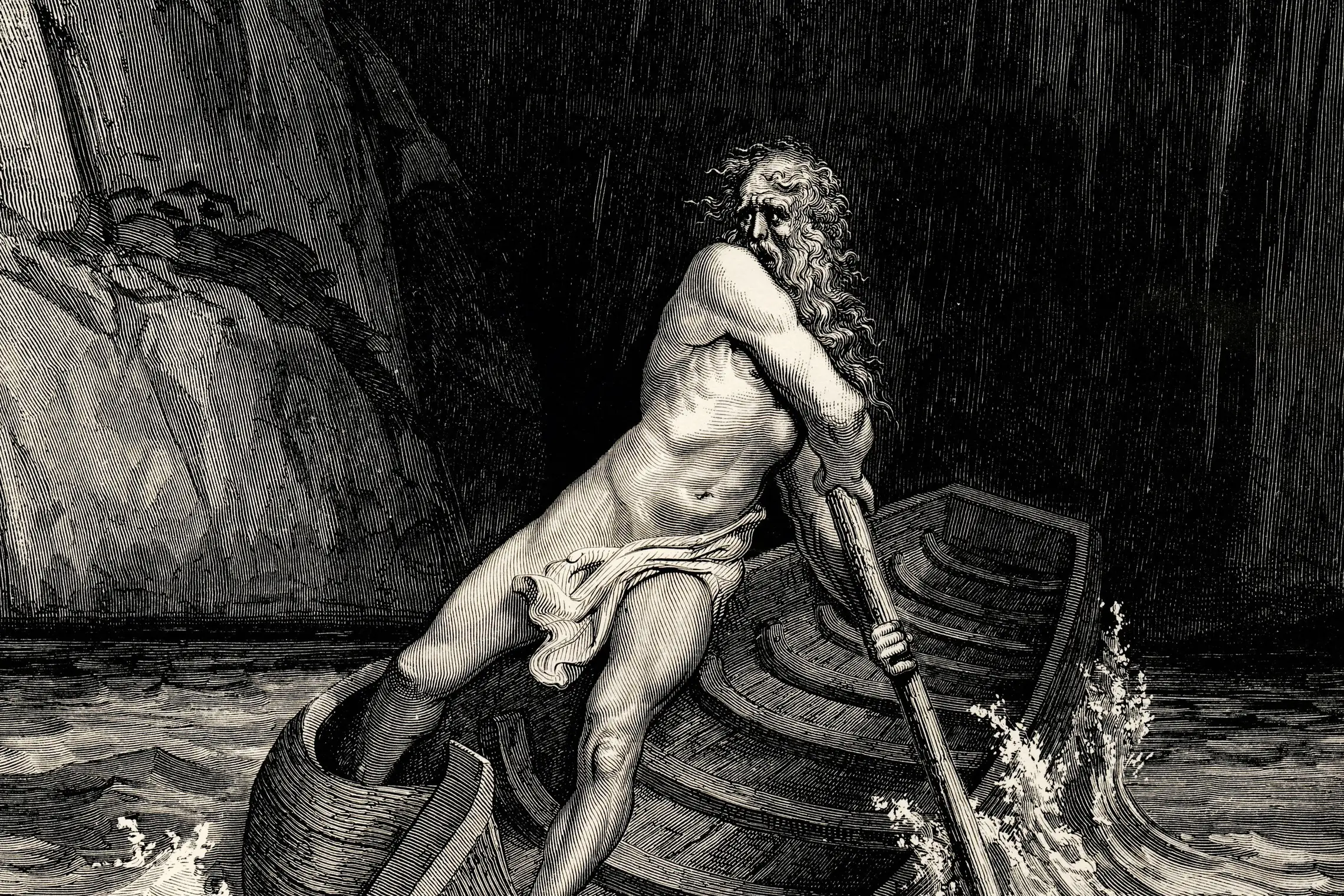
Drawing by Sandro Botticelli to illustrate Dante's "Inferno" (Kupferstichkabinett, Berlin.)
Dante as Painter: The Pictorial Genius of the Divine Comedy
Chase pigliar occhi per aver la mente.”
(To take the eyes in order to have the soul.)
(Paradiso, XXVII, 92.)
This year, the entire world of souls celebrates the jubilee of Dante Alighieri, who died on September 14, 1321, in Ravenna. Every family of the human spirit honors in its own branch this universal father, who has spread life through them all. The arts of drawing cannot remain indifferent. Let us not forget that he himself wished to appear before our eyes in the guise of a painter—and on what occasion? The anniversary of Beatrice's death.
Recall the account in the Vita Nuova: "I was sitting in a place where, remembering Her, I was drawing an angel on some tablets." Friends had approached: "They were looking at what I was doing, and, from what I was told afterward, they had already been there for some time before I noticed them." The painter and his friends exchange a few words, and then: "when they had departed, I returned to my work, that is, to drawing figures of angels."¹
It is a delightful scene, assuredly. Is it true? Perhaps. Imaginary? Who can say? Woe to anyone who claims to seek factual information in the Vita Nuova! In the work of a lyric poet, everything is true; so Plato teaches. If Dante represented himself in the guise of a painter, it at least corresponded to the truth of his thought. When Maurice Denis encountered this image to interpret in his unparalleled edition of the Vita Nuova, he lovingly developed it into a composition where the real and the imaginary fraternize. Nothing is more Dantesque than his happy anachronism. He has seated the painter Dante on one of the terraces of San Miniato, from where the panorama of Florence and the Arno unfolds at his feet, just as time and art have fixed it for us.
Dante is a painter. Let us hold to this notion without argument.