

In modern European—and even Scandinavian—art, Norway holds a unique place. Contrary to the trend in other countries, it mounted a proud and energetic resistance to the encroachment of what we call Art Nouveau. If Norway was victorious in this struggle, it owes its success in large part to the profound influence of Gerhard Munthe, who countered the invading movement with a stronger one, moving in what could almost be described as the opposite direction.
Strange, curious, powerful, artificial, original, barbaric, childlike, brilliant—from its very inception, Gerhard Munthe's decorative art was promptly christened with a host of epithets, both laudatory and disparaging. Yet neither the good nor the ill that was said or thought of it influenced its development, for it was—and remains—the work of an artist moving by deliberate means toward a chosen goal. That goal was to create a frankly Norwegian art; the means were to rediscover, reconnect with, and, naturally, enrich the tradition of a national decorative style that predated both naturalism and classicism.
We are quite ignorant of contemporary Norwegian art; one writer, otherwise serious, recently spoke in a very distinguished review, without batting an eye, of the "Swede" Gerhard Munthe. It is therefore permissible to assume we are at least as unfamiliar with the Norwegian art of the past. It is no insult to begin by stating that this ancient Norwegian decorative art did indeed exist. Wood sculptures, such as the prows of Viking pirate ships or the carved furniture and motifs of old houses and primitive Norwegian stave churches, as well as ornamented stones, jewelry, metal objects, painted utensils, and especially tapestries—these are the direct sources from which Gerhard Munthe drew his sense of a decorative art that had been forgotten, worn down by time, and distorted by foreign influences.
The Artist's Transformation
We first saw Gerhard Munthe at the Exposition of 1889, where he presented only naturalist landscapes. At the 1900 Exposition, by contrast, he exhibited exclusively decorative works. Why did this landscape painter, who had successfully followed the naturalist path for twenty years, devote himself almost completely for the last fifteen years to creating a style—or resurrecting an ancient decorative one? Why and how did the observant painter who created the watercolor Spring, reproduced above, and the watercolor Bergen, presented in color on a separate plate, also become the simultaneously naive and deliberate author of so many illustrations in drawing and color, where reality appears only in a simplified form to support and reinforce fiction?
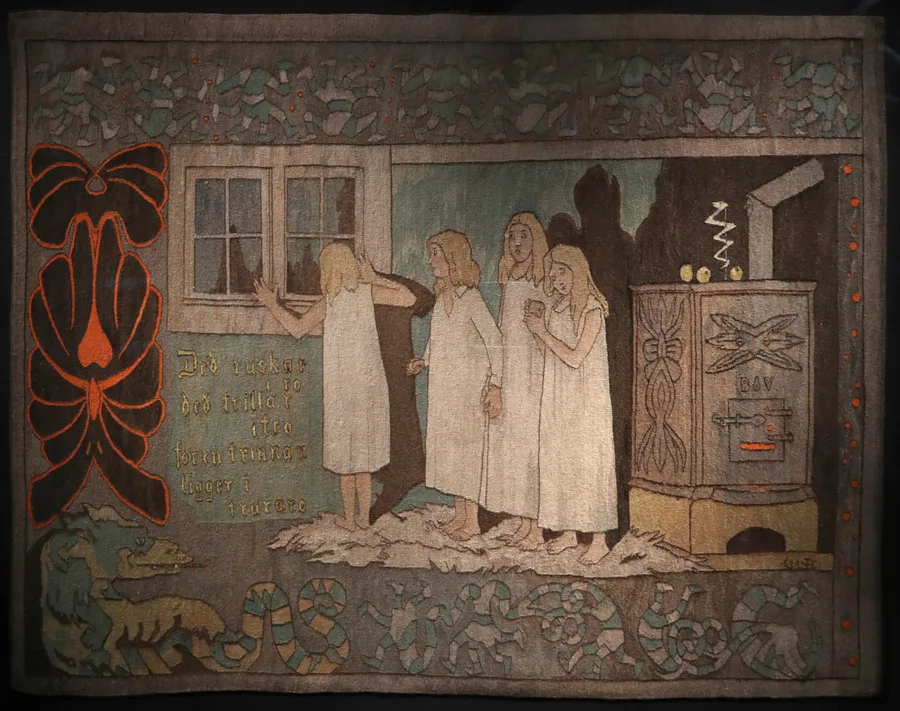
It would be of little use, I believe, to search for the principle of Munthe's decorative evolution within his naturalist works. Of all his pieces, the watercolors of Bergen and Spring lend themselves best to this game; for those who wish to find them, the decorative qualities of simplification, abstraction, grouping, and balance will always be manifest. But in art, as in history, such after-the-fact demonstrations have never truly demonstrated anything. Even after we have noted the decorative qualities of Munthe the naturalist painter, we still must explain why it was precisely these qualities that took precedence over the others. The fact does not substitute for the reason, and we must evidently look elsewhere.
Did the subject matter impose the style? Undoubtedly, for an artist conscious of what he wanted and intelligent about what he was doing, illustrating a primitive era demanded the art of that era. This was less a matter of archaeological accuracy than a necessity, a way to create the illusion of reliving the ideas and sentiments—not only moral but also aesthetic—of Norwegians from the Bronze and Iron Ages. In this pursuit, avoiding errors against the concrete reality of past times is certainly a merit. But Munthe's thinking goes further. For him, artistic truth is not archaeological truth. He believes that illustrations of the past must not be retrospective naturalism; above all, we must not clothe an era that had a diametrically opposed conception of art in our own artistic vision. We can only claim to give the illusion of the primitive if we see with the eyes of a primitive.