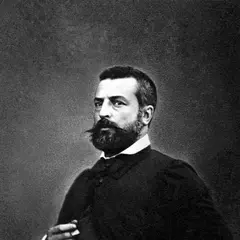
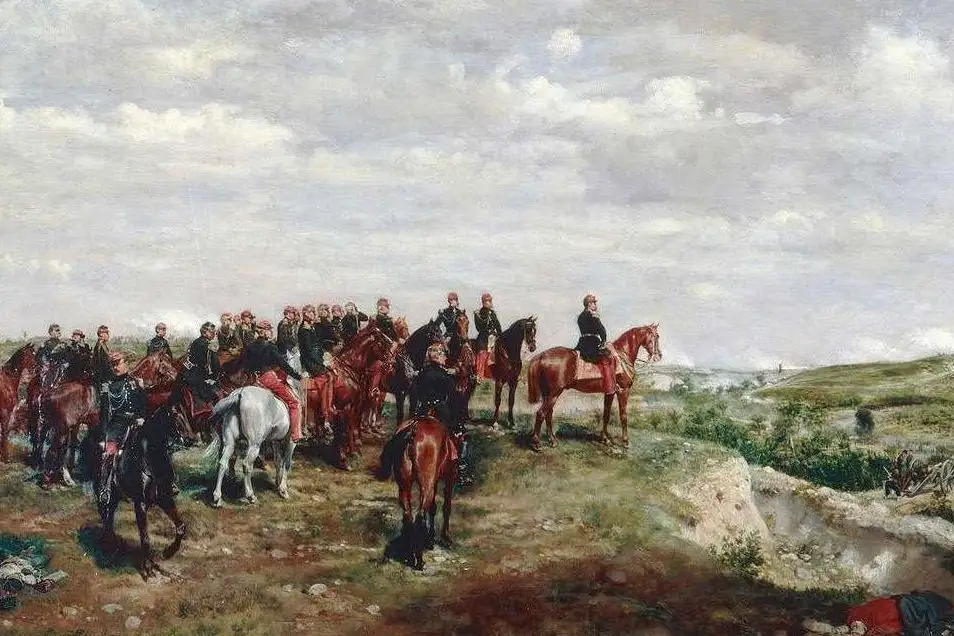

One of the most remarkable artistic figures of our time is, without a doubt, Ernest Meissonier. His originality found its formula without hesitation; from his very first steps, he set foot on the path he still travels today with such a firm gait.
In those early attempts, where a painter seeks his own identity through imitations and reminiscences, Meissonier was himself from the start. He did not, of course, possess the same emphasis, relief, and distinct character that define him now, but he was already quite separate from the others, a true master of his domain, and forever recognizable to even the most inattentive eye. A rare thing, Meissonier's talent had, from its inception, its own home—a Dutch house, built at the end of the 17th century, with a stepped-gable roof, small leaded-glass windows, old oak paneling, brass chandeliers, faded tapestries, blue and white earthenware, and furniture with turned legs. It was a calm sanctuary where a discreet light descends in the silence, and where not a single atom of dust ever floats. This is where his painting lived, waiting for him to come and lodge there himself. For the artist, in his delightful house in Poissy, which he could sign as one of his canvases, has brought several of his paintings to life with the same will, finish, and perfection he applies to all things. There are rooms in it that ought to be framed; they are almost as valuable as the master's paintings, of which they are the copies.
An Illustrator's Eye
The first time the name Meissonier caught our attention was at the office of the publisher Curmer, who showed us, with admiring satisfaction, an illuminated fleuron, or decorative emblem, crafted in the style of medieval miniaturists for one of those beautiful books in which he delighted in pitting modern typography against Gothic calligraphy. The artist's monogram, an E back-to-back with an M, which he has kept to this day, already marked this charming design, but it still designated an unknown. Curmer gave us the key, and soon we found the two joined letters at the bottom of the marvelous illustrations for La Chaumière indienne (The Indian Cottage). These were a prodigy of finesse, accuracy, and local color, where all of India is summarized in woodcuts a few centimeters in size, with all its strange types, vegetation, and architecture. One might think it the work of some painter attached to the Dutch East India Company in the last century, who had pushed on from Batavia to Masulipatnam or Chandernagore.
We insist on these vignettes—ingeniously composed, witty, and humorous—because they indicated a vein of talent in the young artist that his success in painting soon diverted him from pursuing: the art of illustration. It is impossible to better understand an author's sentiment, spirit, and style than Meissonier did in interpreting the work of Bernardin de Saint-Pierre. Indeed, it was from this very illustration, so lovingly cared for in its microscopic details, that the painter borrowed the subject of the first painting he exhibited, to our knowledge. This small picture reproduces the vignette where we see the honest doctor, returned from his journey, smoking the pipe his pariah friend had given him as a gift in his armchair.
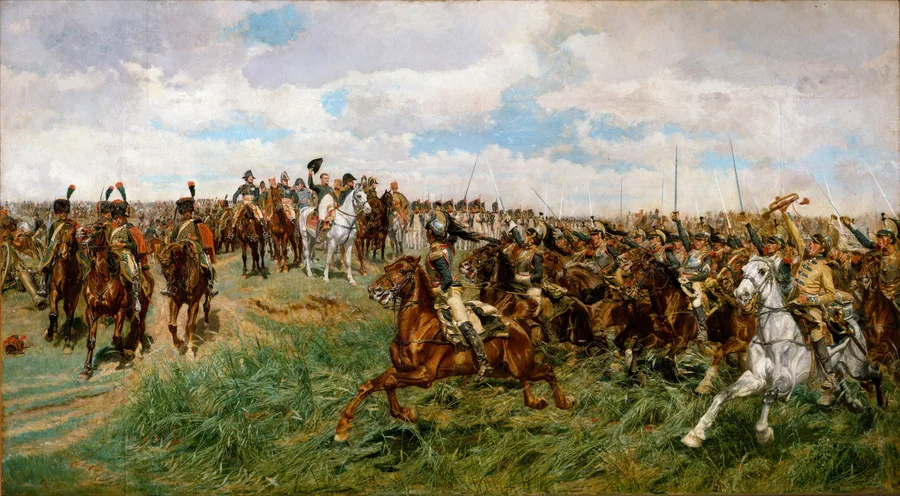
This Doctor, a work of great color finesse and already masterful execution, was followed by a Monk at a Sick Man's Bedside, then a Man Smoking His Pipe—a long, white clay pipe—and soon after, a Beer Drinker. From that moment on, the public had its eyes on Meissonier, and the favor he so richly deserved has never left him.