
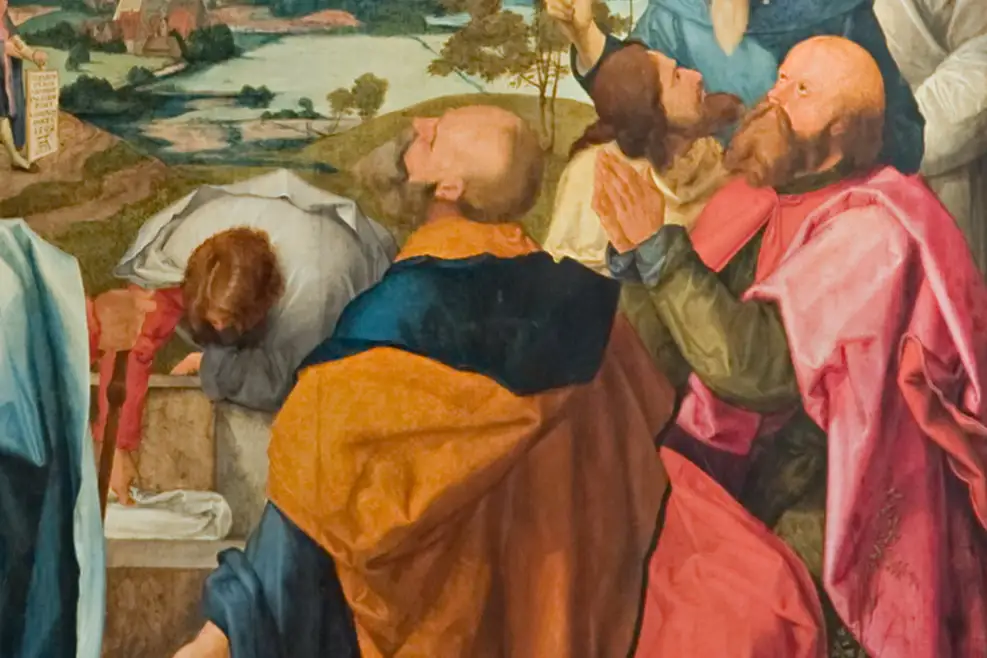
"I wish to take no account of my trouble, provided that I achieve a result that does honor to both you and me." So wrote Albrecht Dürer in the fifth of his letters to Jacob Heller. The work to which he alludes is the important triptych known in Germany as the Heller Altarpiece. This vast composition will be the subject of our study.
We will begin with a short biography of Jacob Heller, whom Dürer brought into his own immortality by creating this grandiose work for him. We will then attempt to describe the central panel and the two wings, and we will provide the first French translation of the nine letters Dürer addressed to Heller concerning this triptych. These letters will offer us the opportunity for some reflections on the material conditions of German art at the beginning of the 16th century.
The Patron: Jacob Heller
Jacob Heller was born around 1450 to an old and wealthy Frankfurt family, which owned the Firnburg court in that city, now known as the Hellerhof. A member of the powerful drapers' guild of Frankfurt, he married Catherine de Melem, the daughter of an opulent patrician, in 1482. He then purchased the Nuremberg court, where he lived until his death and where, in 1517, he hosted Emperor Maximilian I and his retinue.1
He held high offices in his native city and was entrusted by it with important missions abroad. In 1505, he traveled to Gelnhausen to pay homage to Maximilian on behalf of his fellow citizens. In 1506, he was part of a five-member deputation sent to meet the ambassadors of the King of France, who had come to Frankfurt to visit the Emperor. We find him again as a representative of the city of Frankfurt at the Congress of Augsburg, where the alliance of the Pope, Maximilian I, and Louis XII against the Venetians was prepared. After losing his wife in 1518, he died on January 28, 1522.
Heller left a very curious will that reveals certain traits of his character. Preoccupied above all with the salvation of his soul, he regulated with scrupulous exactitude the details of the practices that were to ensure it. He ordered the construction of a shelter for the poor, where a wooden crucifix would be placed bearing the inscription: "Pray to God for Jacob Heller and Catherine Melem, founders, for their parents and their benefactors." Heller also stipulated that a trusted man should go to Rome to make a pilgrimage for the benefit of his soul.
The duration of the journey was set at fourteen or fifteen weeks. The pilgrim was to be supervised by a German priest; throughout the journey, he was to recite thirty Pater Nosters and Ave Marias and three Acts of Faith "with fervor" every day. If he fell ill or died, a replacement was to be sent. Once in Rome, he was to visit, on the first day, St. John Lateran and Santa Maria della Scala Coeli; on the second day, St. Peter's, and have three masses and a Requiem said there, and so on. On the final day, accompanied by the German priest, he was to go to the Abbey of St. Andrew. Heller had visited this abbey during his trip to Rome for the Jubilee of 1500 and had been enrolled there as a member of the Confraternity.
This narrow formalism and meticulous devotion show that Heller had completely escaped the great influence of the Reformation, which so strongly affected Dürer. But he redeemed his simple piety with a certain spirit of benevolence and a rather keen taste for art. Wishing to satisfy both his superstitious piety and his artistic instincts, he commissioned two works that rank among the most accomplished pieces of German sculpture and painting: the Crucifix in the cemetery of the Frankfurt Cathedral and the altarpiece that concerns us here.2