
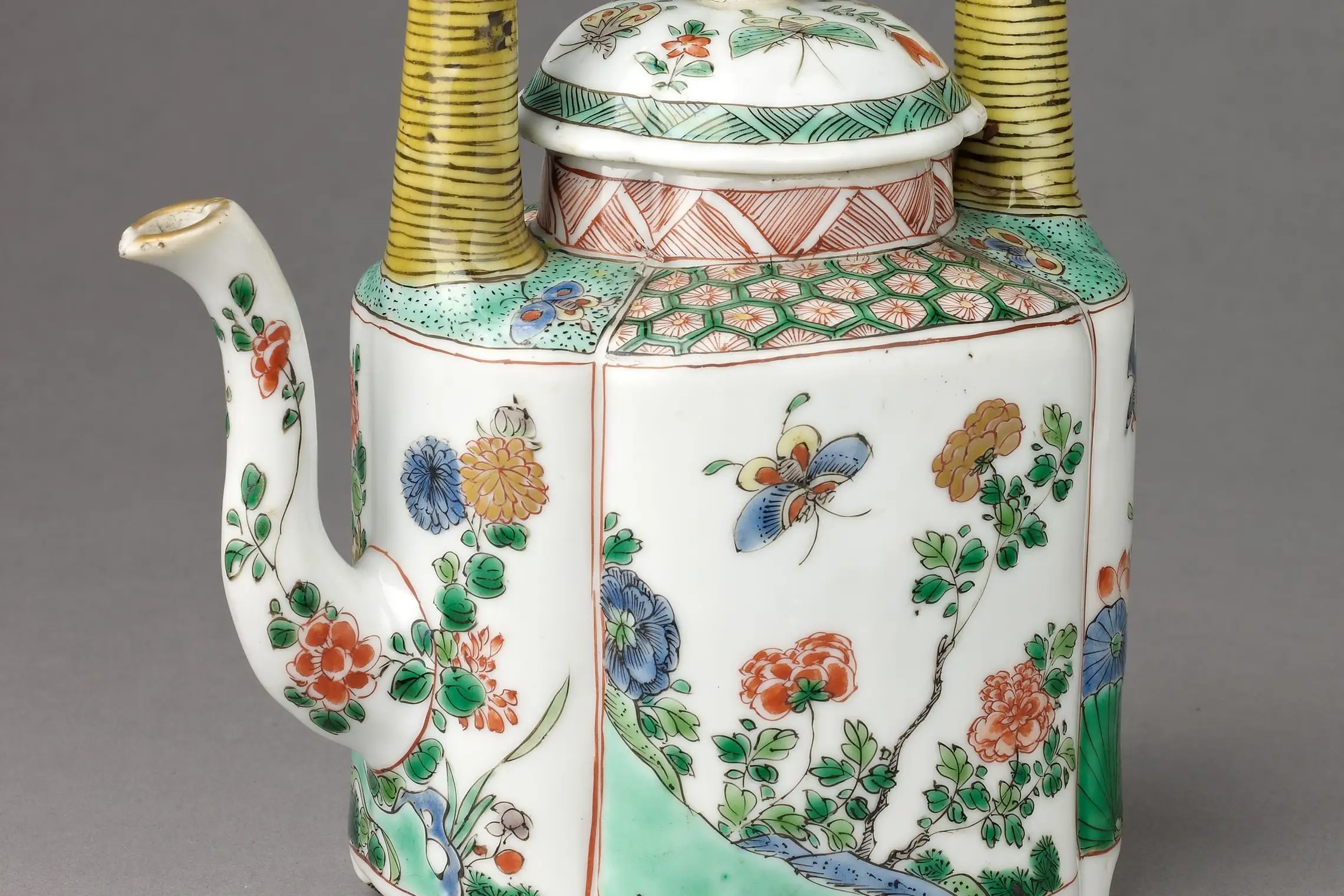
An official work on Italian faience and an article intended to reduce a pseudo-scholar's book to its proper value—that is to say, to very little—have made me a "ceramographer," if you will pardon the term. No matter what I do, even if I were to smash all the crockery while crying out against "faience-mania," a ceramographer I am, and a ceramographer I must remain. As M. Albert Jacquemart cannot speak of his own book here—which would be the best way to make it known—it falls to me to discuss it with our regular readers. May they forgive the pseudo-critic for his faults!
There is certainly much to be gained from frequenting the writings of our learned collaborator, for with him there is always a great deal to learn. But why, of the three volumes on ceramics he is to publish in the "Bibliothèque des Merveilles" (Library of Marvels), did he have to begin with the first? It would have been much more pleasant for me if he had set aside this Oriental art, for which I have never felt anything other than admiration or covetousness, without ever being troubled by that need to know the why and how of things that possesses and grips me when it comes to other subjects.
I used to admire "the glue of enamel where the sun is caught," and that was enough for me. I hardly suspected that the chubby-cheeked magots (Chinese figurines) "who go gathering blooming peonies from the blue bushes of painted landscapes" were presenting me with a mark of classification. For me, everything about these elegantly contoured vases was fantasy—the form, the color, the subject. It had never entered my mind to notice that those little figures "whom the varnish holds attached to the vases" belonged to "the green family," while "the beautiful ladies seen smiling at their large parrots" were of "the rose family."
Learning of these mysteries has somewhat tarnished the China I had imagined, a land more capricious in its arts than the tangled line Uncle Toby once traced with the tip of his cane. But no matter. The spell is broken, and I must now walk the straight paths of classification instead of wandering the winding trails of fantasy. This classification, which at first seems arbitrary and, to be frank, as bizarre as the objects to which it applies, becomes simplified and extremely clear when one follows its evolution in the charming collection where M. Albert Jacquemart has brought it to light.
Countless cups, aligned in front of their saucers standing upright against the back of the cabinet, stretch out over some ten meters. Their ranks, like the different corps of an army, are distinguished by the color of their livery. Here, what escapes the eye in the ordinary jumble of chinoiserie collections—arranged for pleasure rather than for the justification of an idea—leaps out, so to speak.
Archaic Wares and Natural Imitations
First are the archaic porcelains, those in which the potter, seeking to rival nature, gave the porcelain glaze the cool green of jades or the warm carmine of agates, with the matte transparencies of sardonices. They feature the milky whiteness of shells, sometimes turning to an ivory yellow; the deep blue of lapis lazuli; the amber yellow of rattan; or the glaucous roughness of rocks amidst which gray crabs lie in wait. In these distant epochs, the semi-transparent paste still oscillates between stoneware and porcelain.
The accidents and hazards of firing gave the Chinese new decorative motifs. Here they used "crackle" (craquelé), there "trout-like" (truité) crackle, which imprison the vase in their uneven mesh as if in a net. Elsewhere, the flambé or "flamed" glaze flickers on its sides like the flame of a hearth.