
The sky has always been a repository for impossible desires. For millennia, to navigate the air was a fantasy reserved for gods, angels, and the doomed Icarus—a dream belonging to mythology, not mechanics. Yet by the middle of the eighteenth century, a new kind of mind, sharpened by the logic of the Enlightenment, began to look upward not with poetic longing but with a measuring eye. This was an age that believed the universe was a grand clockwork mechanism, and that even the heavens would yield their secrets to reason, geometry, and patient observation. The question of flight was slowly migrating from the realm of fable to the pages of natural philosophy. And it was here, in a slim volume from a provincial press in Avignon, that one of the most vital and fantastical conceptual leaps was made, not by an engineer or an adventurer, but by a Dominican friar obsessed with the weather.
In 1757, Father Joseph Galien, a professor of philosophy and theology, published L'Art de naviguer dans les airs. On its title page, he called it an “Amusement physique et géométrique,” a physical and geometrical amusement. Yet this modest, almost playful, description belied the sheer audacity of the thought experiment within. Galien proposed the construction of a vessel not of wood and sail, but of canvas and air; a craft of such impossible scale that it would rival the very city of Avignon in size. His theoretical airship was born from a strange intellectual parentage: a meticulous study of the formation of hail. In puzzling over the physics of what falls from the sky, Galien stumbled upon the fundamental principle of how to rise into it.
A Theology of the Atmosphere
Joseph Galien was a man steeped in the rigors of scholastic thought. Born in 1699 near Le Puy-en-Velay, he had spent his life in the Dominican Order, ascending through academic ranks to hold chairs in both theology and philosophy at the University of Avignon. His world was one of structured argument and divine order. Yet in 1751, he resigned his professorships to dedicate himself entirely to a more chaotic and unpredictable subject: the earth’s atmosphere. He turned his formidable intellect from metaphysics to meteorology, a field that was, at the time, a frontier science, rich in folklore but poor in verifiable data.
His primary fascination was with hail—the destructive, seemingly capricious phenomenon that could ruin a harvest in minutes. Where others saw an act of God, Galien sought a physical cause. In 1755, he published his first thoughts on the matter in an anonymous booklet, Mémoire touchant la nature et la formation de la grêle, a memoir on the nature and formation of hail. His theory, based on observation and deduction, was that the atmosphere was not a uniform whole, but a series of distinct layers. He posited a cold, dense lower layer of air and, above it, a lighter, warmer, and less dense region where hailstones were formed. It was in this stratification, this layering of aerial fluids of different densities, that he located the engine of the storm.
Though his meteorological model would be superseded, its core premise contained a revolutionary seed. For Galien, this insight into the structure of the atmosphere was not an end in itself. His scholastic training had taught him to pursue the logical consequences of a proposition to their ultimate conclusion. And so, in his treatise on hail, he included what he called a “conséquence ultérieure”—a further consequence. If the air was indeed a layered ocean of varying densities, could a vessel be built to float upon it, just as a ship floats upon the sea? The study of hail had become the unlikely prolegomenon to the art of aerial navigation.
The Geometry of an Impossible Dream
The second edition of his work, published in 1757 under his own name, made this “further consequence” its main attraction. Retitled L'Art de naviguer dans les airs, it laid out his astonishing proposal. The project was an exercise in pure reason, a geometrical proof scaled to the size of a city. Galien imagined a colossal rectangular craft, an ark made of reinforced taffeta or canvas, with a volume so immense it could displace a sufficient weight of the denser, lower air to achieve buoyancy. He calculated its dimensions to be larger than Avignon itself, capable of lifting a payload equivalent to the city’s entire population, its buildings, and its armies.
This was not a blueprint for craftsmen; it was a thought experiment for philosophers. The means of its inflation were as theoretical as its scale. Galien, believing the upper atmosphere—his “région de la grêle”—to be composed of a fundamentally lighter kind of air, proposed that his empty vessel be somehow hauled to a mountaintop. There, its valves would be opened, and it would fill with this superior, buoyant air, ready to be crewed by ‘aérostatiers’ who would navigate the atmospheric currents.
The practical flaws are, to the modern mind, immediately obvious. The materials could not have supported the structure; the air at high altitudes is thin, not fundamentally different; the logistics of construction and inflation were pure fantasy. Galien’s airship was destined to remain forever moored on the page. But to dismiss it as a folly is to miss the staggering intellectual achievement. He had correctly identified the essential principle of aerostation, twenty-six years before it would be physically demonstrated. He had grasped that flight was a matter of buoyancy, a game of densities. The core idea—that an envelope containing a medium less dense than the surrounding air will rise—was perfectly sound. He had grasped the why, even if his proposed how was impossible. He was applying the ancient principle of Archimedes not to water, but to the invisible ocean above.
An Amusement for an Age of Inquiry
That Galien himself framed his work as an “amusement” is telling. In the mid-eighteenth century, science had not yet fully professionalized. It was still the domain of the gentleman scholar, the curious cleric, the amateur philosopher. Public lectures with dramatic chemical reactions and electrical demonstrations were a popular form of entertainment. Natural philosophy was a serious intellectual pursuit, but it was also a source of wonder and spectacle. Galien’s subtitle places his work firmly in this cultural milieu. It was a serious speculation presented with a light touch, inviting the reader to marvel at the logical possibilities unlocked by new scientific understanding.
He was not working in a vacuum. The dream of aerial navigation had other proponents, most notably the Italian Jesuit Francesco Lana de Terzi, who in 1670 had proposed a flying boat lifted by four large copper spheres from which all the air had been evacuated. Lana’s concept, like Galien’s, was theoretically sound in its physics but practically impossible due to materials science—the copper spheres would have been crushed by atmospheric pressure. Galien, building on thinkers like Lana and the German Gaspar Schott, advanced the conversation. Instead of a vacuum, he proposed a different, lighter gas—even if his candidate for that gas was imaginary. He shifted the problem from creating nothingness to finding and containing somethingness of a different quality.
His book, therefore, is a perfect artifact of the Enlightenment mind: rational, audacious, systematic, and imbued with an unshakeable confidence in the power of human reason to model and eventually master the natural world. It was a work of physics presented as a diverting puzzle, a mathematical proof of a miracle.
The Spark in Annonay
For a quarter of a century, Galien's airship remained a theoretical curiosity, a footnote in the burgeoning literature of natural philosophy. The professor died around 1772, his dream unrealized. Yet the idea he had set loose was adrift in the intellectual atmosphere of southern France, waiting for a different kind of mind—not of a theoretician, but of a practical inventor.
In the town of Annonay, not far from Galien’s own birthplace, two paper-making brothers, Joseph-Michel and Jacques-Étienne Montgolfier, were also fascinated by the sky. Like Galien, they had a keen interest in meteorology and the new sciences. It is certain that they were familiar with his work. And it was they who found the key that unlocked his theoretical cage.
One evening, watching sparks and smoke rise from a fire, Joseph Montgolfier had the crucial insight. He saw, in the billowing currents of heated air, a practical demonstration of the principle of varying density. They did not need to climb a mountain to find Galien’s mythical light air; they could manufacture it on the ground with a simple fire. Hot air is less dense than cool air. It was the simple, achievable solution to the problem Galien had so brilliantly, if impractically, defined.
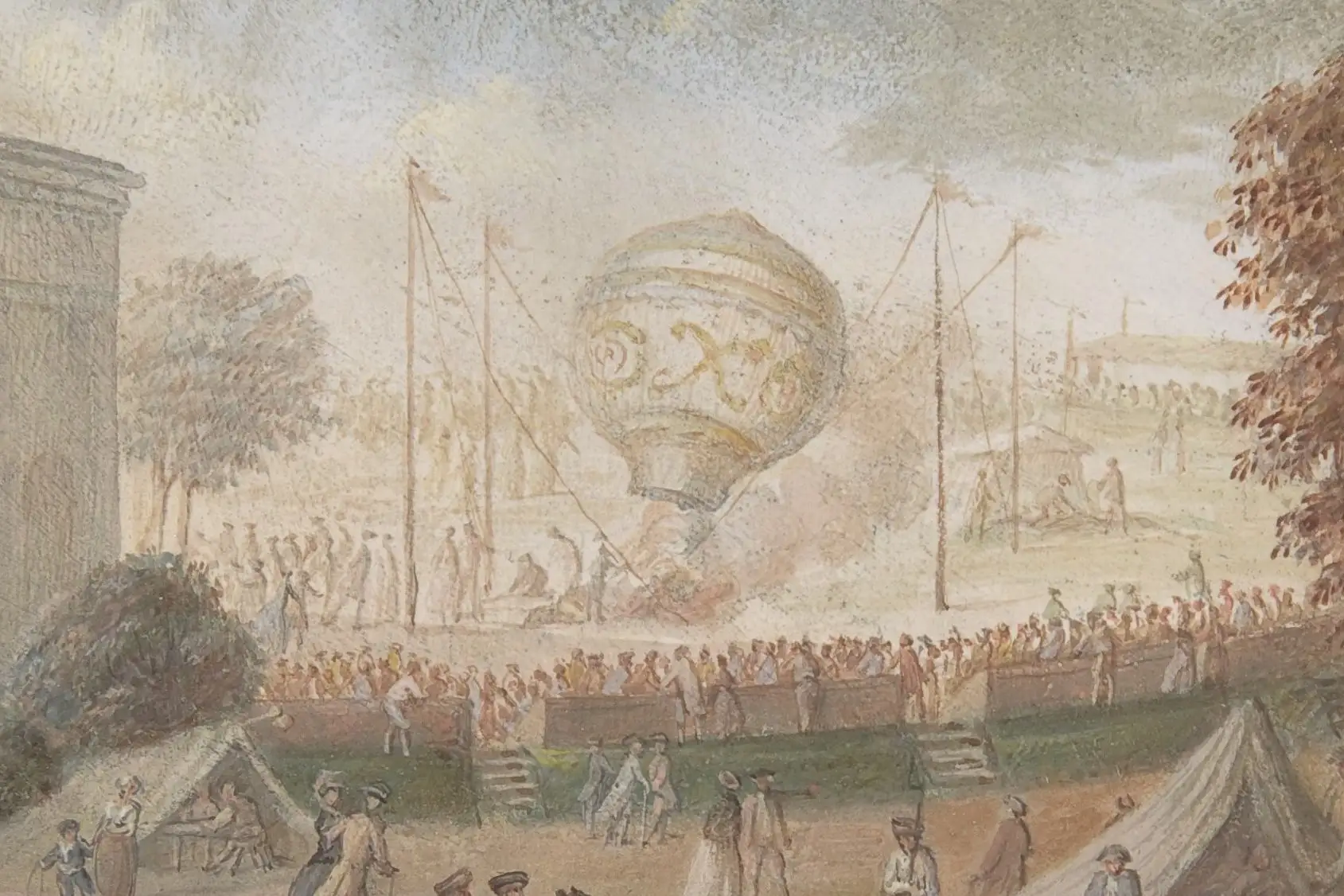
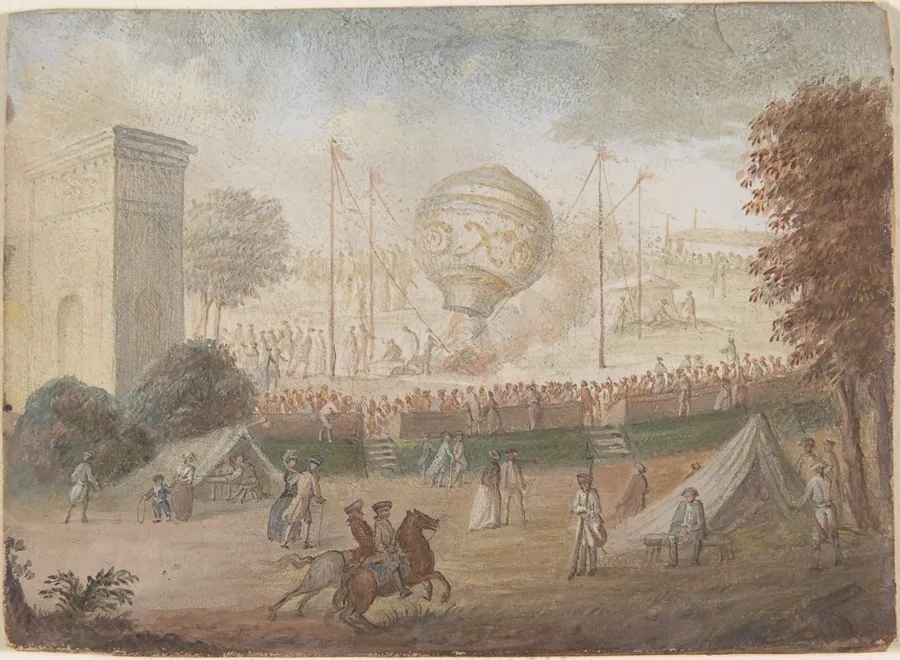
The Montgolfiers began experimenting, first with small silk bags held over a flame, then with larger and larger envelopes. In 1782, the elder brother made a first, private ascent at Avignon—the very city Galien had used as the measure of his theoretical craft. The link between the Dominican’s theory and the paper-maker’s practice was sealed. In June 1783, they made their first public demonstration at Annonay. By November of that year, Pilâtre de Rozier and the Marquis d'Arlandes were drifting over Paris in a Montgolfier balloon, the first free-flying humans in history. The age of flight had begun.
The Unmoored Ark
The Montgolfiers are rightly celebrated as the pioneers of aviation. But their triumph was the culmination of a long chain of reasoning. Father Joseph Galien stands as a crucial, indispensable link in that chain. His contribution was not a working machine, but something more fundamental: a correctly formulated idea. He built a ship of pure reason, a vessel of logic so vast and unwieldy it could never be constructed, but which carried within its imaginary hull the precise concept that would enable all subsequent flight.
His L'Art de naviguer dans les airs is a monument to a particular kind of scientific progress—one that proceeds not just through successful experiment, but through bold, flawed, and magnificent thought experiments. It reminds us that before a thing can be built, it must first be imagined according to the right principles. Galien’s city-sized ark never left the page, but it showed the Montgolfiers that there was an atmospheric ocean to sail, and a principle of buoyancy on which they could rely. The quiet Dominican’s “amusement,” born from a meditation on falling ice, had shown humanity how to ascend into the clouds.
Seen at auction: Forum Auctions