
The Business of Salvation
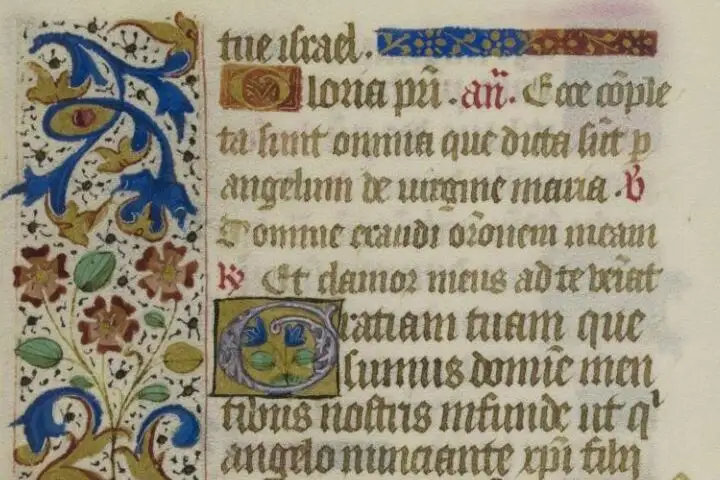
In the 1470s, the city of Rouen was a creature of commerce and law. Situated on the Seine, it was a vital artery of trade, its ports crowded with vessels, its courts humming with the language of contracts and disputes. Still bearing the scars of the Hundred Years’ War, the Norman capital was rebuilding itself not just with stone and mortar, but with a renewed sense of civic identity. Power here was not solely the preserve of the cathedral’s canons or the landed nobility. It was increasingly wielded by a new class: the échevins, the city’s lay judges and magistrates. These were men of substance and learning, their authority rooted in the administration of the city, their wealth drawn from the very trade that gave Rouen its lifeblood. And like all powerful men of their age, they understood that authority must be made visible. It required a uniform, a coat of arms, a visual grammar. For this rising urban elite, that grammar would find its most exquisite expression not in a public monument, but in the most private of books: a Book of Hours.
At the heart of this cultural moment was a workshop led by an artist known to us only by his commissions. The Master of the Rouen Échevinage, also called the Geneva Latini Master, was the preeminent illuminator in the city from roughly 1450 to 1485. His name itself tells the story: it derives from a series of magnificent devotional books he produced for the very lay judges who governed Rouen. His workshop was not merely a studio of pious artistry; it was a purveyor of high-status luxury goods, a place where spiritual devotion was rendered in the tangible, costly language of power. To commission a Book of Hours from this master was to make a statement. It was an act of public piety, certainly, but it was also an assertion of wealth, taste, and a place within the city’s ruling stratum. In an era on the cusp of the print revolution, the hand-painted, bespoke manuscript remained the ultimate symbol of cultural capital, and the Master of the Échevinage was its chief local supplier.
A Calendar for the City
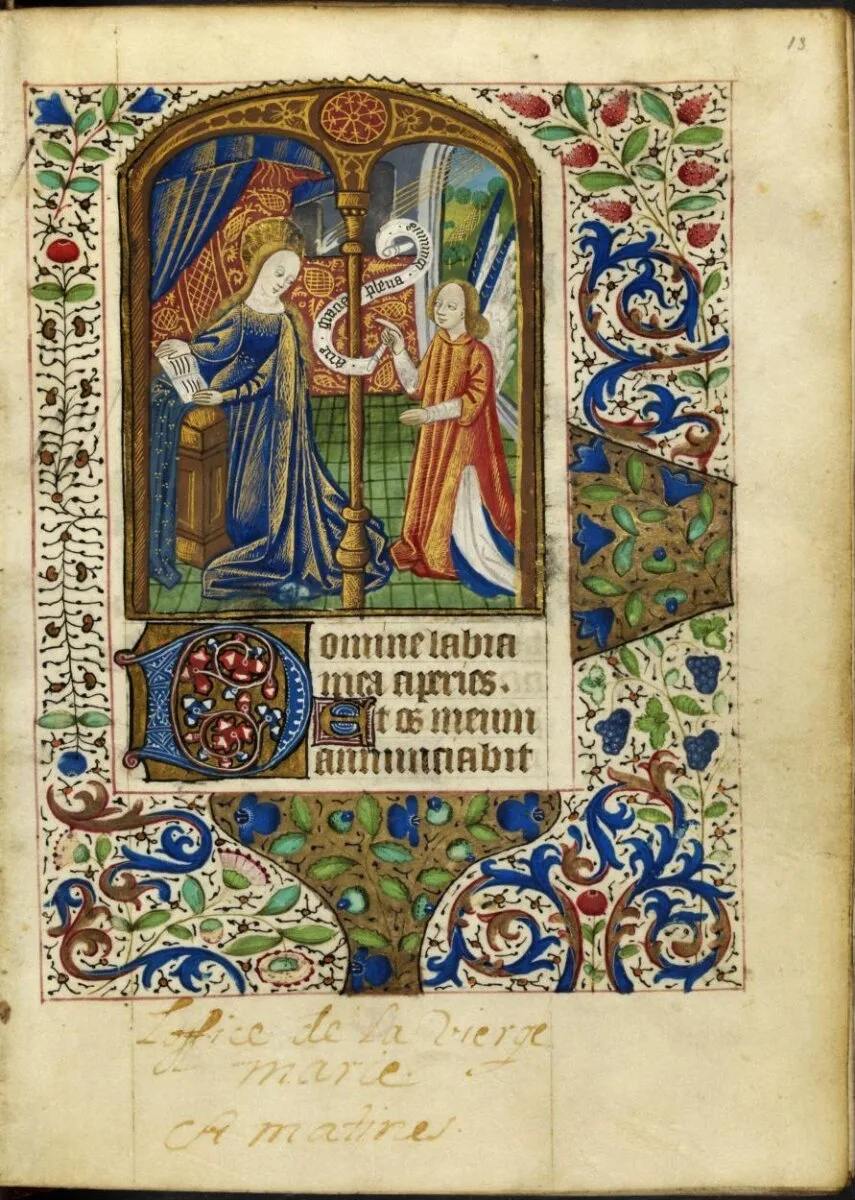
The books that emerged from his workshop were tailored to the specific identity of their patrons and their city. While the core text followed the established liturgical hours, the details were pure Rouen. The calendar pages, which marked the feast days of the Christian year, were carefully customized to what is known as the “Use of Rouen.” This was more than a technical variation; it was an act of civic inscription. Alongside universal saints, the calendar was populated with the city’s own sacred heroes: Saint Romain, the 7th-century bishop famed for defeating a monstrous gargoyle, whose procession was a cornerstone of civic life; Saint Audoen, the Merovingian courtier and patron of the city’s great abbey; and Saint Wandregisil, another founder of Norman monasticism. To open the book was to see the universal story of salvation interwoven with the specific, local history of Rouen’s own streets and stones. The sacred year was mapped onto the civic landscape.
This localization extended to the language. The manuscripts were typically bilingual, with the formal Latin of the liturgy accompanied by captions and prayers in French. This was the natural linguistic environment of the échevin. Latin was the universal tongue of the Church and of classical learning, a mark of their education. French was the language of the law courts, of commerce, of the household. The book’s dual languages reflected the dual lives they led: men of God who were also, and perhaps primarily, men of the city. The prayers were not just whispered in an ancient, sacred tongue; they were read and understood in the vernacular of daily administration. This linguistic blend made the act of devotion both universal and deeply personal, connecting the owner to the great sweep of Christendom and the immediate reality of his Norman identity.
The Grammar of Gold and Vellum
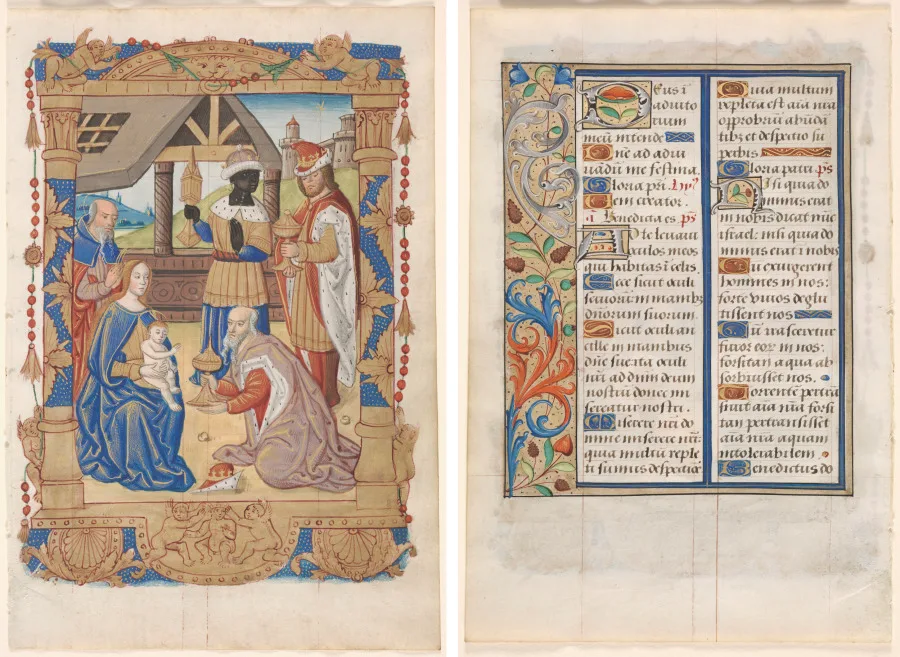
If the text grounded the book in Rouen, its art proclaimed the owner’s status to the world. The Master of the Échevinage developed a signature style of breathtaking opulence and technical precision. Each of the twenty-nine or more full-page miniatures in a typical manuscript was a marvel of composition and color, demonstrating a masterful play of light and space. The pigments, derived from precious minerals, retained their jewel-like vibrancy even after five centuries: deep lapis lazuli blues, rich reds, and verdant greens, all set against the luminous glow of burnished gold leaf. The use of gold was not merely decorative; it was symbolic, signifying the divine light of heaven. But it was also a frank display of wealth. The sheer quantity and quality of the gold leaf spoke volumes about the patron’s ability to command the finest and most expensive materials.
The pages were surrounded by elaborate borders, a hallmark of the workshop’s style. These were not simple geometric frames but teeming ecosystems of naturalistic detail. Acanthus leaves curled in intricate patterns, interwoven with realistic depictions of flowers, fruits, and berries native to the Norman countryside. Peeking from within this foliage were often tiny, fantastical creatures—zoomorphic figures, grotesques, and drolleries—that added a touch of secular whimsy to the sacred text. This style, which absorbed influences from the great Flemish masters, was a statement of cosmopolitan taste. It showed that Rouen’s elite were not provincial; they were connected to the major artistic currents of Northern Europe. The very artistry of the book—its sophisticated design, costly materials, and flawless execution—functioned as a form of non-verbal rhetoric. It argued for the patron's discernment, piety, and, above all, his worldly success. This was not the stark, ascetic devotion of a monastery; this was the lush, confident faith of a man who had prospered in the world and sought to sanctify that prosperity.
The Book in Hand: Private Devotion, Public Persona
For an échevin or a wealthy merchant, the Book of Hours served a dual purpose. In the privacy of a personal chapel or study, it was a guide to the soul, its miniatures providing focal points for meditation on the life of Christ and the Virgin Mary. The daily rhythm of its prayers—Matins, Lauds, Prime, Terce—structured the day, sanctifying the mundane hours of a life spent in legal and commercial pursuits. It was a tool for forging a personal relationship with God, an intimate spiritual companion.
But the book was never entirely private. It was an object to be seen, handled, and displayed. It might be carried in public procession or displayed on a lectern. It was, in effect, part of its owner’s public persona. The quality of one’s prayer book was a reflection of the quality of one’s soul—and, by extension, one’s social standing. It became an heirloom, a vessel of family identity passed from one generation to the next. The ownership inscriptions that accrue over time on manuscripts like these tell a story of their social life. A Book of Hours from the workshop, for example, records its passage from Françoise Laisné and her husband Etienne Rabet to their daughter Marie in the 16th century. Through these bequests, the book’s initial statement of civic status evolved into a testament to family lineage, carrying the prestige of its first owner forward through time. It was an anchor of identity in a changing world.
The Antiquarian's Gaze
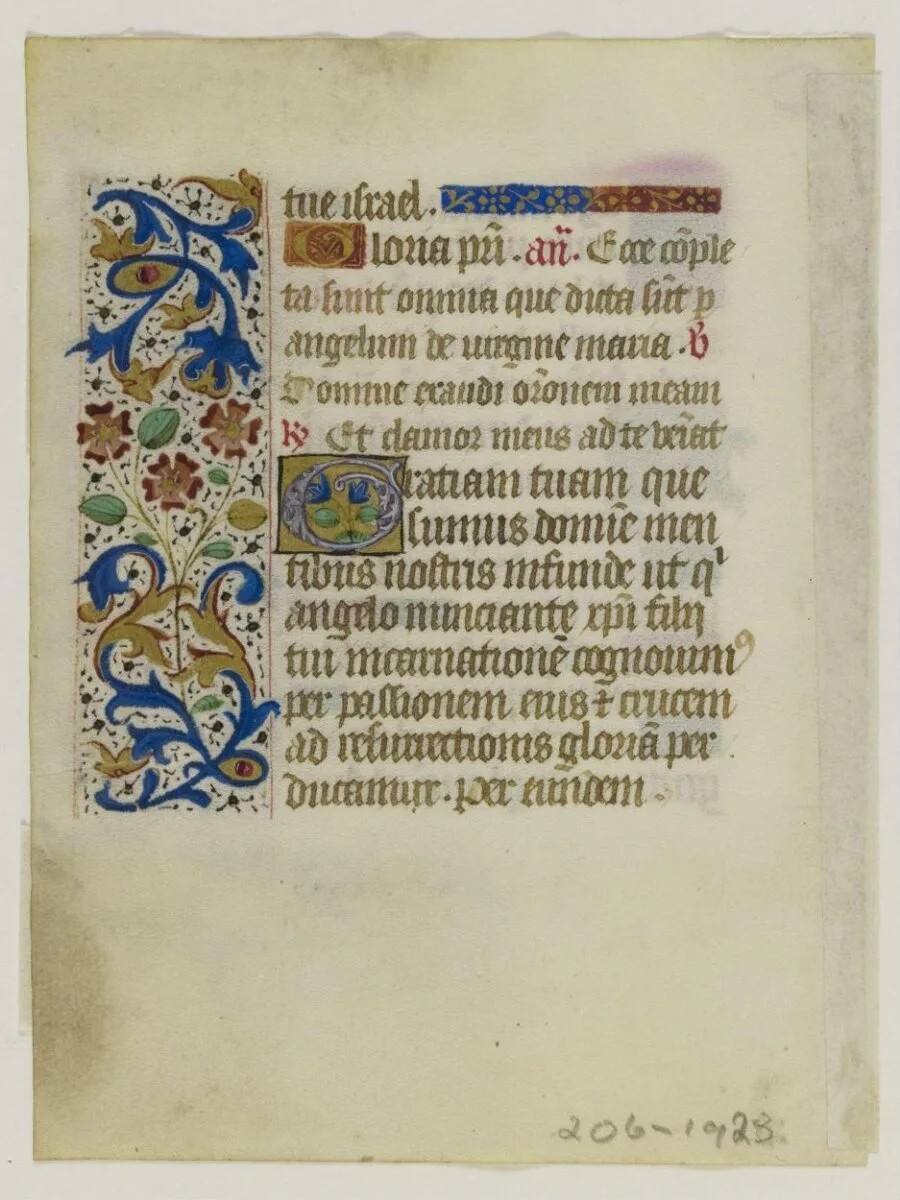
As the centuries passed and the printed book displaced the illuminated manuscript, these objects began a second life. They transitioned from tools of devotion to artifacts of history. The hands that turned their vellum pages were no longer only those of the faithful, but of collectors and antiquarians who saw in them a tangible connection to a lost past. By the 18th and 19th centuries, they were sought after by connoisseurs who valued them for their artistry, their rarity, and their historical associations.
One such owner was Matthew Weld Hartstonge, an Irish poet and antiquarian who recognized the book’s immense cultural and aesthetic value. For Hartstonge and his contemporaries, the manuscript was no longer primarily a prayer book. It was a masterpiece of French art, a relic of late medieval craftsmanship. This shift in perception ensured its survival. It moved from a family treasury to the curated collections of men like the bookseller Leo S. Olschki and the great American collector Henry Walters. Eventually, prime examples of the Master’s work found their way into public institutions like the Cleveland Museum of Art, where they are studied today not just for their religious iconography, but for what they reveal about patronage, workshop practices, and the material culture of the 15th century. Modern facsimile editions even allow a wider audience to experience their splendor, continuing the legacy of an artist whose name we do not know, but whose work speaks volumes.
Ultimately, the books of the Master of the Rouen Échevinage are more than just exquisite objects of religious art. They are legal documents of a sort, evidence of a pivotal moment in the history of a city. In their shimmering gold and vibrant pigments, they capture the self-image of a new, powerful class of secular leaders who were shaping the future of Rouen. These patrons commissioned a reflection of their world: orderly, prosperous, devout, and unapologetically magnificent. The Master did not just illuminate scripture; he illuminated a form of power, turning the private act of prayer into a lasting statement of civic pride.
Seen at auction: Christie's