A Monument on a Fault Line
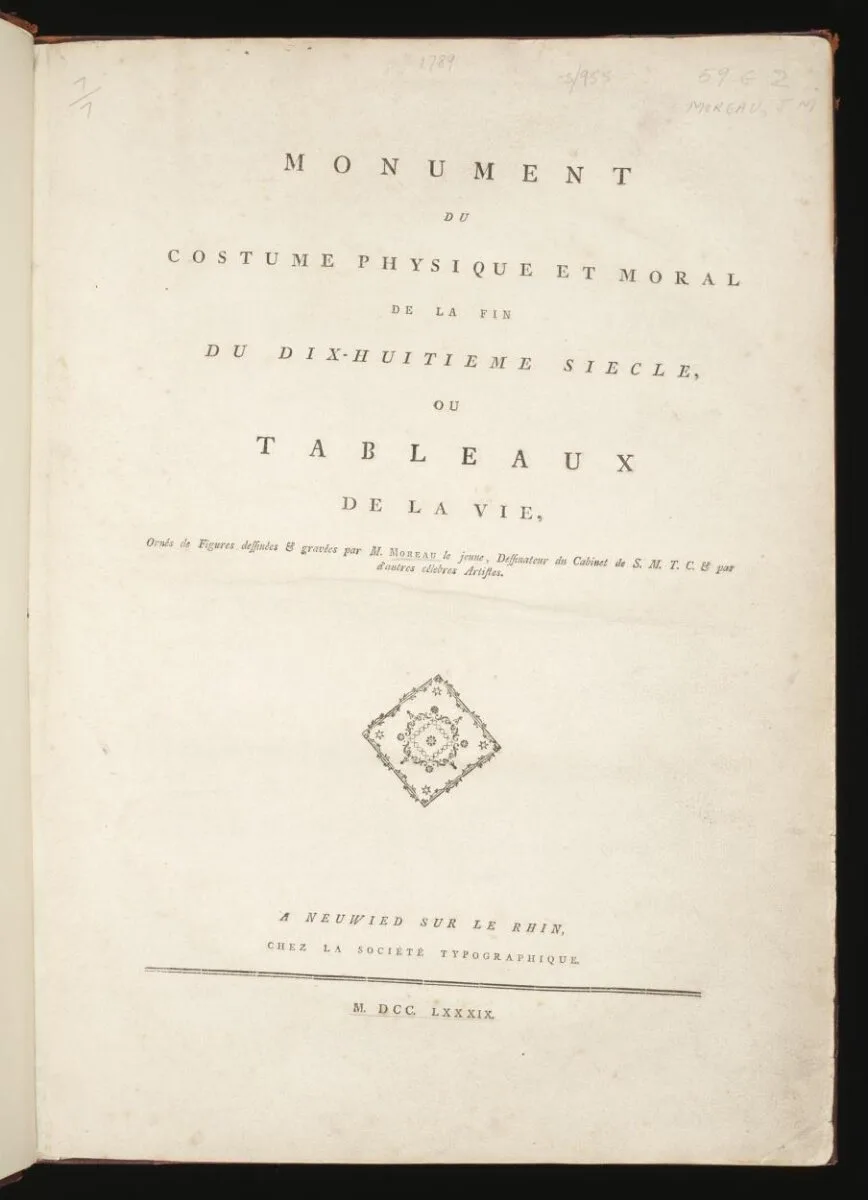
To build a monument is an act of supreme confidence. It is to declare a thing permanent, to carve a moment, a person, or a way of life into the stone of eternity. It presumes a future that will look back with reverence, a stable ground upon which to build, and a consensus on what is worth remembering. In 1789, in the quiet German town of Neuwied on the Rhine, a group of publishers, printers, and artists put the finishing touches on just such a project. Its title was an unambiguous declaration of this confidence: Monument du Costume Physique et Moral de la fin du Dix-Huitième Siècle. A monument to the physical and moral world of the late eighteenth century.
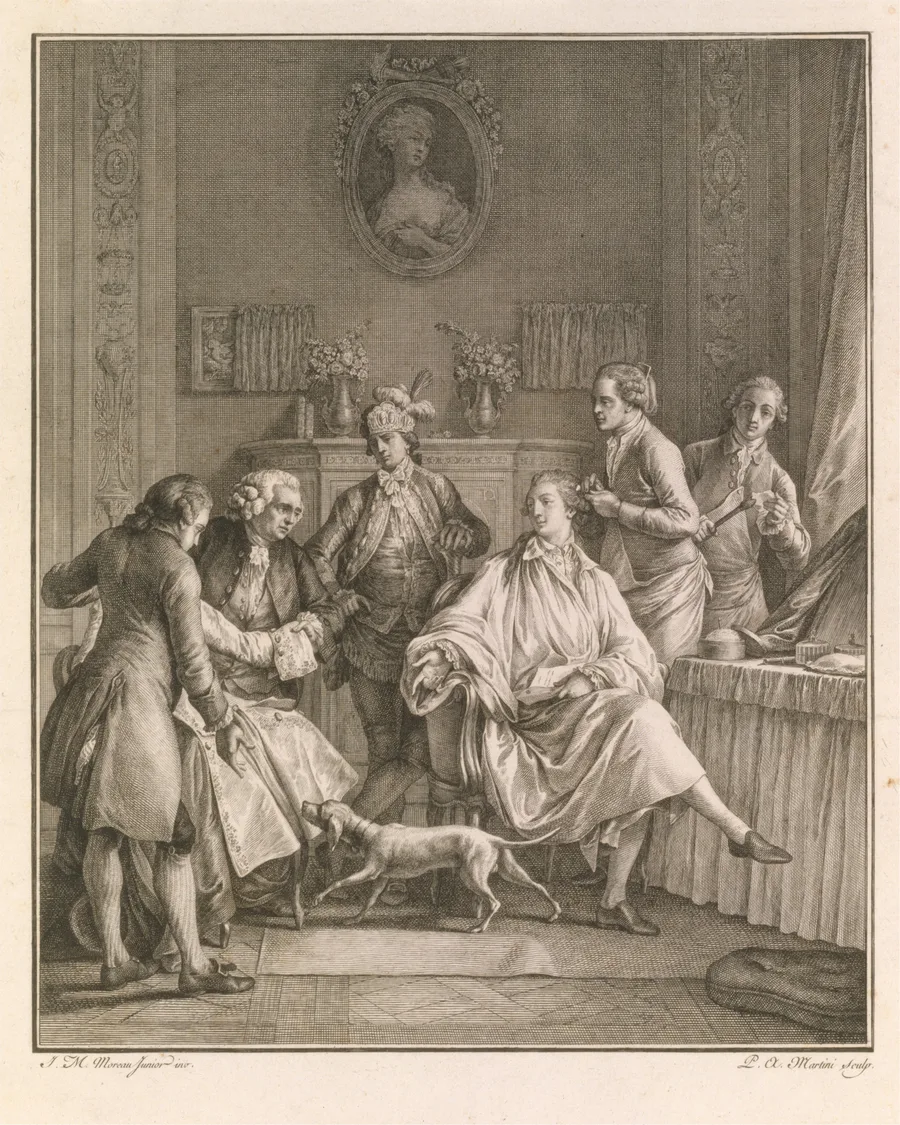
It was a magnificent folio, vast in scale, its pages filled with exquisite engravings depicting the gilded life of the French aristocracy. Here were the rituals of the day, from the intimate morning toilette to the formal farewells, rendered with peerless grace by Jean-Michel Moreau le Jeune, the official Draughtsman of the King’s Cabinet. Here was a world of silk and sensibility, of whispered secrets in manicured gardens and choreographed encounters in grand salons. It was a book designed to be a perfect mirror, reflecting a society at the very pinnacle of its refinement. Yet, as the first copies were being bound, that society was ceasing to exist. The monument was being erected on a fault line, and the ground was already beginning to tremble. The year was 1789. While this book celebrated the codes of an unchanging order, Paris was inventing a new, violent vocabulary of revolution. The Monument du Costume was intended as a celebration of life, a Tableau de la Vie; it became, by the sheer, brutal irony of its timing, the most beautiful and poignant death mask ever made.
A Society in Amber
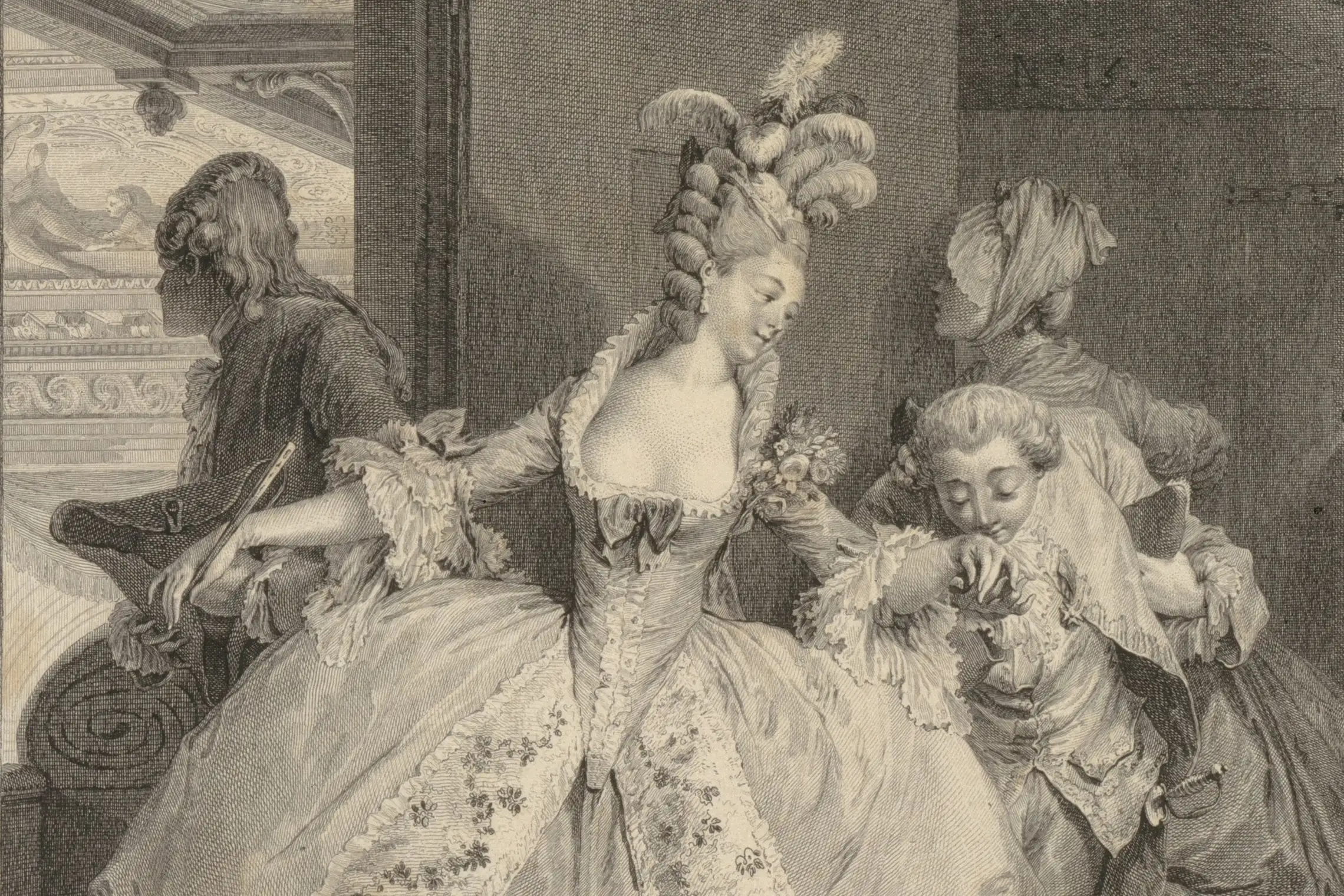
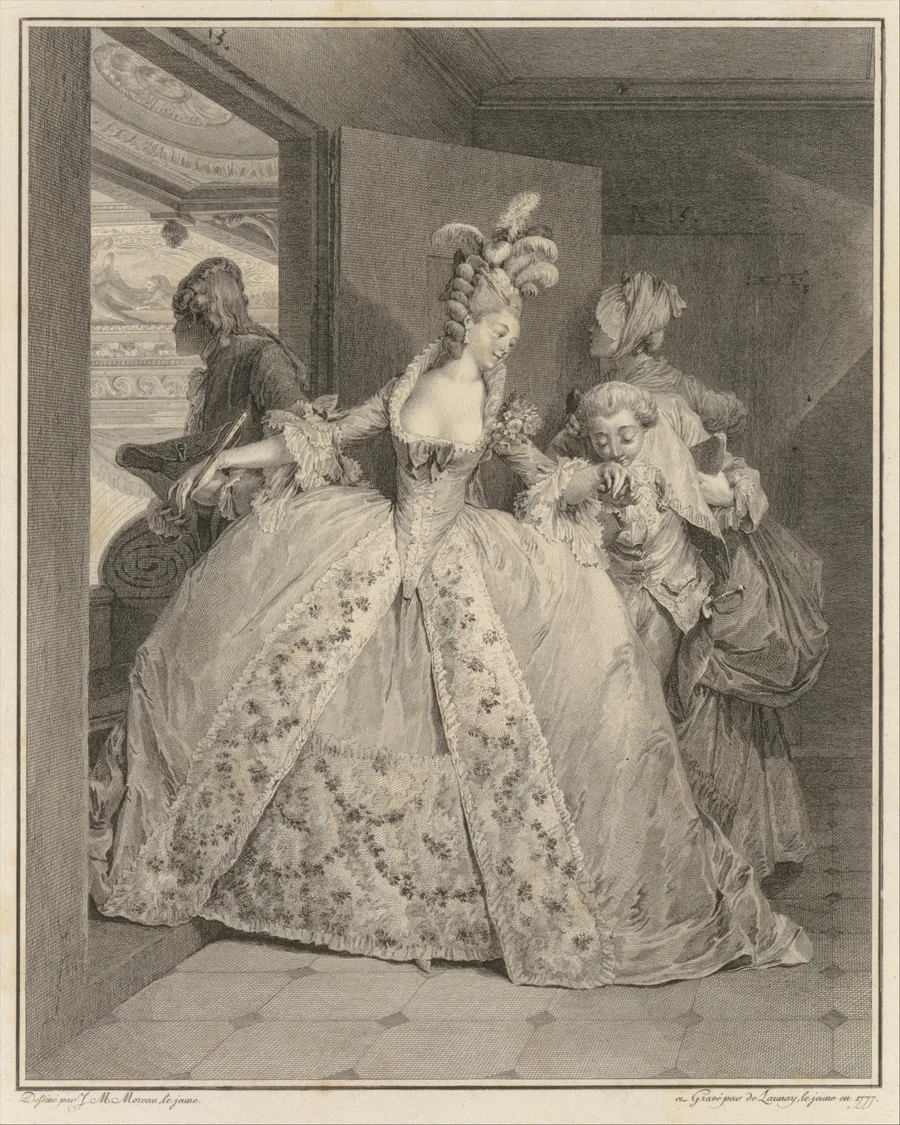
The world captured by Moreau’s graver is hermetically sealed. It is a universe governed not by politics or economics, but by etiquette and aesthetics. The twenty-four plates he designed, supplemented by two from Sigismond Freudeberg, do not depict events so much as they codify moments. We see a young woman having her hair dressed for a ball, the air thick with powder and anticipation. We witness “Les Adieux,” a moment of tender departure so perfectly staged it feels like a scene from a play. In another plate, a suitor makes his declaration, his posture a study in controlled passion, the lady’s response a masterpiece of subtle signaling. This is not journalism; it is choreography.
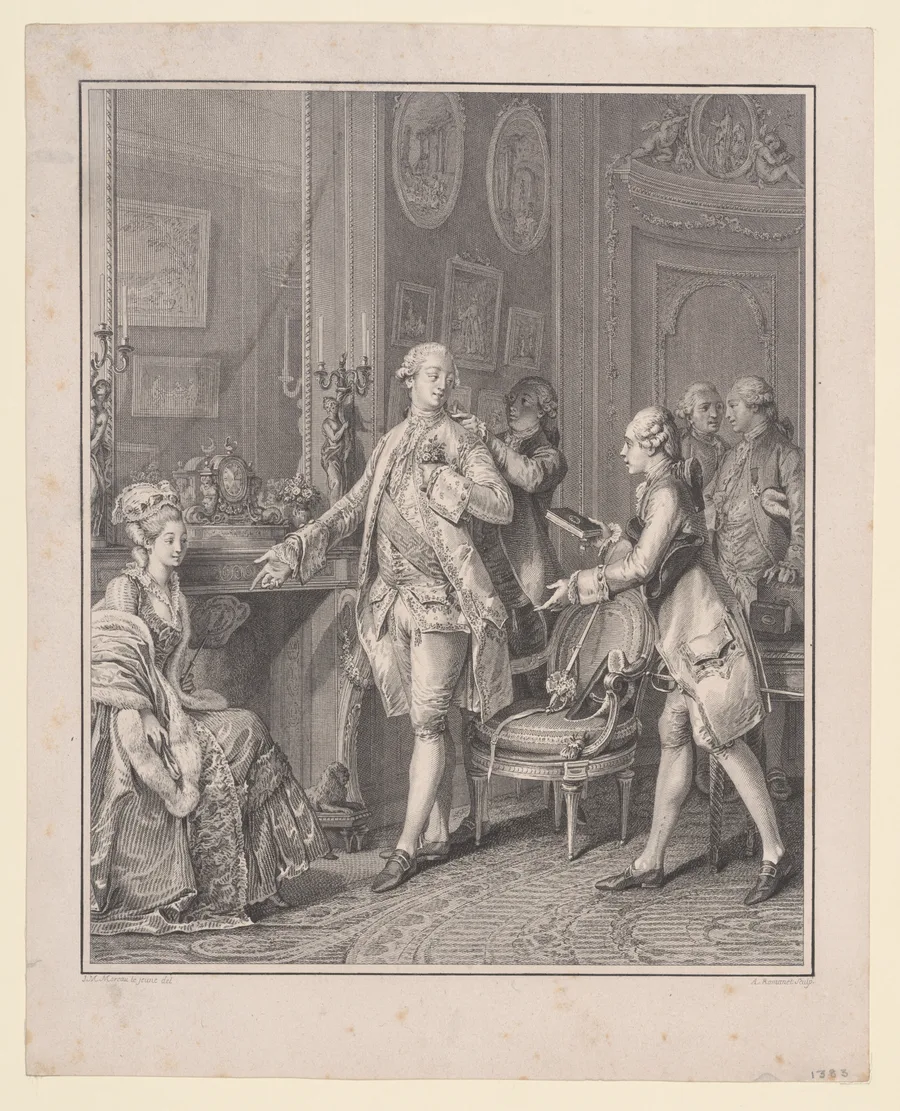
Moreau le Jeune was the ideal artist for this task. As Dessinateur du Cabinet de S. M. T. C. (His Most Christian Majesty, Louis XVI), he was more than an observer of this world; he was an official participant, a master of its visual language. His line is fluid and precise, capturing the sheen of a satin dress or the delicate curve of a hand with equal facility. The figures inhabit opulent interiors, every detail, from the boiserie on the walls to the design of a chair, rendered with an almost documentary obsession. Yet the effect is not one of realism, but of hyper-reality. It is a world polished to such a high gloss that it seems to exist outside of time, preserved in amber. The air is still, the light is perfect, and no hint of the grime, poverty, or discontent of the real Paris intrudes upon these elegant tableaux.
The book was a luxury item for a luxury market, a statement piece for the libraries of the European elite. Its sheer size and the quality of its engravings spoke of wealth and taste. For its intended audience, it was an affirmation. It told them that their lives, their clothes, their manners, their very way of being, were worthy of monumental commemoration. It was a visual consolidation of an identity, a shared language of refinement that stretched from Paris to Saint Petersburg. The figures in the plates are not specific individuals but archetypes: the coquette, the gallant officer, the virtuous mother. They are actors playing their assigned roles in the grand theater of high society, and the Monument was their script and their stage design, bound in red morocco.
The Quill and the Graver
Yet this seamless vision of aristocratic grace was, in reality, a composite, an afterthought. The project did not begin with a unified concept but with a publisher’s commercial impulse. The engravings by Moreau and Freudeberg had been created years earlier, between 1775 and 1783, as two separate suites. The idea to collect them and frame them with a new text came from the publisher Jean-Henri Eberts, a German banker and art connoisseur. To write this text, he hired one of the strangest and most prolific figures in French letters: Nicolas-Edme Restif de la Bretonne.
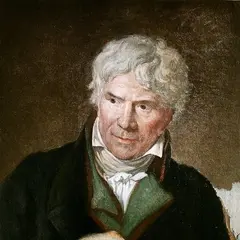
If Moreau was the consummate insider, Restif was the perpetual outsider. A printer by trade and a novelist by compulsion, he was a man of the people, a self-described “Rousseau of the gutter.” He chronicled the lives of prostitutes, artisans, and peasants with a raw, often scandalous, energy that was the polar opposite of Moreau’s polished refinement. He was fascinated and repulsed by the aristocracy in equal measure. His commission was to provide a narrative and moral commentary for images he had no hand in creating.
This shotgun marriage of image and text, a point of focus for modern scholars, results in a “compositional incoherence” that is deeply revealing. The book’s true nature is not that of a singular artistic vision but a commercial package, a collage of pre-existing parts that subtly mirrors the fragmented soul of the society it claimed to represent. Restif’s prose often strains to connect the disparate scenes, weaving moralizing fables around Moreau’s elegant figures. He gives them names and backstories, inventing tales of virtue rewarded and vanity punished. His tone is often that of a scolding sermonizer, a stark contrast to the amoral, aestheticized world of the engravings.
This internal tension is the book’s unintended genius. The friction between Moreau’s graceful surfaces and Restif’s often prurient, moralizing commentary creates a parallax view of the Ancien Régime. We see the world as the aristocracy wished to see itself—elegant, ordered, timeless. And through Restif’s words, we glimpse the voyeuristic gaze of the outsider, obsessed with the codes of a world he does not belong to, trying to impose a narrative of moral consequence onto scenes of pure, untroubled leisure. The artist depicts the performance; the writer tries to peek behind the curtain. The combination reveals more than either could alone: a society performing its own elegance, watched by a world growing increasingly impatient with the show.
A Monument in Exile
The book’s place of publication is another layer in its complex story. It was not printed in Paris, the heart of the world it depicted, but in Neuwied, a small principality on the Rhine known for its religious tolerance and thriving publishing industry. This choice was likely a pragmatic one, a way to circumvent the powerful and restrictive Parisian guilds or perhaps to appeal directly to a broader, pan-European aristocratic market.
But the location adds a powerful symbolic dimension. The Monument was produced at a remove, in exile from its subject. From the tidy workshops of the Société Typographique in Neuwied, the chaos of Paris would have seemed a distant rumor. This physical distance mirrors the psychological distance of the work itself. It is a book about a culture that is already being treated as an artifact, a phenomenon to be cataloged and described from the outside. The German publication site reinforces the sense that this world, even before the Revolution, was becoming a spectacle for others, its customs a subject for anthropological study.
In this serene setting on the Rhine, the team could assemble their grand folio, insulated from the rising political temperature in France. The project was one of recollection, not of immediate reportage. It looked back to the fashions and manners of the 1770s and early 1780s, framing them as the definitive statement of the era. The book was, by its very nature, nostalgic, an attempt to fix a fleeting moment before it faded. What no one in Neuwied could have known was that they were not merely preserving a recent past, but embalming a civilization.
An Epitaph in Real Time
There is no more dramatic juxtaposition in the history of the book than the content of the Monument du Costume and the events of its publication year. As the printers pulled the large folio sheets from the press, the Estates-General convened at Versailles. As the engravers’ plates were meticulously inked, the Third Estate declared itself the National Assembly. While binders stitched the quires, the citizens of Paris stormed the Bastille.
The very title, Monument, became a mockery with each passing month. A monument to what? To a social order whose foundations were being systematically dismantled? A monument to the “physical and moral customs” of a class that was about to be stripped of its privileges, its property, and, for many, its life? The book is a document of profound, almost sublime, obliviousness.
Imagine a Parisian aristocrat in that fateful year, receiving their subscription copy. They unwrap the magnificent volume and gaze upon a plate titled “La Sortie de l’Opéra.” They see the elegant crush of finely dressed figures, the social ritual of being seen, the familiar architecture, the liveried servants. It is their world, rendered permanent and beautiful. But as they look up from the page, the world outside the window is unrecognizable. The opera house might still stand, but the social opera itself—the intricate dance of rank and deference—has had its final curtain call. The street outside is no longer a stage for elegant promenades but a forum for revolutionary fervor. The book in their hands is not a mirror of their current life but a dispatch from a country that no longer exists.
This is the book’s ultimate, tragic power. It is not a prophecy of the end, but a perfect record of the moment just before. There is no hint of the coming storm in Moreau’s serene compositions. His figures are not anxious; they are not looking over their shoulders. They are wholly absorbed in the intricate rituals of their own lives, confident in the permanence of their world. The Monument thus captures something essential about the fall of the Ancien Régime: it was a collapse that came, for many within it, as a complete surprise. They were so entranced by the beauty of their own reflection that they failed to see the cracks spidering across the glass.
The book that was meant to be a monument to a culture’s life became the definitive monument to its death. Its publication in 1789 did not immortalize the Ancien Régime; it dated it, sealed it, and placed it firmly in the past, an archaeological specimen from a lost world. The grand folio became an instant relic, a souvenir from a country that had vanished overnight.
Seen at auction: Briscadieu