Around 1840, Count de Sartiges, who was the French chargé d'affaires (head of mission) in Athens, had the opportunity to acquire a number of antiquities. The scientific importance of these objects is all the greater because they unquestionably originate from Athens itself. Last year, I persuaded him to cede the fragments of bas-reliefs, statues, and inscriptions he had collected to the Louvre Museum.1 Today, thanks to his kindness, I am able to introduce a terracotta figurine that, having been forgotten for more than half a century among less instructive fragments, deserves, I believe, to be brought out of obscurity and take its place among the statuettes from which the history of art is destined to profit.
The Rarity of Athenian Terracottas
When presenting the beautiful statuette of a veiled dancer, found by Titeux on the Acropolis and given to the Louvre by M. Cavelier, M. Heuzey emphasized the relative rarity of Athenian figurines.2 This scarcity can be explained by funerary customs, which varied from one region of Greece to another for reasons we do not understand. In Athenian tombs, painted vases are predominant, whereas terracotta figurines are far more numerous than vases in Boeotia and Locris.3 It is true that statuettes have been found on various occasions in Athenian tombs, but these discoveries have not been frequent, and it is highly probable that they will not become more so. Most of the Attic figurines we possess come from the ruins of sanctuaries; they are ex-voto (votive offerings) to the gods, not offerings to the dead.
Another observation suggested by Athenian statuettes is that they are almost all connected to archaic art, to the tradition that predates Phidias. To find Attic figurines of a freer style, one must look to Tegea, Cyrenaica, and especially Citium in Cyprus.4 Until now, imitations of works from the great sculpture of the fifth and fourth centuries, so numerous in Smyrna and Myrina, have been almost entirely absent from the Attic series.5 The veiled dancer recently highlighted by M. Heuzey is likely no exception, as there is reason to believe that this graceful motif, so frequently treated by coroplasts (terracotta sculptors), originally belonged to the domain of painting, from which it passed into bas-reliefs.
A priori, however, one might have been surprised that the statues of Praxiteles and Lysippus, so often imitated by coroplasts outside of Athens, had not also been copied in Attica. One could wonder why these replicas of major sculptures became so frequent in Smyrna around the first century, while they remained unknown in Athens. The statuette from M. de Sartiges provides a timely answer to these questions, and the answer is all the more conclusive because the Athenian origin of this figurine is absolutely certain.
The fact that it was purchased in Athens would not in itself prove much, although in 1840, when M. de Sartiges acquired it, antiquities traveled far less than they do today.6 But if one compares the clay of this statuette with that of the veiled dancer found by Titeux, which I have had the opportunity to hold in my hands at the Louvre, one will recognize that these two figurines are unquestionably of the same provenance.
An Athenian Copy of a Bronze Masterpiece
The de Sartiges statuette shows numerous traces of a dark red coloration, which must have originally covered the entire figure and of which traces now remain only in the hollows. This red coloring was likely just the substratum (underlayer) for gilding, as is frequently seen on figurines from Smyrna. Moreover, it shares other remarkable analogies with the latter, so much so that were it not for the quality of the clay, I would have been tempted at first glance to see it as a work of the Smyrnaean coroplasts.
There is no vent hole in the back, a distinctive feature of Smyrna statuettes, and the modeling is of a precision and firmness rarely found elsewhere, except in the Athenian workshops of Citium. I would therefore be inclined to believe that the Smyrna school, which has until now seemed so isolated among Greek workshops, derives from some Athenian studio where someone had the clever idea of reproducing, on a small scale in gilded terracotta, the bronze masterpieces of the great artists of the fourth century. These inexpensive reductions would have found buyers primarily in cities that did not possess the originals and where works of great Attic sculpture were rare. This perhaps explains why they are so uncommon in Attica and so numerous on the opposite coast of the Aegean Sea. In any case, the de Sartiges statuette clearly proves that the imitation of large statues in terracotta was not unknown to the Athenians.
That this statuette is indeed an imitation of a considerable statue is shown first by a study of its style, which is so different from that of the Tanagra terracottas and the Myrinaean products that are not themselves imitations of statues. But we also have direct proof to support our view—proof that is all the more interesting because it also tells us that the original of the imitated statue was made of bronze.
Photiades Pasha, who was for a long time the governor of Crete and who assembled a large collection of antiquities, owned a very beautiful bronze statuette, which was claimed to have been discovered in Athens on the Acropolis. This statuette recently passed into the hands of an Italian antiquarian, M. Sambon, who allowed M. Luigi Milani to publish it in the Museo Italiano of 1890.7
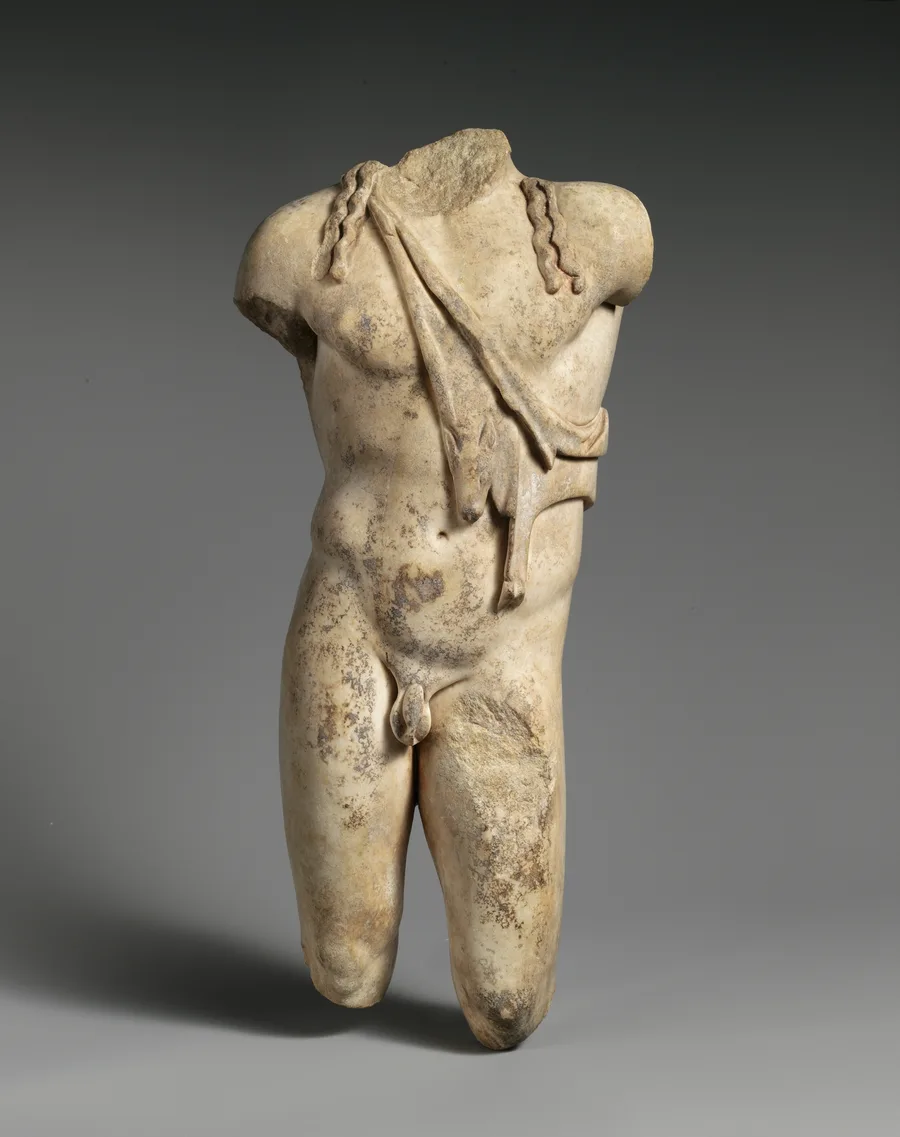
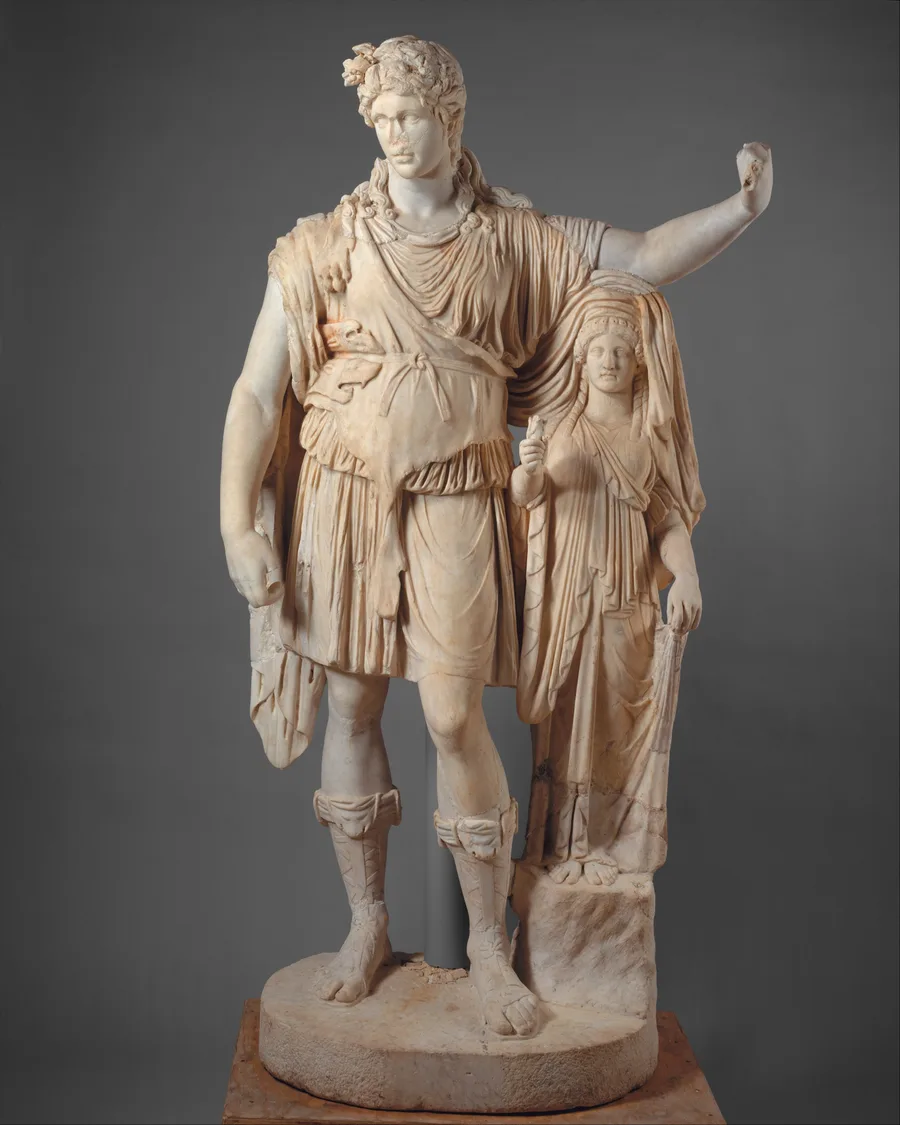
If one looks at the photographs provided by M. Milani, one will recognize without hesitation that the de Sartiges statuette and the Sambon statuette derive from the same original.8 Both must follow this original quite closely, given the remarkable consistency in the facial expressions and the details of the nébride (fawn skin) draped over the body.
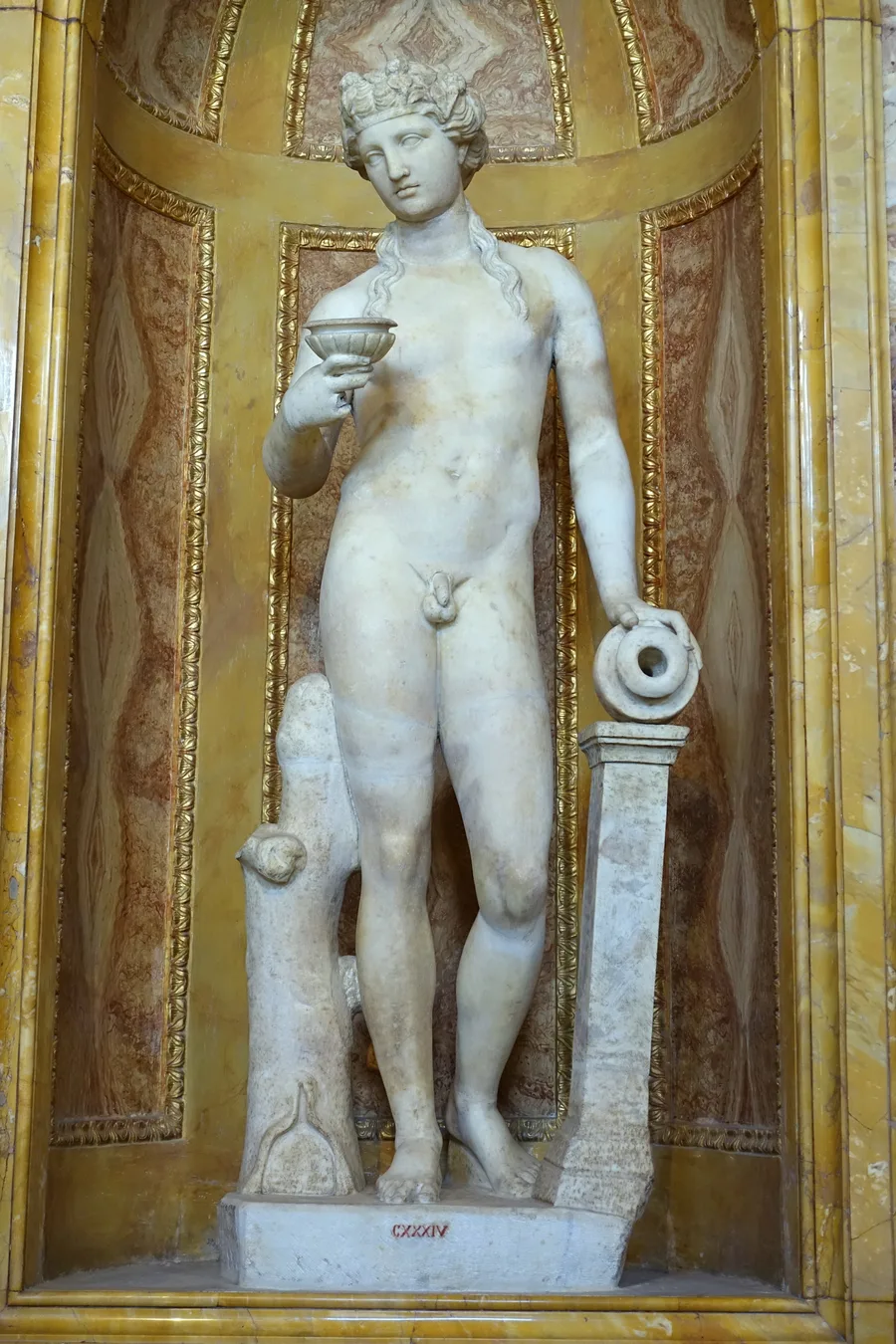
M. Milani also published a restored drawing of the Sambon statuette; he placed a kantharos (a two-handled drinking cup) in its right hand and had it lean on a large thyrsus (a staff of giant fennel topped with a pine cone), which it holds in its raised left hand. This restoration, based on the study of analogous works, is certainly correct. When I first saw the terracotta statuette at M. de Sartiges's home, the lower part of its left arm was missing. A search conducted on-site led me to discover it at the bottom of a vase, and it was possible to reattach it with plaster. One of the statuette's feet must also have been broken after its acquisition, as traces of shellac are visible on the break, proof of an old attempt at repair. Unfortunately, we were unable to find this piece.
The Link to Praxiteles and Callistratus
M. Milani proposed a hypothesis regarding the Sambon statuette that our figurine tends to confirm: he saw it as a replica of a bronze Dionysus, a work by Praxiteles, known to us only through a description by Callistratus.9
Callistratus's Description
This description, like the others bequeathed to us by the same rhetorician, is extremely bombastic, richer in words than in precise details. It has sometimes been supposed that it was entirely a work of fantasy, that the work described by Callistratus never existed. This is certainly an exaggeration. Callistratus tells us that the statue of Dionysus was in a sacred wood or sanctuary (ἄλσος); the god was depicted as an ephebe (adolescent youth) with a delicate body, crowned with ivy, his curls falling on his shoulders, clothed in a fawn skin, and leaning his left hand on a thyrsus.
If we strip these details of the rhetorician's verbose amplification, we are struck by their perfect concordance with the Sambon statuette and with our own. It is true that Callistratus does not mention the vase held by the god in his right hand, but the kantharos is a common attribute of Dionysus. Sculptors and painters have given it to him since the sixth century, and Callistratus, writing for readers who knew hundreds of statues of Dionysus, did not think it necessary to point out the god's essential attribute.
The Athenian Origin
Callistratus also does not tell us that Praxiteles's bronze was in Athens, but this is very likely. In his description of another statue by Praxiteles, Callistratus says only that it was ἐν ἀκροπόλει, that is, on the Acropolis of Athens; he does not name Athens and leaves it to the reader to complete his indication. Corresponding to this unnamed Acropolis is the sacred wood or enclosure (ἄλσος) in the description of the Dionysus. We can therefore think that the statue of Dionysus was located in some Athenian ἄλσος, without being able to be more specific. The fact that the Sambon statuette was said to come from Athens added plausibility to this supposition; it is transformed almost into a certainty now that we have the Sartiges statuette, whose Athenian origin is indisputable.
We know of many examples of ancient bronze statues that were copied in marble, such as the Apollo Belvedere and undoubtedly also the replicas of Attalus's votive offering discovered in Rome in the 16th century. On the other hand, it is infinitely rarer for an ancient marble to be reproduced in bronze, as is so frequently done today. There is therefore every reason to believe that the original of the Sambon and Sartiges statuettes was in bronze. And it is precisely a bronze Dionysus by Praxiteles that is described in the Ecphrasis (a detailed literary description of a work of art) of Callistratus.
Praxiteles and the Coroplasts
It is certainly strange that this bronze Dionysus was not mentioned by any other author. One might believe, if necessary, that Callistratus was deceived by one of those forgeries common under the Roman Empire, which attributed works from Praxiteles's school to the master himself; we have formal testimony on this matter from the fabulist Phaedrus. But, on the other hand, our knowledge of the literary sources for the history of art is so imperfect that even an isolated mention of a masterpiece should be accepted without too much suspicion.
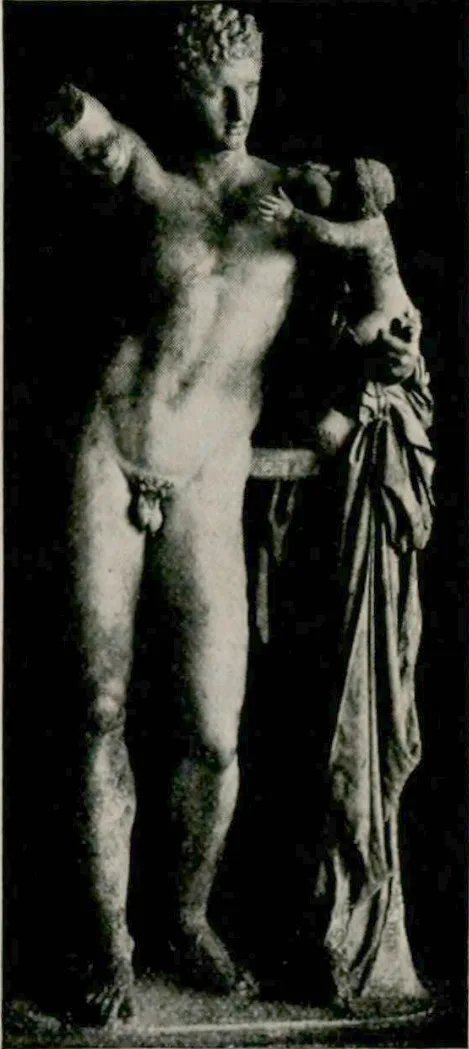
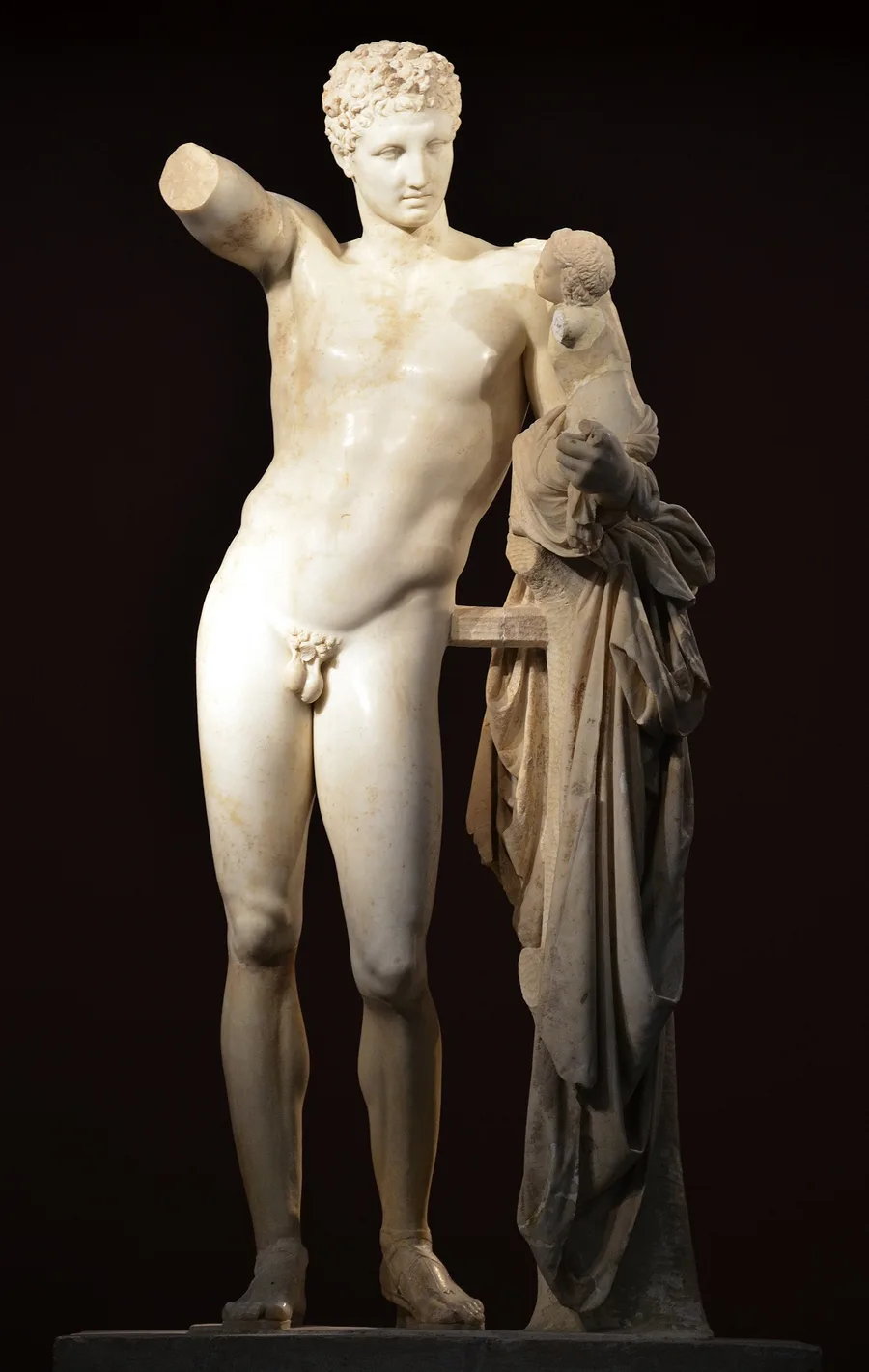
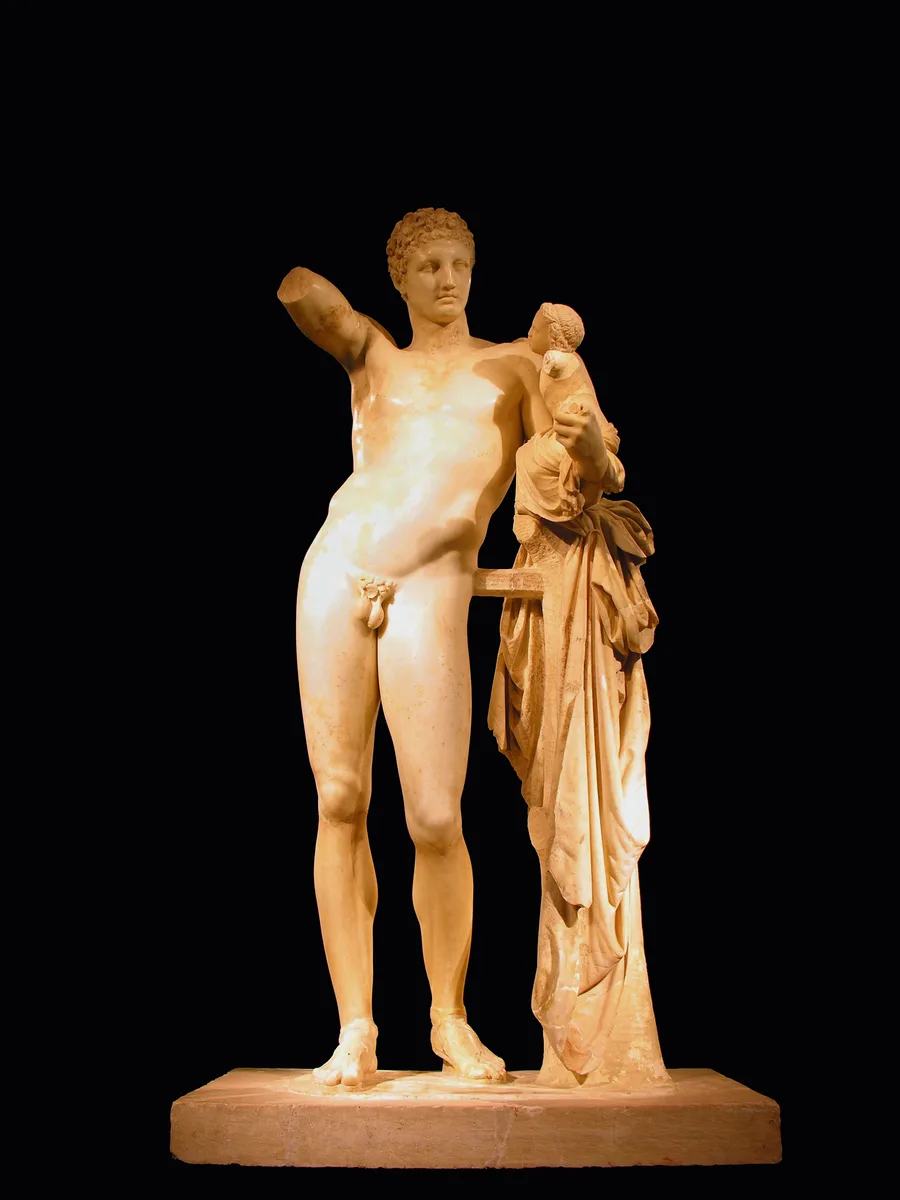
Furthermore, what we know today of Praxiteles's style, thanks to the discovery of the Hermes at Olympia, is in no way contrary to the hypothesis that attributes the original of our two statuettes to him. Finally, it can be observed that Praxiteles is, along with Lysippus, the great sculptor from whom the coroplasts most often drew inspiration. We have numerous replicas of his Aphrodite of Cnidus, both in Myrina and Tarsus. Myrina has also yielded replicas of the draped Aphrodite, velata specie (in a veiled appearance), which Praxiteles had sculpted for the inhabitants of Cos. Several Eros figures from Myrina seem to relate to statues by the same artist. Lastly, M. Heuzey tried to show long ago that a group by Praxiteles, Demeter Bringing Her Daughter Back from the Underworld, was often imitated by coroplasts, both in Italy and in Greece proper and Asia Minor.10 This fact creates a presumption in favor of the hypothesis that attributes to Praxiteles the original of a terracotta whose style is evidently related to his.
The Evolution of the Dionysus Type
For anyone familiar with the history of the Dionysus type in Greek art, it is impossible to date the model for the Sartiges statuette later than the fourth century. After the era of Alexander, Dionysus is indeed presented with effeminate features that earn him epithets such as γύννις (womanish man) and ψευδάνωρ (false man).11 The figures we are studying, however, are those of ephebes with a delicate complexion; they are not hermaphrodites. The conception of Praxiteles is close to that of the Homeric Hymn, where Dionysus is called νεηνίῃ ἀνδρὶ ἐοικώς πρωθήβῃ ("like a young man in the first bloom of youth"), a more recent conception than that which inspired the vase painters of the sixth and fifth centuries, where Dionysus is always represented with a beard.
There is reason to believe that the sculptural type of the beardless Dionysus was particularly promoted by Calamis, who made a statue of this god for Tanagra that was reproduced on Roman coins. Calamis, along with Alcamenes and Myron, is one of the ancient sculptors from whom Praxiteles seems to have drawn the most inspiration, and tradition even connected them, in defiance of chronology. What is certain is that the Dionysus of Calamis, reproduced on the imperial coins of Tanagra, is in a pose entirely consistent with that of the statues that concern us, holding the thyrsus in one hand and a tilted kantharos in the other.
We know nothing of the bronze Dionysus by Myron, but some have believed to recognize a replica of it in a beautiful statue discovered at Tibur; this statue presents quite undeniable analogies with the Sambon bronze.12
Conclusion: A Masterpiece Rediscovered
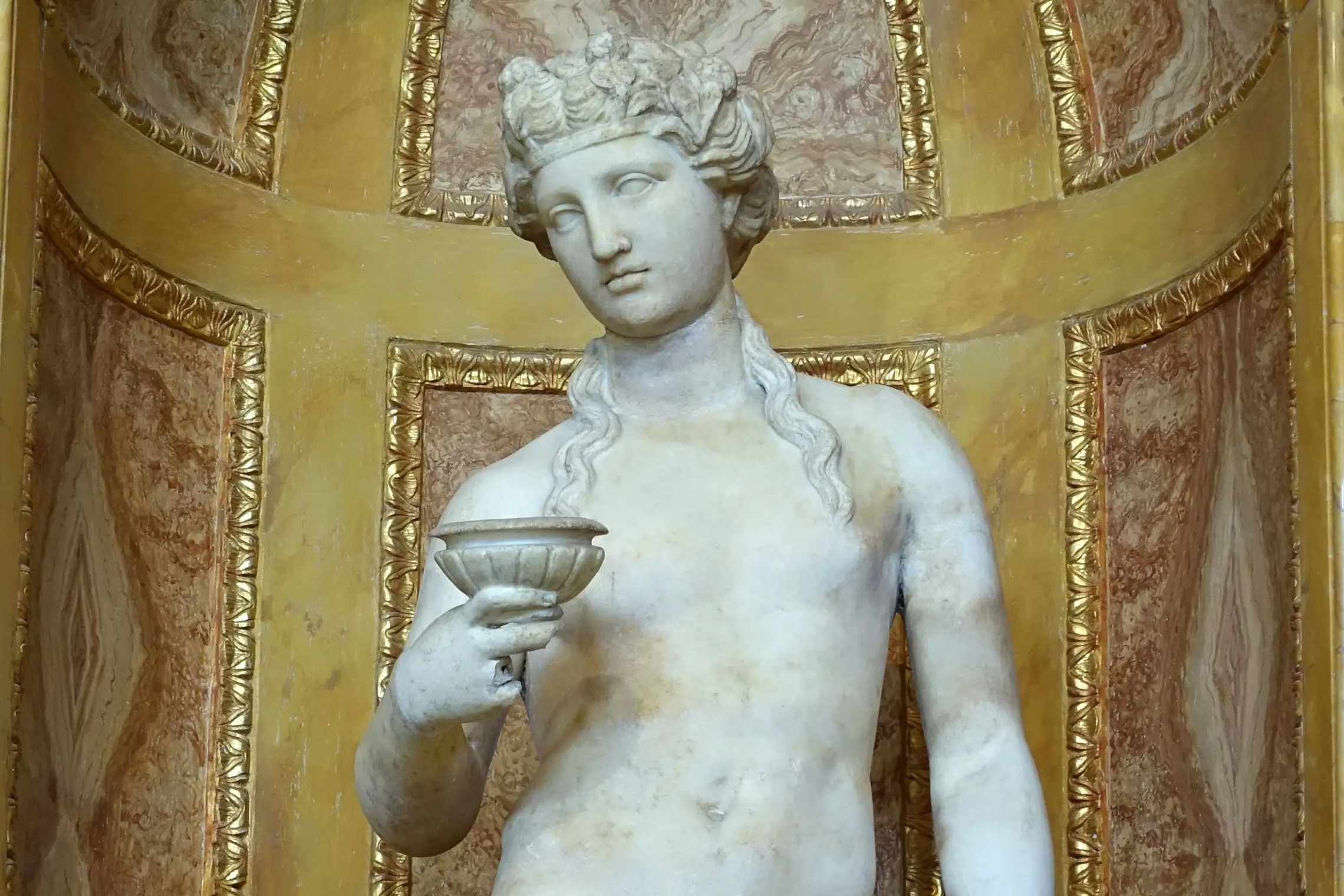
There is no shortage of marble statues in museums that reproduce more or less the same type. Unfortunately, the arms and attributes are almost always restored, and as long as we are not better equipped than we are for the study of ancient marbles—as long as we do not have a large collection of casts at our disposal—it will be difficult to make comparisons between these imprudently completed works and the small monuments that have suffered less from restorations. A Dionysus from the Pembroke collection is analogous to the Sartiges statuette, but a bunch of grapes has been placed in its raised left hand.13 I will also cite, as deriving from the same original, two Dionysus figures from the Bourbon Museum, one from the Pamphili collection in Rome, one from the Chiaromonti Museum, and one from Florence, all imperfectly reproduced in Clarac's collection.
But these Roman works, whose precise provenance is generally unknown, can be of only little help for the restitution and attribution of the originals. There is much more to be gained from coins, which are the most precious documents for the history of art, and from small bronzes and terracottas whose provenance is certain. This justifies the interest that the statuette of M. de Sartiges inspires in us, when compared to the bronze from the Sambon collection. We do not hesitate to consider it, until further notice, as the most complete, if not the most exact and best, imitation of a masterpiece by Praxiteles: the bronze Dionysus celebrated by Callistratus.
SALOMON REINACH.