Leo Putz’s painting, The Lady in Blue, made for a lovely and cheerful cover for an issue of Jugend.¹ This journal, which aims to popularize modern artists like Zuloaga, Steinlen, Aman-Jean, the Erler brothers, Feldbauer, and Angelo Jank, as well as masters of the recent past such as Lenbach, Segantini, Böcklin, and Menzel, has often featured the kind of original works in which Mr. Leo Putz seems to specialize.
The Modern Woman as Motif
Contemplating this painting, one immediately and straightforwardly enters into Mr. Putz's aesthetic thinking. The theme of The Lady in Blue can be found, expressed differently, in most of the painter's works. Its subject is woman, and its idea is the joy of life (joie de vivre).
Leo Putz, much like Hugo von Habermann, paints the modern woman, though perhaps with less psychology and with more reasoning, more conscious analysis. For him, she is a motif for beautiful lines and delicate tonalities; she is an object skillfully arranged, draped with a deliberate fantasy, for the pleasure of the eye. With Habermann, you see more fire and passion, an exuberance in the brushstroke, a voluptuousness in the modeling of flesh and in the flow of paint crushed by his sensual hand. One paints beautiful girls, as lovely as May roses or August harvests; the other commands spirits he summons from nocturnal depths, desires incarnated in the flesh.
Casually leaning, half-extended on a divan against whose back she rests an elbow, the lady in blue does not look at you; her very dark, elongated, and slender black eyes are turned away. One hand supports her head, while the other, clad in a white mitten, holds an oval, ivory-rimmed mirror. The horizontally posed forearm disappears into the dress, and the very simple line it forms, along with the light value it creates, are the two essential elements of the painting.
The body undulates beneath the dress, forming the great line—a sinuous, supple, yet firm oblique. This line culminates in a mirror where the figure is reflected in three-quarter view, a somber accompanying note. Muted, harmonious blues echo a softened repetition of the light, forget-me-not blue of the dress, the deep blue of the cloak reminiscent of deep waters, and the purplish-blue of a drapery thrown over the green divan with its stark green cushion. The verticality of the fabric's straight folds is mirrored in the frame of the looking-glass, which is black like her hair—broad, with blue reflections—and black like the border of the cloak and the shadowed folds.
Against the dark values, the blues are amplified, singing with sobriety. The orange of the flesh tones is exalted, and the red lips come to life.
Fantastical Worlds and Fairy Tales
This artistic spirit also finds expression in the work of Schwind, Böcklin, or Erler. But the fantastic also attracts, fascinates, and at times obsesses Putz. When it does, the measured and tranquil painter launches into works of pure imagination, which can be amusing or tragic.
In his very beautiful volume on Putz, Mr. Michel Wilhelm speaks of the painter's paternal home, of his happy childhood in the sun-drenched garden, of the music he heard there, and above all, of a marvelous book filled with fairy tales that steeped his young imagination. "It is to this book," Putz says, "that I owe my becoming a painter." This likely explains the duality in the character of his work, with one side that could be "conventionally" defined as normal coexisting with another that is fanciful and whimsical.
In this fantastical genre, Leo Putz has also carved out a unique place for himself by creating entirely new and fabulous beings—creatures of his own, unique to his imagination, inhabitants of his secret garden. In this enchanted garden lounge the "peacock women," who carry caressing parakeets on their fists. They wander nude, their bird-like tails trailing behind them or fanning out like wheels. And, as if in a restless dream, the most extraordinary and implausible visions take shape without any apparent connection.
The setting changes: a narrow strip of sky, the dark sea, and a wave breaking on a beach teeming with a population of mollusks. But these creatures have human faces, long horns, and a round, soft torso from which arms emerge and into which the head is nestled. The black mollusk and the white mollusk struggle on the pebbles, embracing furiously. Farther on, an old man, his arms folded under his beard, watches them. A mother, lying on her back, holds up to the sky the shell from which her comical child emerges.
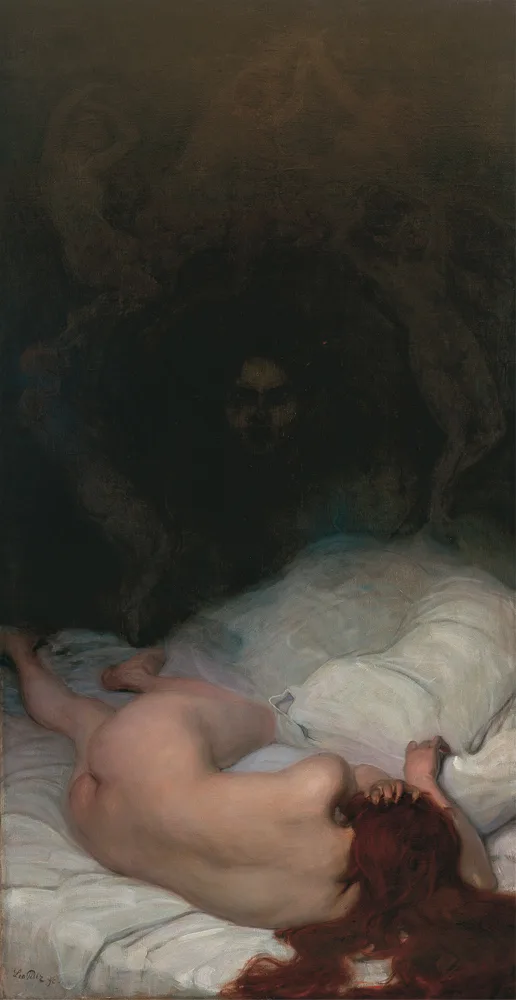
In another painting, it is the little Kobold, a sprite with the wings of a tortoiseshell butterfly, who pulls a large, bewildered gastropod by its horns. Suddenly, terrifyingly, a figure traverses the night: the specter of the marsh, a hideous, giant brute carrying a dangling cluster of humans in its hands. It passes, moving through a desert of eternal night, silence, hell, and damnation—a scene of tragic horror worthy of Poe.
Then there is a Scherzo: a very graceful marquise in her panniered dress, bouncing laughing little cupids on her racquet. And there are many other such evocations, all filled with a boundless fantasy—subjects of ironic worldliness for artists' festivals, or of heartfelt pity in his Hannele in Heaven, based on the drama by Gerhart Hauptmann.
The Artist's Technique and Temperament
Wisdom and reason dominate in Mr. Putz's other canvases. They are revealed in the overall impression, which is purely and strictly pictorial. The woman does nothing; she poses for the artist, and this negative activity helps to reinforce the sensation of a very positive theme.
The artist is young, barely forty years old, but already famous. He owes the esteem and favor of the public, as well as of fellow painters, as much to his prodigious artistic fecundity as to his originality. The man himself is exceedingly modest, very amiable, and jovial. If physical appearance matters, picture him with lively blue eyes, a blond beard, and blond hair.
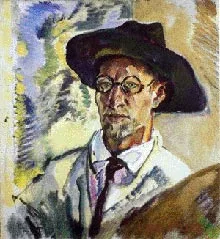
He knows how to pour all the joy of his soul into his painting, creating a mosaic of light tones, scales and harmonies as clear as a bird's song, and shimmering patches of light. Mr. Putz's canvases follow one after another, each imprinted with a happy personal character and a kind of high-bred distinction. Born in Merano, in Tyrol, he is not German but Austrian. This immediately evokes (rightly or wrongly) the elegance of the Prater, the waltzes of Strauss, pretty flowers and ceramics—a host of impressions and memories, a special and indefinable feeling as subtle as a perfume.
Indeed, he possesses a particular charm. Without being able to explain it, one can define the orientation of his work as different from that of other artists. He does not have, for example, the German genius's need for the decorative, somewhat legendary, and mythical epic. His technique derives from Leibl and Trübner—his preferred masters along with Manet—far more than from Bouguereau or Benjamin Constant, whose classes he attended.
He paints broadly, in large planes of local color. Then come the shadows and the highlights, applied with precision and crispness, followed by the softening, binding intermediate tones. The sketch, treated broadly and almost sculpturally in its indication of planes, can become gentle but never limp, always imbued with life.
Unlike certain artists who seize and grip you (Gustave Moreau, Monticelli, Habermann) before the work of reflection can even begin, Mr. Putz's canvases allow for examination and withstand observation. He knows how to limit and restrain himself; his subjects remain intimate, select, and highly concentrated. He does not encumber himself with useless details. He simplifies, brushing methodically with flat, square brushes, but in doing so he achieves tones that are considered, deliberate, and sought-after—exquisite lights, pure in value and luminous in color. It is a chromatic modulation on the violin's chanterelle, and therein lies the secret of the artist's great charm.
An Ode to Spring and Nature
Very pragmatic, he remains on the earth; he opens his eyes, and opens them wide, to tell us charming things. They may not be very profound, but they are so prettily described that it is a true pleasure to contemplate his canvas titled In Autumn, or another, quite similar one, End of Summer. These works depict a woman seated in a garden near a set table, where colorful fruits gleam and porcelain and silver shine on the white tablecloth. Another example is his Picnic in the Pinakothek museum. In these female bodies, in these scenes of figures disrobed in the open air where the flesh shimmers so softly and where filtering sunlight forms stark pink patches, one might see the variegated patterns of light silks.
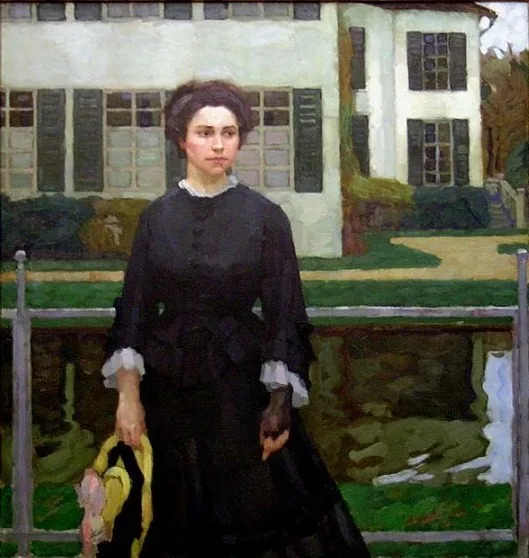
The impression is charming, though upon analysis, one might sometimes find a certain heaviness in the gestures or a lack of atmosphere in certain plein-air canvases. But what does it matter?
The art of Leo Putz makes one think of flowers; it is spring-like in its essence, evoking Germinal, Floréal, Prairial—the months of the French Republican calendar associated with spring. What a glorification of nature! Is it ultramarine, cobalt, or indigo? Veronese green or cadmium? Oh no, I would rather evoke the periwinkle, the wood violet, the squill or the hepatica; the daisy and the rose-tinged anemone, the golden calyxes, the silvery leaf of the willow, the shoots of a pale and tender green to define a coloration like that of Mr. Putz. It is truly the soul of spring that one feels in his canvases; it is the same force that swells the buds.
The earth awakens and blossoms, bodies swoon, and beings listen to the veiled melody of Pan, the hidden god. The work of Leo Putz is a hymn to youth and to joy.
F. Gos (Munich)