The painting that M. Gaujean’s skillful and conscientious burin has rendered in a reproduction as faithful as it is delicate has just been gifted to our national museum. Acquired by M. Édouard André after the sale of the Secrétan Collection, it entered that residence already filled with the most precious art objects. For a long time, its owners had been dedicated to increasing its riches with the noble intention of one day bequeathing all these treasures to public study and admiration.
By thus perpetuating the memory of a name doubly dear to all who love the arts, the couple, united by a complete commonality of taste, crowned a life dedicated to the practice of good as well as the cult of beauty. Regarding the Memling work, M. André had planned to present it to the Louvre from the moment of its acquisition; but, growing ever more fond of this charming piece, he had postponed the gift. It is to fulfill a plan known only to her that Mme Édouard André, in a sentiment that all who knew her will understand, has resolved to honor the memory of the man she lost by carrying out his generous wish ahead of time. Eager to join in this tribute, the editors of the Gazette have had the fine inspiration to offer the readers of a journal that itself owes so much to M. André the engraving attached to this article, which will allow them to appreciate the value of such a gift.
A Devotional Masterpiece
The work is indeed priceless, in an irreproachable state of conservation and without any retouching. It is one of those oratory paintings in which Memling delighted, and which, by the nature of the subjects it portrays as much as by the perfection he brought to it, gives us the highest idea of his talent. As the artist often did, the composition includes several juxtaposed episodes, grouped very ingeniously but independent of one another, showing us all the saints whose helpful protection a pious donor invokes, gathered on a single panel.
The Donor and His Patrons
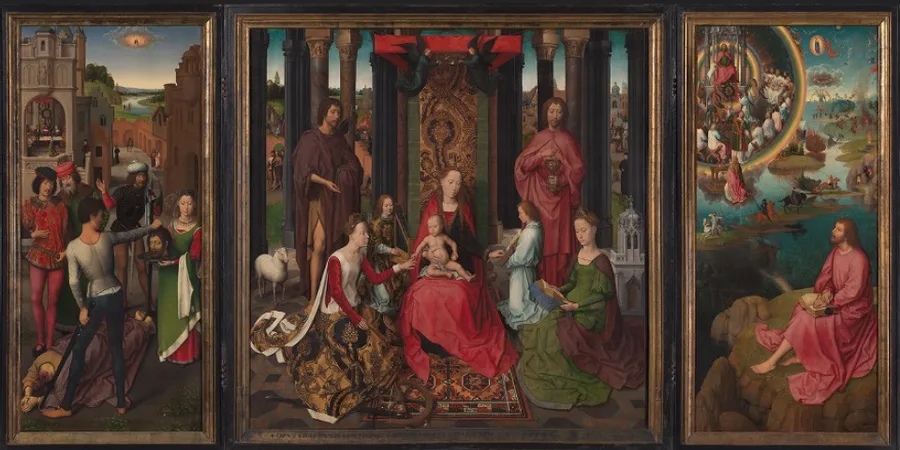
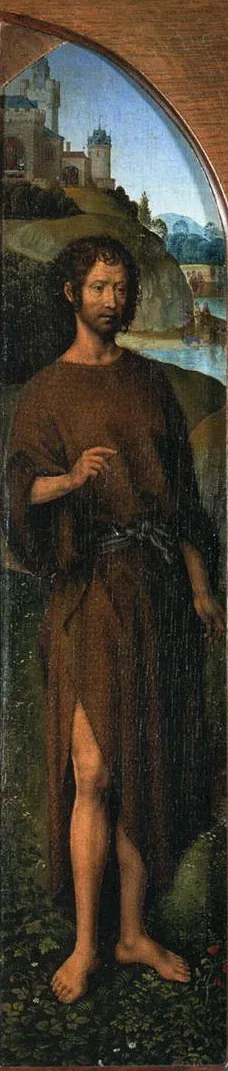
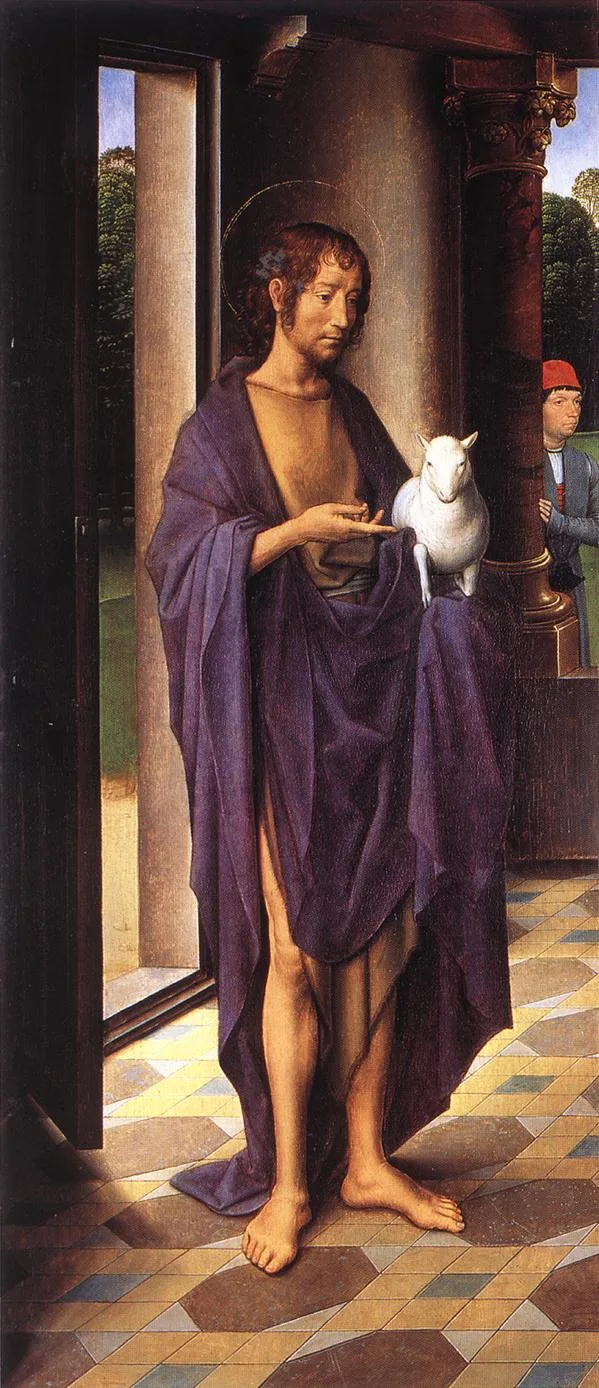
Wrapped in a large, brown, fur-lined houppelande (a type of overcoat), the donor, whose coat of arms is painted below him, is kneeling on a lawn dotted with spring plants: primroses, chicories with their serrated leaves, lychnis, and violets. He prays with fervor, his hands devoutly joined. His hair is graying, and his face, with its fine features and timid, slightly fearful expression, breathes honesty. Dressed in the traditional goatskin, over which a purplish cloth is thrown, Saint John the Baptist stands beside him. His left hand rests on the donor's shoulder, as if to comfort him, while with his right he points to figures placed outside the painting—doubtless painted on another panel attached to this one—Christ or the Virgin, to whom the supplicant addresses his prayer.
To the left, seen from the front, a lamb with a white fleece gazes vaguely with a blissful air. On the other side of a small stream that winds through meadows, trees with thick shade are aligned, under which one can glimpse two roe deer—one on the alert with its head raised, the other grazing—and near them a hare bolting at full speed, its ears pricked. The winding stream flows into a large lake, and on its banks, which rise on either side, two other episodes are depicted.
To the right, Saint George, the Christian Perseus, fully clad in iron, wearing a helmet with a tricolor plume, and mounted on a sorrel horse, plunges his lance into the maw of a dragon posted at the foot of a rock. Behind this rock, a young princess, exposed to the monster's voracity, awaits the outcome of the combat, full of dread.
An Apocalyptic Vision
To the left, on a mound surrounded by water that simulates the island of Patmos, Saint John the Evangelist, draped in a lacquer-red garment, notes in the book placed on his knees an apparition he sees in the upper part of the sky. This vision seems to be described exactly in the following passage from the Apocalypse:
And there appeared a great wonder in heaven; a woman clothed with the sun, and the moon under her feet, and upon her head a crown of twelve stars... And there appeared another wonder in heaven; and behold a great red dragon, having seven heads and ten horns... And the dragon stood before the woman which was ready to be delivered, for to devour her child as soon as it was born. And she brought forth a man child... and her child was caught up unto God, and to his throne.
The background of the lake is enclosed by distant shores whose bluish peaks stand out gently against the pale horizon of a cloudless sky, whitish at its base and a very bright azure at the zenith. On the banks rise trees with slender foliage, quite similar to those whose slim and delicate silhouettes were delineated by Perugino and by Raphael in his early works.
Such are the diverse scenes represented on this precious panel, executed with that accomplished technique and graceful sweetness of impression that constitute the charm of the master's best productions. Within its small dimensions (0.25 by 0.15 meters), the execution remains at once broad and fine. The discreet harmony, more austere than usual, is in keeping with the character of the subjects represented.
A Panel's History and Context
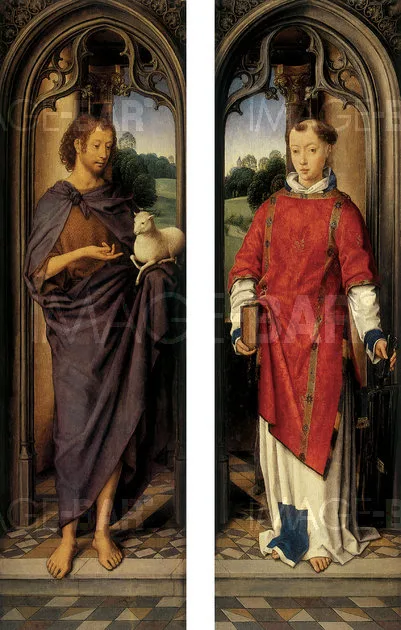
The painting's coloration contrasts with the brilliant hues of another Memling painting bequeathed to the Louvre by M. Gatteaux, the Mystic Marriage of Saint Catherine. That work, presenting the same arched top and absolutely identical dimensions, must be considered the pendant to ours, although neither the lines nor the arrangement of the groups in the two panels align with each other. It would therefore seem more probable that the original ensemble formed a triptych, and that on a now-lost panel, a counterpart to the Saint John the Baptist, the donor's wife would have been painted accompanied by her patron saints. However, since in the precious diptych preserved at Saint John's Hospital in Bruges, two panels with an analogous arrangement serve as pendants, we believe this is also the case for M. Gatteaux's painting and that of M. André.
We believe it is an error that M. A.-J. Wauters, in the catalogue he compiled of Memling's works, lists the painting of M. André and another he attributes to a M. Herz in London (Argyll Place) under two distinct numbers. He confesses, moreover, that he has not seen the latter but finds it mentioned by Crowe and Cavalcaselle "as a masterpiece in the master's best manner." In reality, the dimensions as well as the subjects are identical, and it is certainly the same work, which, after having originally belonged to M. Herz, was subsequently acquired by M. Secrétan.
The Life and Legend of Hans Memling
The legends that once circulated about Memling are well known, particularly the fable created out of whole cloth by Descamps—repeated and even embellished by biographers who followed him until recent times. This story told of an adventurer enlisted in the bands of Charles the Bold, wounded at the Battle of Nancy, and taken in at Saint John's Hospital in Bruges. There, he is cared for by a nun with whom he falls in love and, to prolong his stay in this refuge, paints the marvelous works that are still preserved there today.
From Romantic Fiction to Historical Fact
Thanks to the patient and successful research of Messrs. James Weale,¹ Crowe and Cavalcaselle,² recently supplemented by a Flemish scholar, M. A.-J. Wauters,³ well known for his excellent studies on the masters of his country, these romantic inventions have given way to more precise and reliable information drawn from archives. While these positive documents, combined with the dates found on some of Memling's works, are not yet sufficient to satisfy our curiosity, they have at least allowed the truth to be re-established, giving us the elements of a less suspect biography.
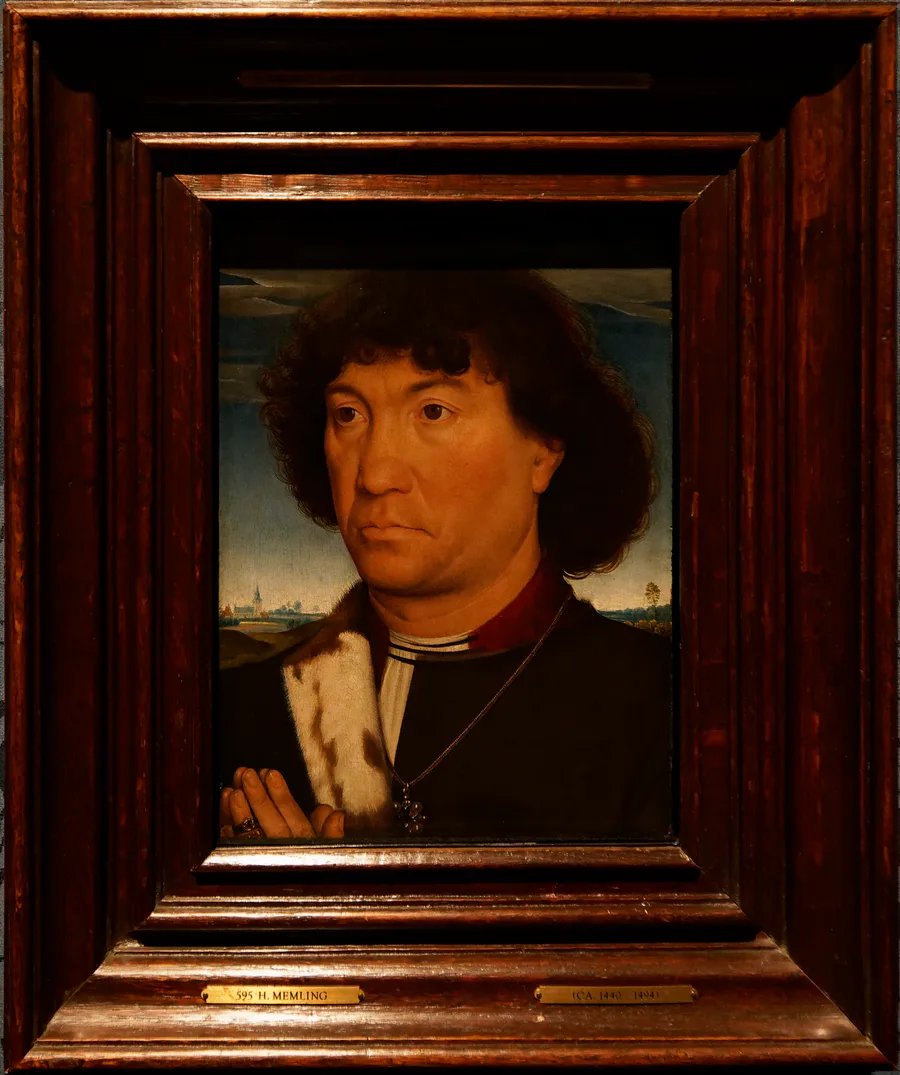
From this scattered information, it appears that the name "Memling" itself is not a patronymic, but rather that of the artist's place of origin: a small village in the diocese of Mainz called Memelingen, where he was likely born between 1430 and 1440. This aligns with the indication already given in the 16th century by the Ghent chronicler, van Vaernewyck, who refers to the painter by the name of Hans duitch, or John the German. M. Wauters supposes that before becoming a student of Van der Weyden in Brussels, Memling would have received lessons from and imitated the manner of Stephan Lochner, the famous author of the Dombild (Cathedral Picture) of Cologne.
A Gentle Soul in a Violent Age
That there are analogies between the two artists—not in execution, but in style and sentiment—is indisputable. We do not believe, however, that this similarity of tendencies necessarily implies a direct lineage of talent. In the absence of certain proof, it seems more natural to us to think that it is merely one of those moral coincidences frequently encountered in the history of art. What Fra Angelico (Angélique de Fiésole) had been in Italy, and Lochner in Germany, Memling in his turn would be in Flanders: a tender and gentle soul of a believer, an artist consecrating his life and talent to the naive expression of his faith.
In those troubled times, full of violence and bloody struggles, these privileged masters, driven by similar vocations, knew how to treat subjects suited to their loving nature with the same sincerity. They found in the intimacy of their art, with the same concern for perfection, a certain pious joy that emanates from all their works.
The World Within the Work
Like them, Memling must have had, along with a similar love of nature, the desire to draw from it the principal adornment of his works. Beneath limpid skies, amidst cheerful countrysides and lively waters, his figures take on their true meaning. Dainty flowers spring up at their feet, and timid animals, forgetting their wildness, come to seek their caresses. In the Elysian landscapes where their lives unfold, the saints he depicts in graceful legends find everywhere an echo of their own purity, goodness, and gentleness. Even in scenes representing their martyrdoms, they have only pleasant images before their eyes.
This is indeed that amiable religion of which Saint Francis of Assisi had once again shown the world the poetic incarnation, with its candor and courageous poverty, with the clear-sightedness of a fundamentally innocent soul whose tenderness extends to the humblest creatures, making them its confidants and partners in the intimate joys and ecstasies of its prayer.
In this paradise rediscovered on earth, everything appears easy and spontaneous, and the art of the old Fleming, with its simplicity and perfection that betrays no effort, is the faithful echo of his naive aspirations. Everything in it is expressive, elevated, clear, and touching. The lines of his compositions gently call to or intersect one another with a happy rhythm, and, as if of their own accord, friendly colors come together under his brush to form the most harmonious chords.
The Artist in Bruges
Alongside the few dates inscribed on Memling's paintings from 1462 to 1491—which, by allowing us to follow his artistic career, also tell us the names of the princes, corporations, or private individuals for whom he worked—other documents show him in 1480 acquiring three properties in Bruges. Then, in the same year, he contributed with 146 other inhabitants of the city to a loan they made to cover the costs of the war against France. In 1487, he lost his wife, named Anne, and he himself died on August 11, 1494, in Bruges, where he was buried in the church of Saint-Gilles. Finally, on December 10 of the following year, the guardians of his three minor children—two sons and a daughter—submitted the mass of the deceased's assets to the wardship chamber of the Saint-Nicolas parish for the children's benefit.⁴
Through the conciseness of these dates and facts, an honorable life, both modest and well-filled, vaguely takes shape. M. Wauters even thought it permissible to go further and, in the form of a hypothesis, it is true, he wonders if it is not possible to recognize the portrait and, as it were, the monogram of the painter in a certain little horseman riding a white horse, which he found in several of his paintings. We do not believe so. Generally speaking, Memling painted many horses. In many of his works, notably in the Seven Joys of the Virgin (Pinakothek, Munich), he introduced a great number of them, of all coats, in all gaits and all positions. What is surprising if, accustomed to scrupulously consulting reality, he more than once used the same studies, as did his colleagues? For even among the most prolific and inventive artists, it is not rare to encounter similar repetitions.
A Devotion to Nature and Detail
Besides, the artist's curiosity was universal; each of his compositions is like a veritable museum, where he took care to gather the most precious and varied objects from nature or human industry: flowers, plants, animals of all kinds, tapestries, magnificent fabrics, weapons, jewels, marbles, and so on. All are reproduced by him with a perfection that has not been surpassed, "the hand," as Fromentin says,⁵ "being occupied only with conveying the luxury and beauty of the material, through the luxury and beauty of the work."
With more reason, in our opinion, M. Wauters—in discussing a large triptych now belonging to M. Charles Stein in Paris, which he very justly attributed to Memling—insists on the important place that music holds in his works. By examining them carefully, one could reconstruct the composition of the orchestra at the time he lived. Harps, flutes, vielles (a medieval stringed instrument), psalteries, small portable organs, and trumpets of the most varied forms—we indeed find these diverse instruments in the hands of beautiful angels. Clad in priestly copes or dalmatics, these noble and delightful creatures, with their innocent features, pure foreheads, and finely waved hair, accompany with their chords the songs of other angels, respectfully grouped around the celestial court.
The Harmony of Music
This passionate love of music is yet another similarity he offers with Fra Angelico and Stephan Lochner. It completes the charming physiognomy of Memling, while at the same time giving us an idea of that marvelous flowering of all the arts that then made Bruges an incomparable center of high culture and intelligent luxury. The school of music that had developed there was destined to radiate from that city throughout Europe.
A Lasting Legacy
It is in the melancholic setting of the old city that one loves to place the noble artist, amidst the desertion of its solitary, grass-overgrown streets, or along its silent canals whose tranquil water reflects the blackish bricks, pointed gables, and turrets of its peaceful dwellings and monuments. Commerce, life, and with them wealth, have withdrawn from the ancient city. But however fallen it may be from its original splendor, with its intact piety, its numerous confraternities, its frequented churches and chapels, it has preserved that crown of art given to it by a master whose entire work is a poem of adoration and fervent prayer.
Everything here speaks to us of him, of his regular, almost monastic life. More than once, the pilgrim drawn by his genius to his adopted homeland has believed he recognized, at the turn of a street, some female figure detached from his compositions—one of those Flemish women he painted who, wrapped in the long-folded cloak they still wear, piously makes her way to one of the sanctuaries he illustrated. In this retreat and recollection of memories, one is prepared to understand him. It is with the necessary respect that one approaches him, that one gradually deserves to be penetrated by this art that does not reveal itself all at once, but whose restful sweetness wins you over little by little, awakening in the depths of our soul the noble and pure sentiments he knew how to express with such angelic eloquence.
After Bruges, which possesses the most numerous of his works, and thanks to this gift which so fortunately joins those of the Duchâtel family and M. Gatteaux, our Louvre is today, along with the National Gallery and the Brussels museum, one of the best-endowed collections—one of those where one can also best appreciate the diverse aspects of the master's talent. It is therefore fitting, in closing, to thank M. and Mme Édouard André for the new joys that their generosity will henceforth provide to the faithful admirers of Memling.
ÉMILE MICHEL