
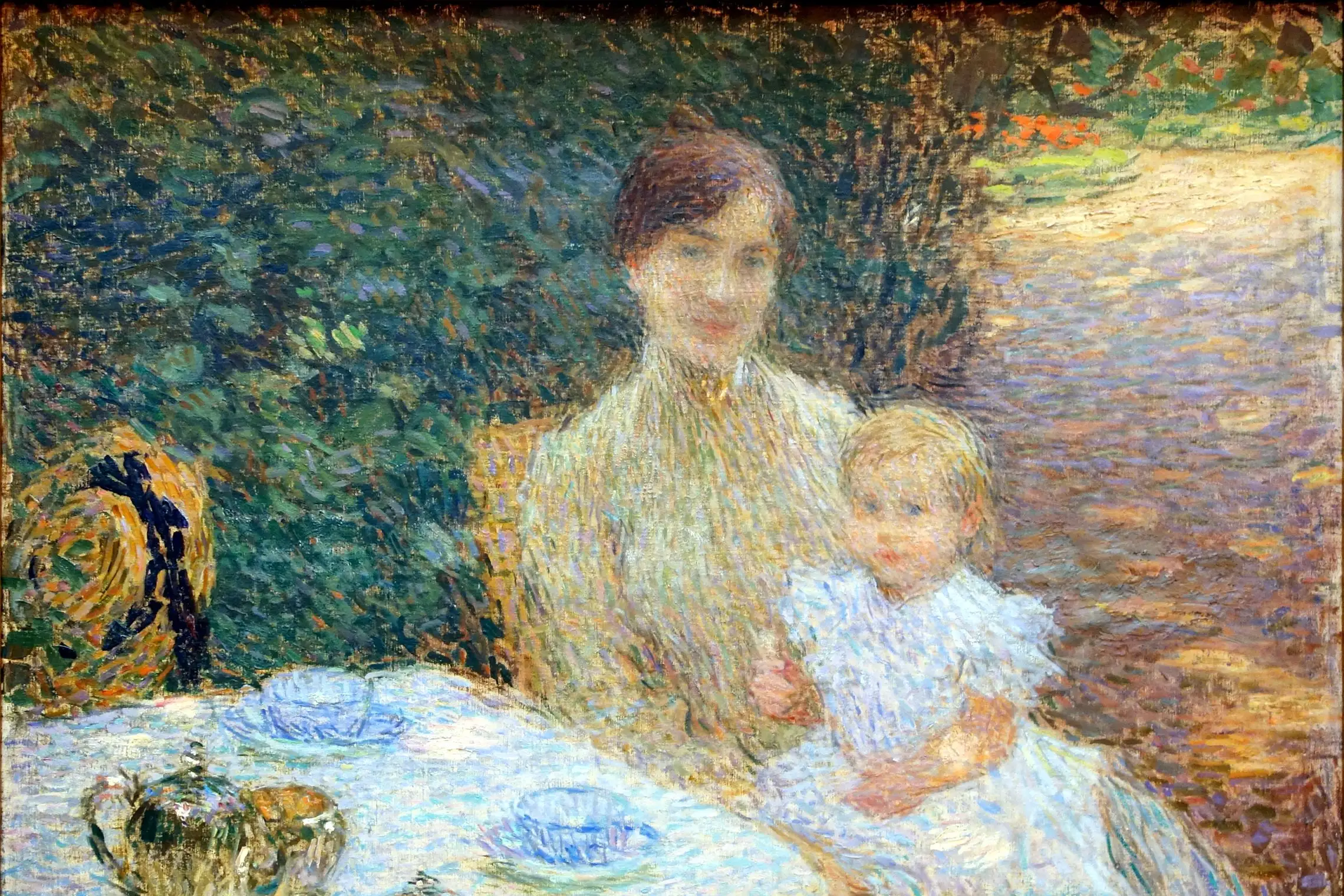
Small and nervous, with his head tilted back from a lifetime of observation and his gaze penetrating and sharp, Ernest Laurent wins over those who meet him. While the vivacity of his smile might at first cause some apprehension, one quickly recognizes in it less irony than benevolence.
His conversation is most varied and seductive. His mind—subtle, delicate, and infinitely sensitive, capable of both analysis and critique—is at the same time warm and enthusiastic, singularly open to all things. It is sustained by a strong, even exceptional, culture. The library, for which the artist himself designed the sober and harmonious lines, is not for him a piece of decorative furniture. It is a friend, consulted every day.
Among his family, in the intimate atmosphere where he leads a discreet and laborious existence, he gives his friends the impression of uniting all the merits that, three centuries ago, were demanded of the honnête homme—the ideal gentleman. Had his hand betrayed him, he would have been a poet in words as he is in colors; he would have spoken, he would have written. At the very least, he would have shared with a few friends the treasures of a rich soul and heart.
Ernest Laurent will forgive me for revealing all this to the public. I felt it was essential to say it, and to say it at the outset. There are so many artists who possess wit only at the end of their sculpting tool or their paintbrush. They are no less great for it, but they are perhaps less complete and, certainly, less endearing.
From the Academy to the Avant-Garde
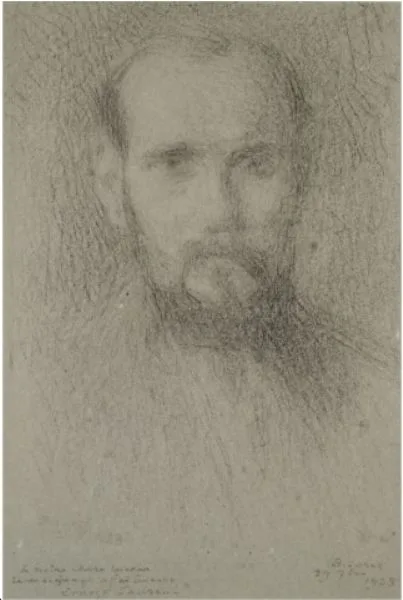
Ernest Laurent was born in Paris in 1860. Several of his relatives had been painter-decorators; one of them was a friend of Hubert Robert. When the artist, as a young child, showed his first inclinations, it was a joy for his father, who had been unable to become a painter and had never consoled himself for it. Ernest Laurent entered the studio of Henri Lehmann.
The creator of The Oceanides was a conscientious painter and a fanatical disciple of Ingres. Unfortunately, his devotion was not very comprehensive. He incessantly invoked the memory of Ingres to authorize a narrow and superficial orthodoxy. Ernest Laurent loved Ingres and never ceased to admire him; he respected that absolute and revolutionary temperament and envied the sharp, sensual sense of form he possessed. He rebelled against Lehmann's teaching in the very name of Ingres, who was being wrongfully invoked.