
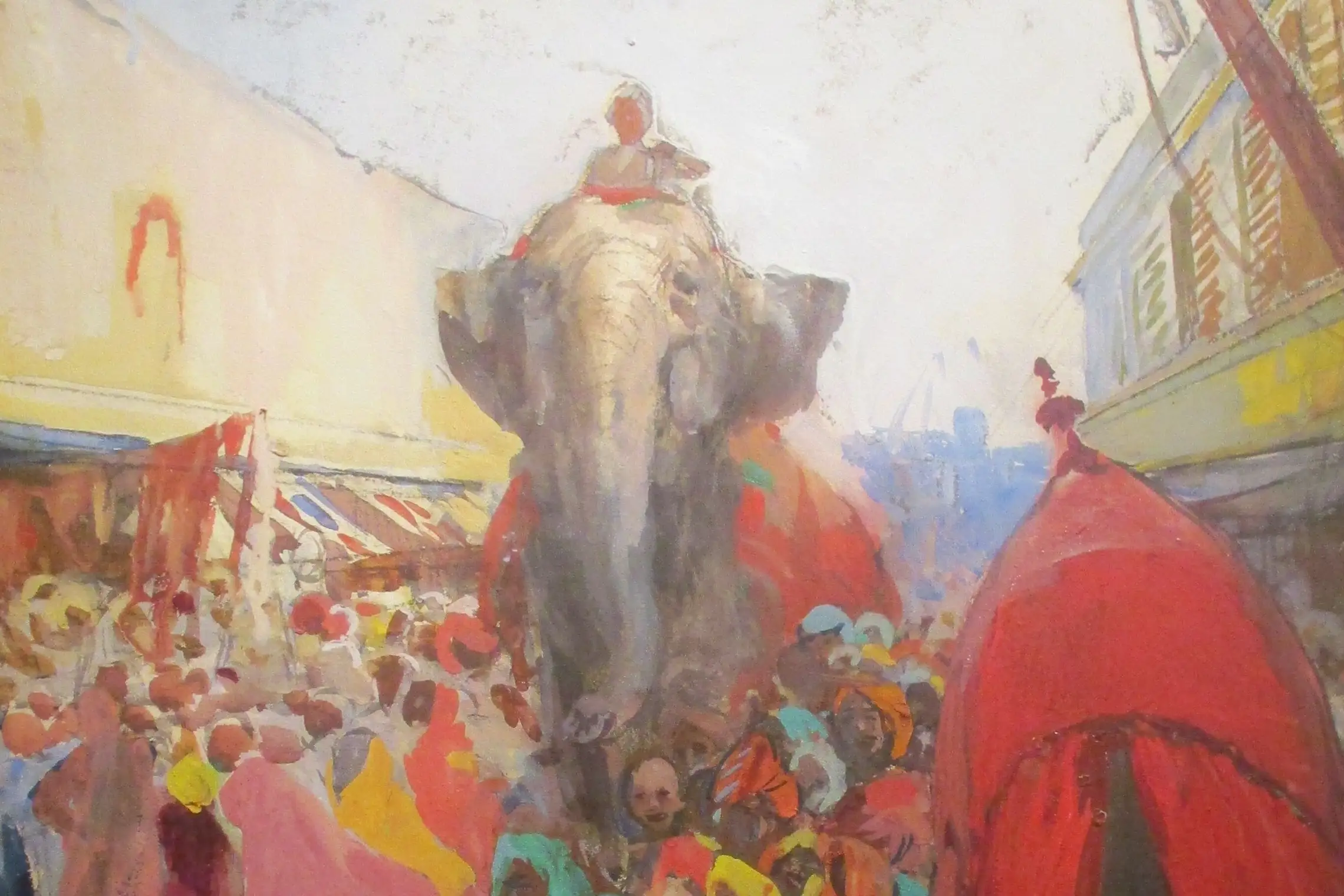
On a beautiful day last summer in Talloires, on the shore of Lake Annecy, I found the traveler on the threshold of his home. Seeing him there, peaceful, his gaze amused by the changing colors of the water, the sky, and the peaks that frame the horizon, no visitor would have guessed that a new world inhabited his mind. And yet, he had just crossed India.
This great land, the "cradle of human thought and prayer," where Pierre Loti once landed as a pilgrim seeking peace "from the custodians of Aryan wisdom," Albert Besnard had ventured into as an artist. He sought only a refreshment of his senses, a renewal of that entirely pagan and pantheistic joy that overflows in all his work.
At the time I speak of, however, Besnard was still keeping the beautiful images from his expedition secret. They existed within him. He enjoyed them for himself alone, reliving them in his memory. He said little about them, being one of those whose emotion is expressed only through creation. On the studio furniture, a dozen or so glazed and intensely polychromed statuettes represented a very small assembly of India's thirty-seven thousand gods. One could also see glass-bead bracelets and a pile of the pagnes (sarongs or loincloths)—"strongly colored with violent or muted hues"—with which the women there drape their nudity.
The Nature of Exoticism
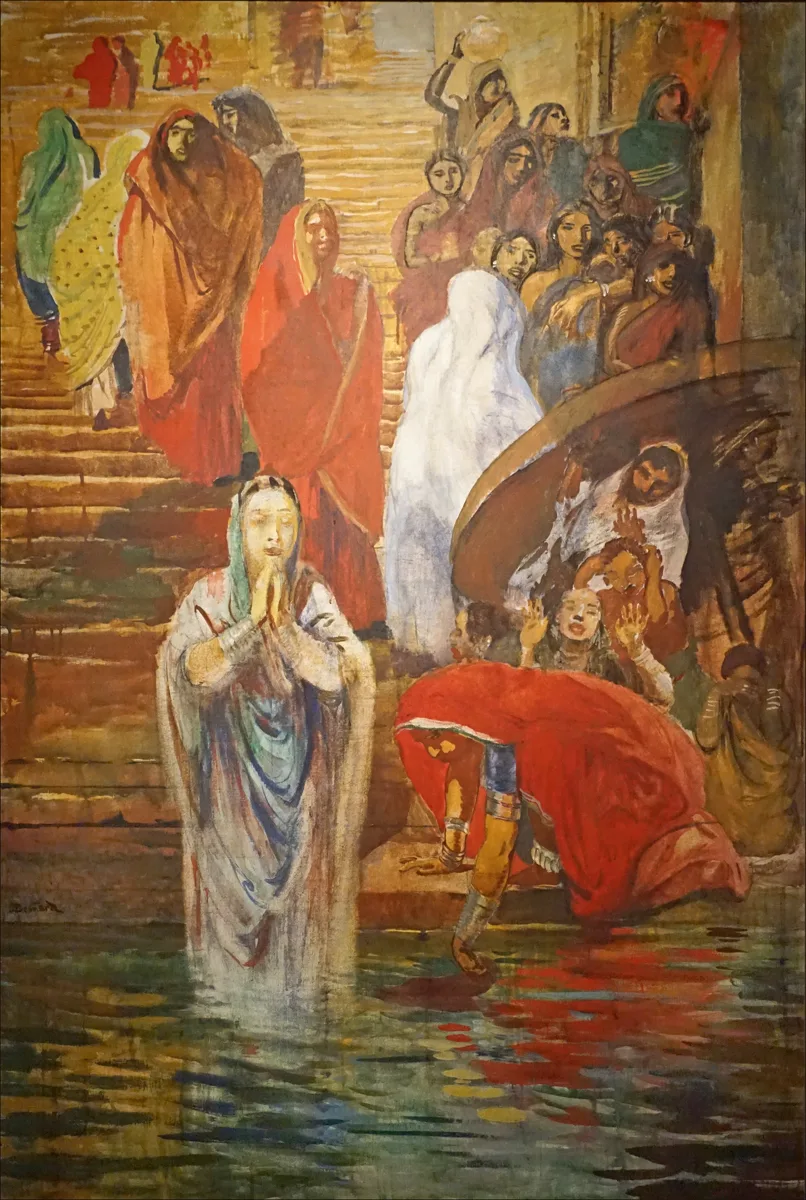
During ten months of solitude and relentless work, surrounded by these inanimate objects, the artist's imagination—so nourished by experience and observation—would unfold all his memories. He would restore their color, form, and movement, and finally bring back their strange life, thanks to that subtle and somewhat miraculous gift we call the "feeling of exoticism." This is "the faculty of evoking, around an object, the environment from which it comes, and of animating that environment with its own particular life."1 The feeling of exoticism is made of "contemplation, nostalgia, and concentration."
It is from a distance that this feeling is best experienced, and that the artist delights in recomposing the magic of faraway climates. What will constitute the beauty of the recreated spectacle is not only its degree of accuracy and picturesque value; it is also, and above all, that emotion of memory, that regret of separation which the artist confides in us. It is the tension of memory and sensibility that makes the hand more feverish, that gives the vision more bite and sincerity.
First and foremost, one must praise the fine desire, the noble dissatisfaction that drove Besnard to embark for India. At the height of his career, at a moment when so many others, content with glory and honors, look no further than official salons and worldly acclaim, he undertook a long journey, not without its difficulties or even its perils. Like a young man seized with impatience and desire, he aspired to learn new forms, to know the more beautiful and freer ways that other men have of holding themselves on the surface of the earth, of carrying their heads and moving their limbs.