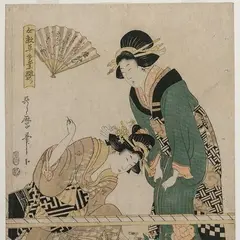
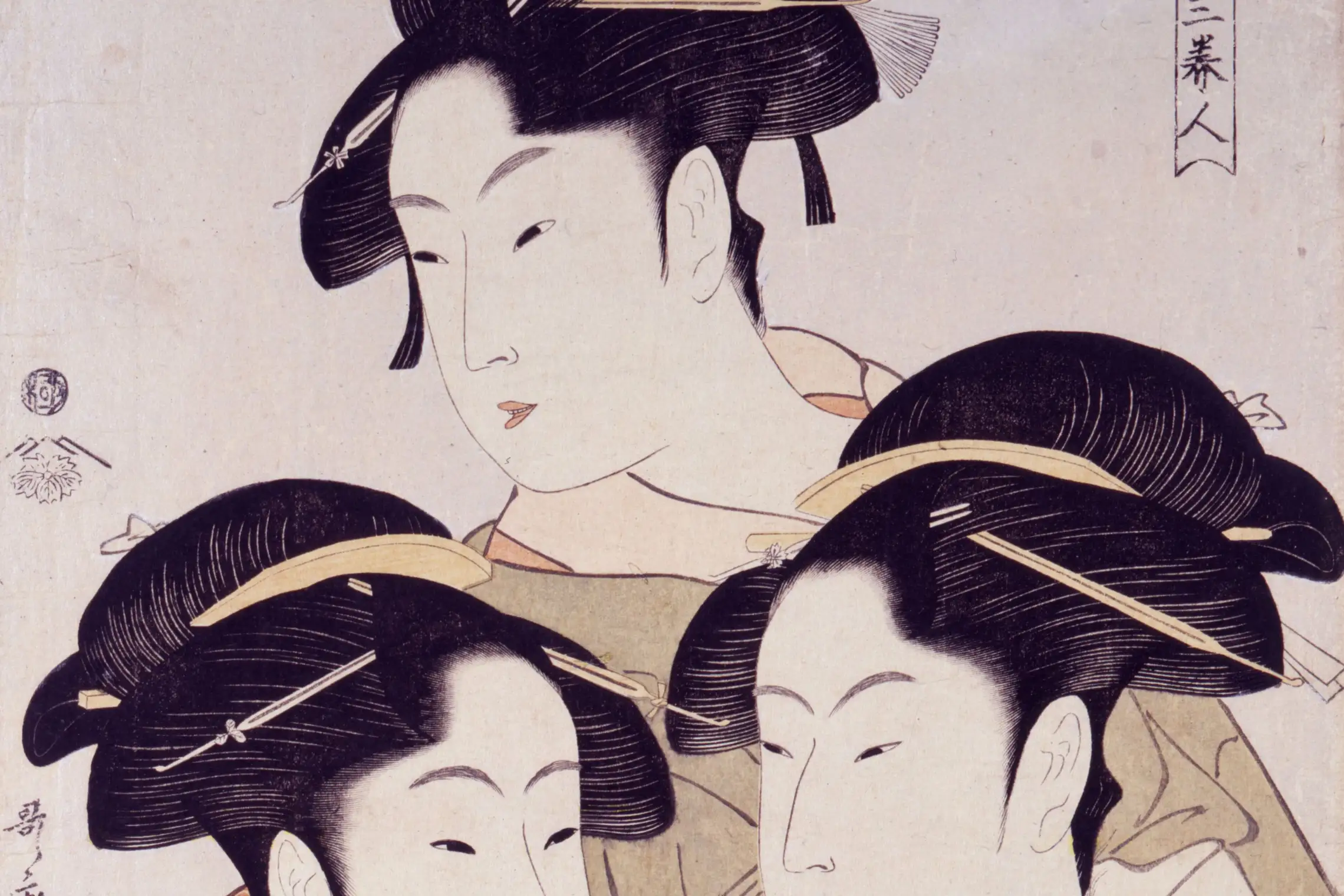
Of all the Japanese printmakers, the most popular in France is perhaps still Kitagawa Utamaro. When the first prints from Japan were introduced to us—prints which, let us not forget, were all works by artists from the late 18th and early 19th centuries—the public’s taste immediately gravitated toward this elegant and refined artist. His works evoked, in certain aspects, those of our own 18th century (which was just then coming into vogue). Since that time, and despite a more thorough knowledge of the admirable masters who preceded him, Utamaro has remained, for the general public, the very personification of the Japanese print.
Utamaro was fortunate, it is true, to have as his first historian one of the last century’s most discerning connoisseurs, Edmond de Goncourt, who published a charming book about him as early as 1891. We too often forget this date when we seem to reproach him for not having provided a catalogue of the artist's work as complete as that of Dr. Kurth, as if it were not always easier to perfect a study (especially twenty years later) than to begin one. It is also common today to criticize Goncourt for having seen Utamaro only as the painter of the "green houses" (the licensed pleasure quarters). This is an exaggeration and not entirely fair, since he, on the contrary, noted the diversity of Utamaro's talent very well. Among other things, he highlighted the artist's highly original understanding of maternal feeling (though Kiyonaga had treated it before him).
If Goncourt gave his work the subtitle Utamaro, Painter of the Green Houses, it is because the artist, who painted almost nothing but women, did indeed particularly distinguish himself in depicting those tall courtesans. He portrayed them with their frail waists and flexible necks that seem to bend under the weight of their high coiffures, adorned with multiple hairpins. He shows them to us in all their occupations, dressed in costumes of marvelous designs. Despite a few series representing the work of women from all walks of life, we do not yet see how Utamaro could ever be considered the painter of family life; one need only leaf through his work to be convinced of this.
Furthermore, Edmond de Goncourt, very well-informed by the Japanese dealer Hayashi, had admirably understood—or rather, divined—the full subtlety of this refined art at a time when the number of known Utamaro prints was still limited. He was able to analyze its charm in a language that was perhaps precious, but in any case, happily evocative. For this, we cannot be too grateful to him, for it is still to him that we owe our being best prepared to appreciate the very beautiful exhibition at the Musée des Arts Décoratifs—the most significant and remarkable collection, in terms of quality, of this master's works ever assembled.1
The Influence of Kiyonaga
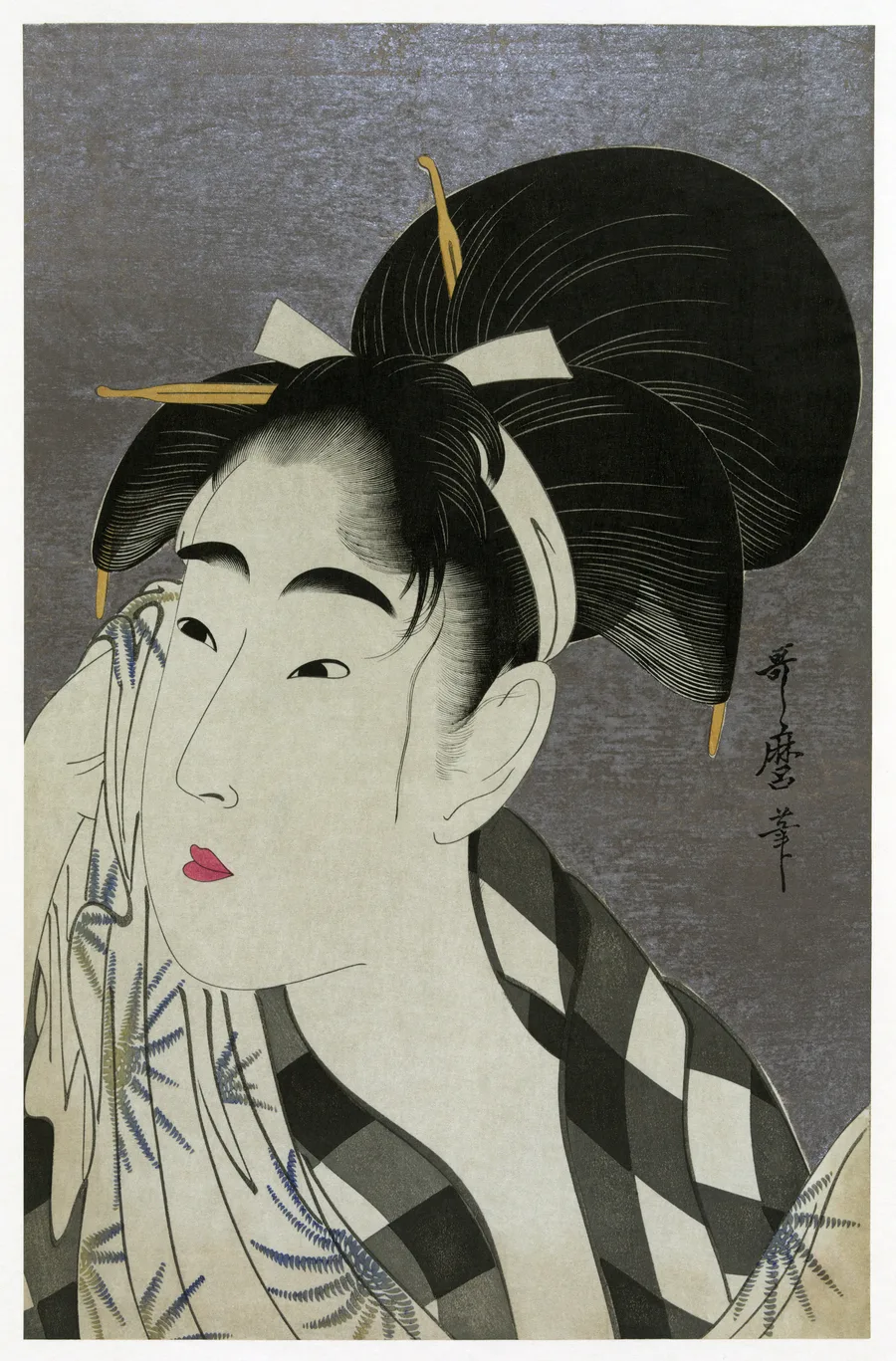
When Yūsuke Utamaro,2 born in 1754 in Kawagoe, began to draw, the technique of woodblock printing had long since reached its perfection. We saw this last year and the year before in the way that admirable printmakers such as Harunobu, Koryūsai, Sharaku, and Kiyonaga—to name only the principal ones—had taken advantage of it. As for the art of the print itself, Kiyonaga had raised it to such heights, both in terms of drawing, refined and sober taste, and true, harmonious elegance, that it was extremely difficult for his contemporaries to rival him without imitating him.
This is precisely what the young Utamaro did at first. After leaving the studio of his old master, Sekien (1712-1788), he abandoned painting to devote himself to printmaking. We have used the word "imitate" intentionally, for in the beginning, Utamaro did more than just fall under the more or less direct influence of Kiyonaga. When, after illustrating a few small books, he turned to single-sheet prints, he began by imitating him—remarkably, it is true—but borrowing not only his drawing style, his technique, and his coloring, but also very often his inspiration and his subjects.3