
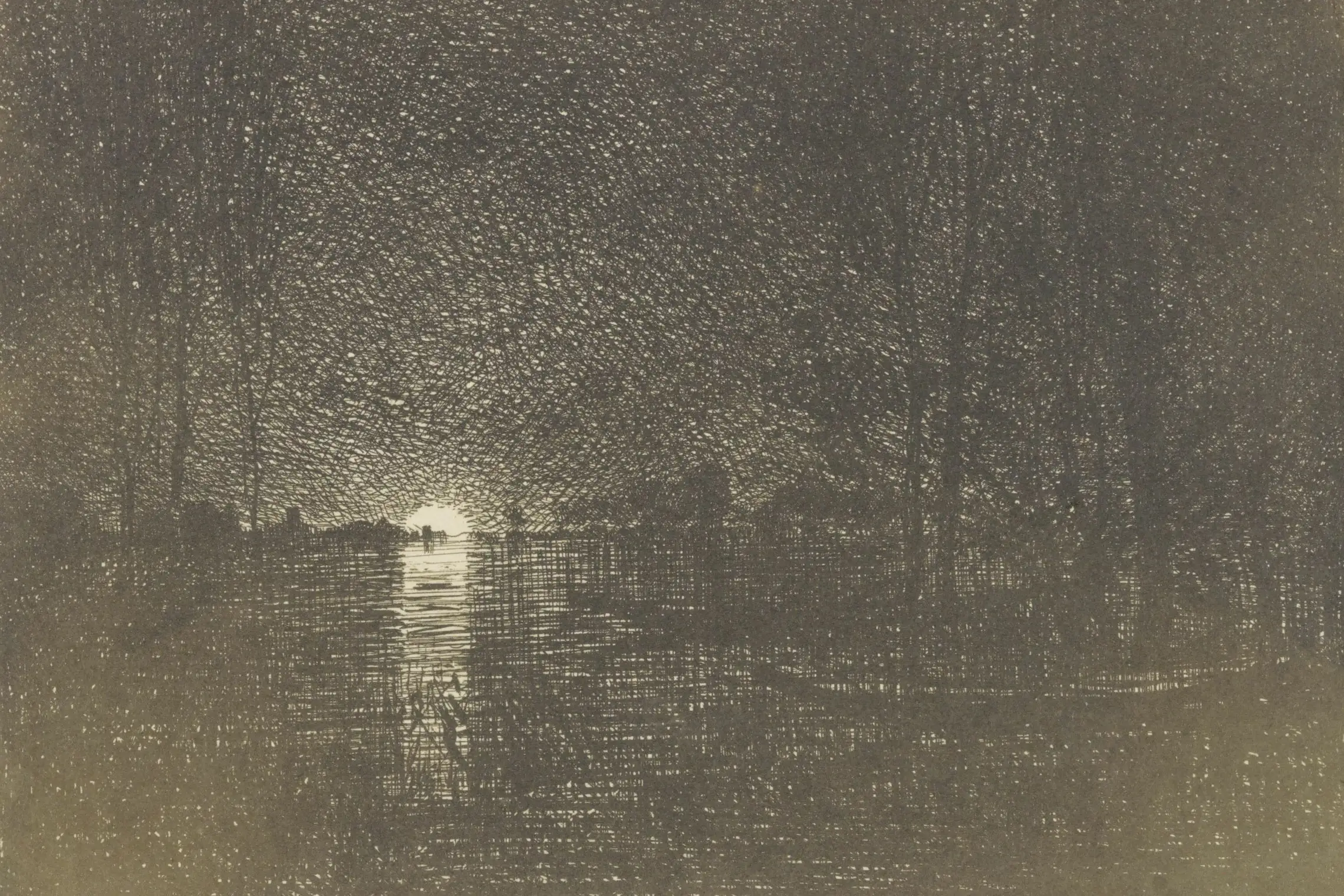
The prints I am about to discuss are generally referred to by dealers in their sales as procédés sur verre (processes on glass). In his catalog of Charles Daubigny's work, M. Frédéric Henriet calls them clichés-glace (glass plates), and in his catalog of Millet's work, M. Alfred Lebrun calls them héliographies sur verre (heliographs on glass). The inventor Barthélemy Pont used the terms autographies photographiques (photographic autographies) and héliotypie in his patents. The artists from Arras, who preceded him, simply called them dessins sur verre pour photographie (drawings on glass for photography). Finally, if one were to follow the decisions of the photographic congresses of 1889 and 1891, one should use the expression photocalques (photo-tracings), which has so far remained unused. As one must choose from among all these names for the same thing, I will stick with the first, which seems to me not the best, but the most commonly used.
The Cliché-Verre Technique
The process itself consists of this: one takes a glass plate and produces on it, not with a camera but by hand, a drawing of transparencies and opacities, analogous to a photographic negative. This drawing is then printed on sensitized paper, exactly like an ordinary photographic plate.
One can imagine that the means of obtaining such artificial plates are highly varied. The principle remains the same, but the substances that can be applied to the glass are countless, and the way of working them also involves all sorts of methods.
In practice, two processes were almost exclusively used, as they yielded the best results. The first consists of covering the glass plate with a completely opaque layer, which is then scratched with a stylus, much like an etching varnish, to expose the bare glass. Care is taken to give the surface of this layer a white or light color. To work on the plate, it is placed on a black cloth; consequently, all the stylus marks appear in black, exactly as they will on the final print.
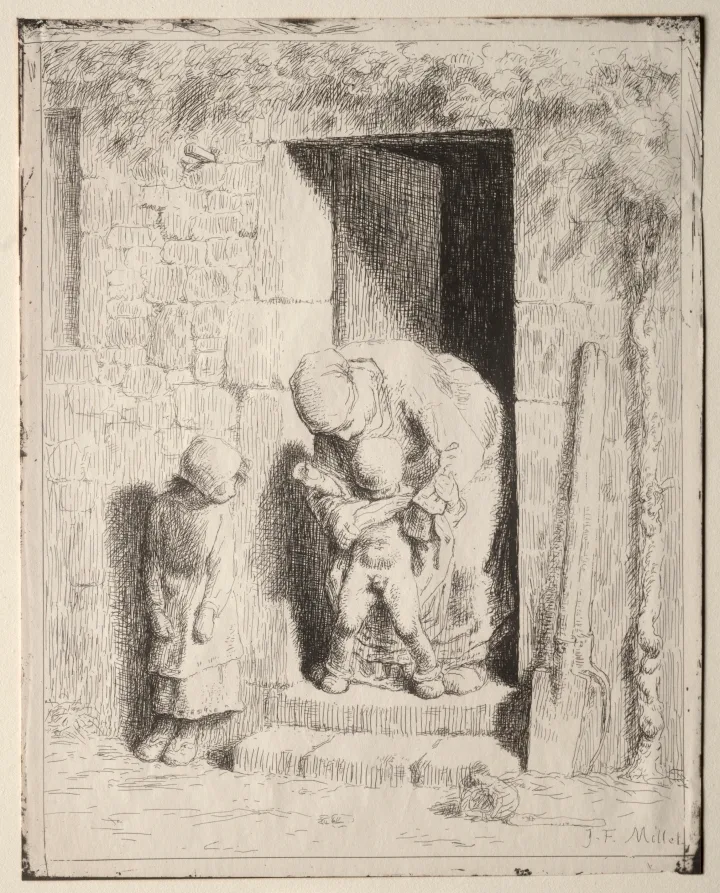
To make the print, the sensitized paper can be placed facing the opaque layer of the plate, which captures all the precise subtleties of the drawing. Often, however, the plate is turned over, with the paper applied against the bare face of the glass. This allows light to diffuse within the incised lines, creating a softer effect. The same result can be achieved without inverting the image by separating the plate from the paper with another transparent glass plate of appropriate thickness. Prints made in the first manner are often a bit thin. Indeed, on the unyielding, polished surface of the glass, the stylus tends to leave only a fine line of constant thickness. No matter how one blunts it, turns it while working, or even uses several styluses of varying sizes, these tricks cannot replicate the resources the etcher finds in the acid bite, nor those the pen-and-ink artist derives from simple pressure. On the other hand, the diffusion of light through the lines produces very particular soft-focus effects, which are almost always pleasing when the plate is not overworked.
I have not yet specified the nature of the opaque layer used to cover the glass. From the information provided to me, I believe I can infer that the operators in Arras—the first chronologically and, as we shall see, almost the only ones who concern us—began by using collodion plates, which were then developed after being exposed to light. However, a collodion layer is not well suited to the work of a stylus; instead of being cleanly scratched, it tears. This is undoubtedly what led them to replace it with a layer of printer's ink spread with a roller, then dusted with white lead to obtain a white surface instead of a black one.