
Since the discovery of the "Protat Woodblock,"¹ that famous engraving on a long-grain woodblock in the manner of playing-card makers, no incunabulum could be more welcome than a large plate engraved on copper using the technique of goldsmiths. I have just rediscovered such a plate, so close at hand that I am astonished no one had found it before.
A Mysterious Negative Print
In the collection titled Les Deux cents incunables xylographiques du Département des Estampes (The Two Hundred Xylographic Incunabula of the Print Department),² M. Henri Bouchot, under number 37, provides a reproduction of an engraving whose main subject, an Annunciation, is presented negatively, as shown in our own reproduction on page 274. The whites of the image have come out black, and the blacks have come out white. The original measures 0.275 x 0.195 meters, and the copper is of a standard thickness.
M. H. Bouchot writes on page 210 of his catalog's text:
(French Flanders, circa 1470). This plate, which belonged to M. Victor Gay, was printed in the mid-19th century. It is a metal plate engraved with a burin to create a tonal effect; it must have been intended for hot embossing, as the letters are read in the correct direction. Without this explanation, one could not accept that this negative was meant for a paper print, as all the figures would remain black when printed. On a banderole held by an angel, one reads: Gloria in excelsis, and on the angel's phylactery: Ave gracia plena Dominus tecum. Note the floor tiling, which recalls those in the Santin Eveillard series.
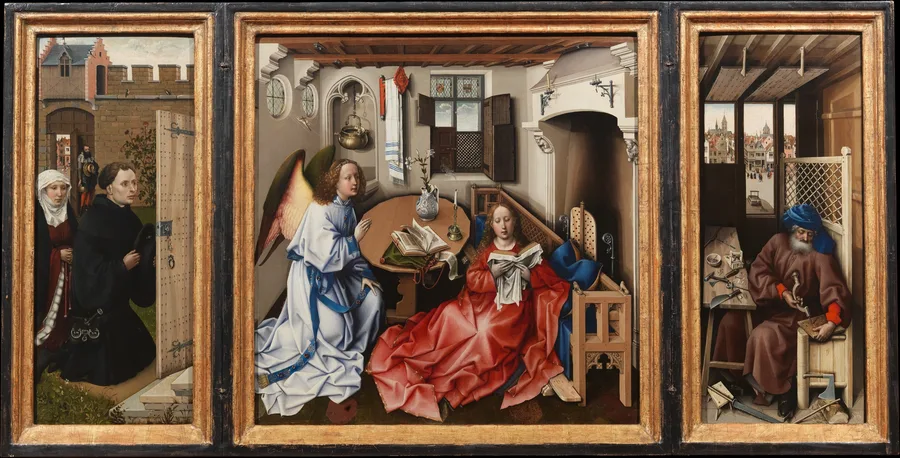
There is a nail for holding the metal plate near the top border. The plate is dotted (criblé) and scratched.
A question immediately arises: Why is the print negative? This has always seemed to me to be a printing absurdity. Indeed, serious doubts came to me upon examining the original print at the Cabinet des Estampes (the Print Room of the Bibliothèque Nationale). I realized that the intaglio printing of this image produced a far too noticeable relief of ink on the paper, indicating that the engraving was cut much more deeply than ordinary intaglio plates. From this, I deduced that the plate must have been engraved for relief printing on metal.
To proceed with more certainty, I photographed Victor Gay's negative print. Immediately, the resulting photographic plate gave me the most perfect positive image I could hope to reveal. The work of the burin cuts, the dotted (criblé) effect made with punches of various sizes—everything reminded me of the precious technique of the most beautiful incunabula of this category. The faces were illuminated, the horizons became clear, and I then became convinced that a major error had been made.
One might object, as Passavant did (Vol. I, p. 357), I believe incorrectly, regarding a modern printing of an old plate, that an impression with white ink on black paper would better render the original's appearance. While a few specimens printed in this manner do exist,³ they do not exhibit the same burin technique or the same method of execution. The lines expressed in white are very shallow, and the prints lack substance, recalling chalk drawings on a blackboard.
The Rediscovery of the Original Plate
Knowing that the original plate of the Annunciation had existed in Paris in the mid-19th century and had been part of the Victor Gay collection, the task was to find it to dispel all doubts. After M. Gay's death, his collections remained forgotten in crates for twenty years before being dispersed at auction over the last three years.
After many fruitless inquiries, I had the idea to ask M. Marquet de Vasselot, assistant curator in the Department of Medieval and Renaissance Art Objects at the Louvre, if he might by chance have a copper plate from the Gay estate depicting an Annunciation.
Upon the learned curator's affirmative reply, I obtained permission to study the plate, which had remained unknown because it had not yet been exhibited or officially cataloged. At the sight of the rediscovered object, all my doubts dissipated. I was certain I was holding a copper plate engraved in relief, admirably preserved except for some minor damage from impacts, particularly in a crenelated tower on the horizon. Soon after, in the curator's presence, I myself pulled several proofs from the original copper onto China paper using an ivory frotton (a burnishing tool). I left one at the Louvre Museum, brought the second to M.
Courboin, curator of the Cabinet des Estampes, whom I had informed of my hopes, and kept the third proof, from which the reproduction accompanying these lines is taken (page 275).
The proofs I pulled surpass in beauty all known typographic plates and incunabula of the 15th and 16th centuries, and Bouchot's hypothesis is thus disproven.
Authentication and Analysis
The result seemed so perfect that new doubts arose. Could such a well-preserved plate be authentic? Without seeking certainty in style and special technique, which can sometimes be deceptive, or dwelling on the past error, which rules out any idea of deliberate deception, I found my proof in a purely physical and therefore indisputable fact. The reverse of this Annunciation copperplate bears another engraving, which we also reproduce. This second image depicts the passage of the comet of 1665 amidst the constellations.
The Latin inscription reads: Via Cometae ex observationibus Anonymi Maceratae a die 14 Decembris usq. ad 21 Januarii 1665, longitudo, et situs caudae ex figura Astronomis patebit. (Path followed by the Comet from the observations of the Anonymous of Macerata,⁴ from December 14 until January 21, 1665; the length and position of the tail will be clear to Astronomers from the figure). This intaglio engraving is signed with the interlaced initials AP; the Italian-style burin work is from the 17th century. It is therefore thanks to the reuse of this metal plate for a new engraving that we owe the preservation of a work that would otherwise, like so many others, have disappeared into the founder's crucible.
Later, the Annunciation subject, treated as a religious icon, was pierced at its top to make it easier for some pious person to hang.
However, a new objection arose: the engraving of the 1665 comet could have been executed before the Annunciation, in which case the religious image would be modern—that is, a fake. Could it be an admirable pastiche? Here again, an examination of the plate proves that the Annunciation was engraved on the front of the copper, whose edges are beveled, while the edges on the reverse, where the Comet appears, are sharp-angled, consistent with the back of all engraved metal plates. Furthermore, the Comet was engraved on a surface that was neither smoothed nor prepared for engraving. It would also be interesting to find the astronomy book in which the Comet of 1665 was published, unless this plate is an unpublished one.
Having detailed the discovery of this plate, I will now confine myself to a few observations on its relationship with other incunabula that it resembles. I will address these more fully later, particularly in my forthcoming book, La Gravure sur bois et sur métal en relief, du XIVe au XVIe siècle (Wood and Metal Relief Engraving from the 14th to the 16th Century), where the Annunciation plate will be featured in its original form.
Stylistic Comparisons and Attribution
First, let us note the small placard fixed to the wall, visible to the right of the Virgin. To facilitate reading the inscription it bears, I provide it below, enlarged and presented in two different aspects: one as it is engraved on the plate, and the other, reversed, as it appears in the impression. Does it indicate a name? A date?⁵
As for the inscription legible on the banderole held by the angel in the background, it is in the Flemish language and is addressed to the shepherds; it can be translated as: "Glory to Jesus Christ the Savior." The two other secondary subjects depicted are the Visitation and the Nativity.
Initially, for attribution, we considered the school of Master E. S., whose works date to around 1466. However, we are more inclined to consider the work as belonging to the school of van Eyck from 1480.⁶ Perhaps the Annunciation plate is even from the same family as the Virgin and Child from the Jagiellonian collection in Krakow. A replica of the latter, but in reverse, was executed as a facsimile from a plate framed with a mount signed: Bernhardinus Milnet (or Milnil, or Cuisnet), likely the mark of a print dealer.⁷
We also believe that the Annunciation plate should be compared with that of Saint Jerome (Bouchot, no. 117a). The two plates are of roughly the same dimension, and the manner of presenting the subjects is of the same essence, following the formula of miniaturists: a principal scene in the foreground, with accessory or complementary subjects in the background. The faces in both subjects are by the same hand, with the same manner in the drawing of the nose and downcast eyes. The halo of Saint Jerome features, next to the inscription, the same ornaments as in the Virgin's halo. The criblé work on the walls and the way the sky and backgrounds are treated are identical; likewise, the rocks are cut and worked into polygonal points.
The punches are used in the same way on the clothing and terrain; only the shape of some differs, with rosettes used instead of stars.
The criticism that one cannot fail to make of this comparison between two plates from the same period is that the Saint Jerome engraving lacks crispness and freshness. This is undeniable. However, one must consider that the Saint Jerome plate was still being printed in 1532 in Spain, where it had been imported from Flanders.⁸ We thus find it in a sorry state, an appearance the Annunciation would also present if, instead of being printed on China paper, it had been worn down and crushed by print runs on poor paper, likely from a soft-metal polytype (a stereotype cast). This opinion would align quite well with that expressed by M.
Courboin⁹ and with the fruitful research I am conducting on the subject of early plate casting.
In any case, for one who knows the technique, it is easy to see that the engraving work is the same in the Annunciation and Saint Jerome plates; one is intact, the other is deteriorated. The two subjects therefore seem to be the work, if not of the same artists—painter and engraver—then at least of neighboring Flemish workshops.