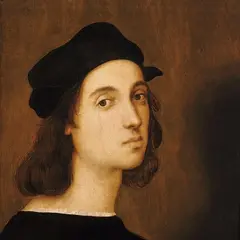
What a poem a drawing by Raphael is! The grandest and purest conceptions of the human mind passed from the artist's soul through his light pen, fixing themselves on paper with the unconscious simplicity of a newborn child. When the drawing is one of those dreams of happiness, varied infinitely by the divine Sanzio under the title of Madonnas or Holy Families, it seems that an even more elevated idea fermented in his brain, that a more chaste sentiment made his heart beat, and that from his virile hand bloomed a flower of grace and tenderness with a more penetrating fragrance.
We have often wondered about the source of Raphael's special attraction to depictions of maternal love. An examination of his life offers no easy answers. Where did he learn to love the child? Where did he learn to love the mother? It was not in his own family. At the age of eight, he lost his gentle mother, Magia. The following year, his remarried father, Giovanni Santi, gave him in Bernardina, his new wife, a true stepmother, whom the orphan was forced to leave a few months after his father's death. Wandering from city to city, he never knew the intimate joys of a domestic home.
Later, in Rome, laden with wealth and honors, he considered marriage. A letter to his uncle proves that he thought of it like any mortal, calculating the dowry down to the last écu. But the niece of Cardinal Bibbiena did not become his wife. As for his mistress, the Fornarina, it does not appear that she ever gave him a token of her affection in the form of a child. It was not, therefore, around him or in his own home that Raphael could have contemplated the intimate drama of the family. He could only have loved the spectacle of maternal love as an unrealized dream or a distant memory of his earliest childhood.
And who knows? Perhaps it was this very lack of personal experience that allowed him to see the mother and child through the veil of an ideal that was always happy and always charming.
The Initial Composition
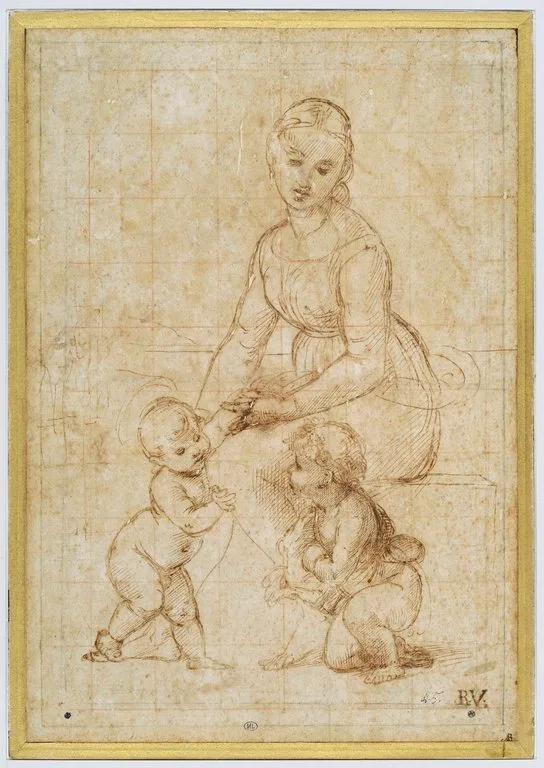
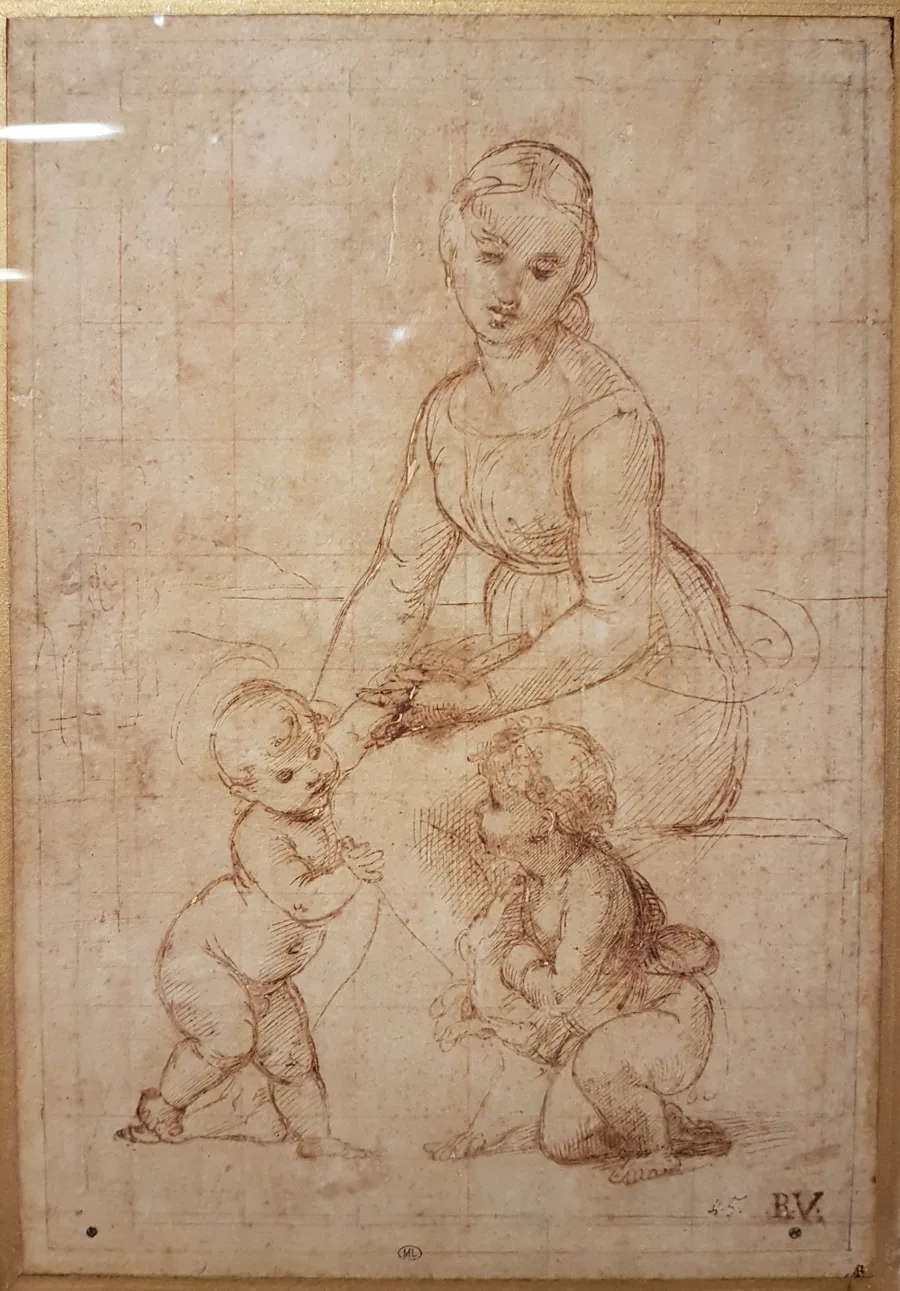
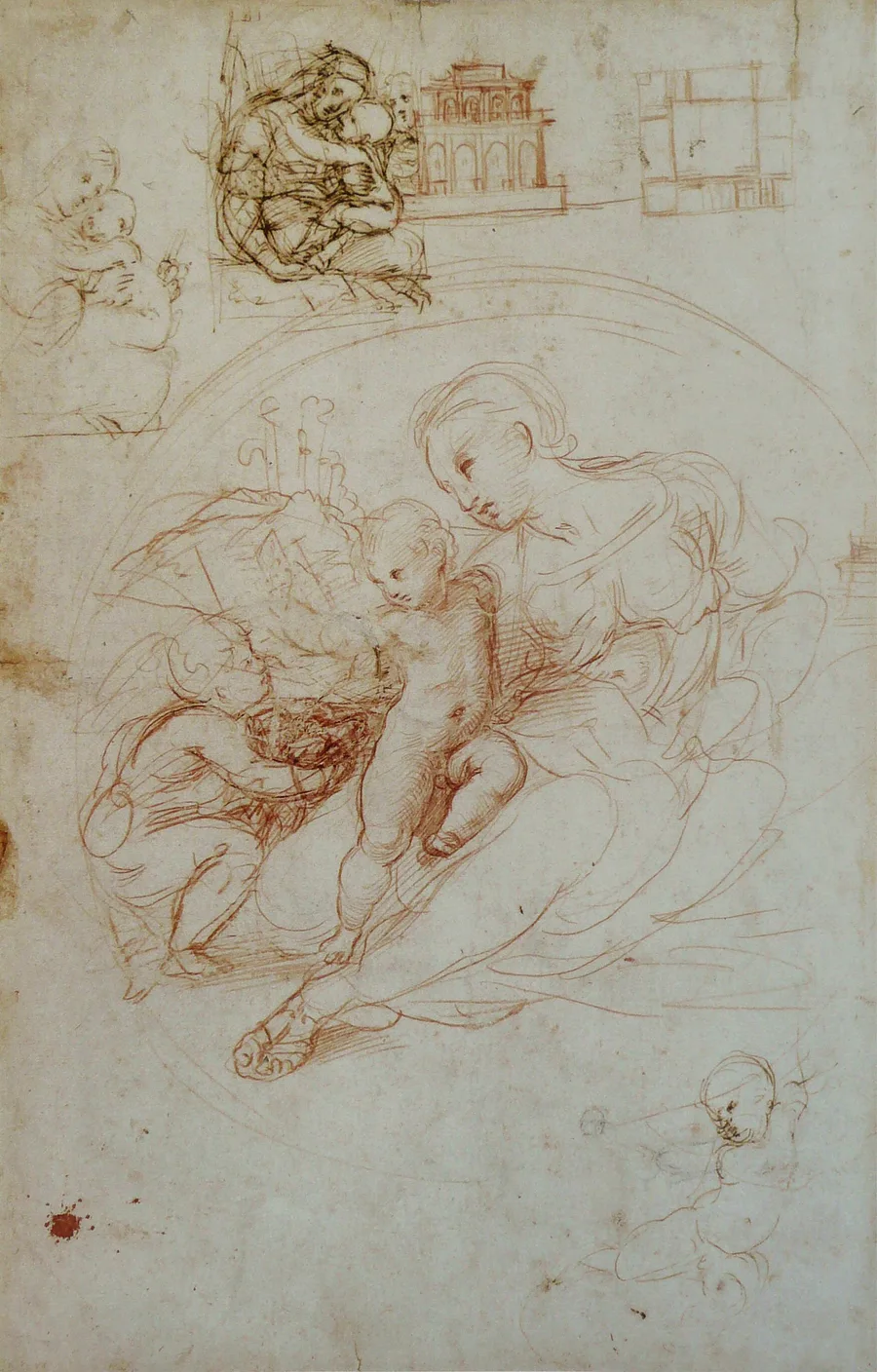
Of all Raphael's Madonnas, perhaps none possesses this character of unalterable peace to a higher degree than La Belle Jardinière in the Musée du Louvre. The drawing reproduced here presents the first thought for the painting. The Virgin Mother is seated with her son and his faithful playmate, the young Saint John. A few indistinct lines barely indicate the background, but one senses that this happy group could only be placed in a garden, in the heart of a cheerful landscape, and not under a canopy or amidst sinister rocks.
Supported by his mother, Jesus attempts his first steps. As if this first step already revealed his divine nature, the kneeling precursor, with his hand on his heart, pays a first homage to the future Christ. Mary's gaze envelops them both, a look of astonishment almost clouded by a vague premonition. Nothing is better linked than these three figures, nothing more expressive than the feeling of tranquil love that unites them, and nothing is more simply expressed. The child truly belongs to the mother, and she, while her gaze seems directed primarily at Saint John, makes it clear enough by her gesture which of the two is her son.
The Quest for a Model
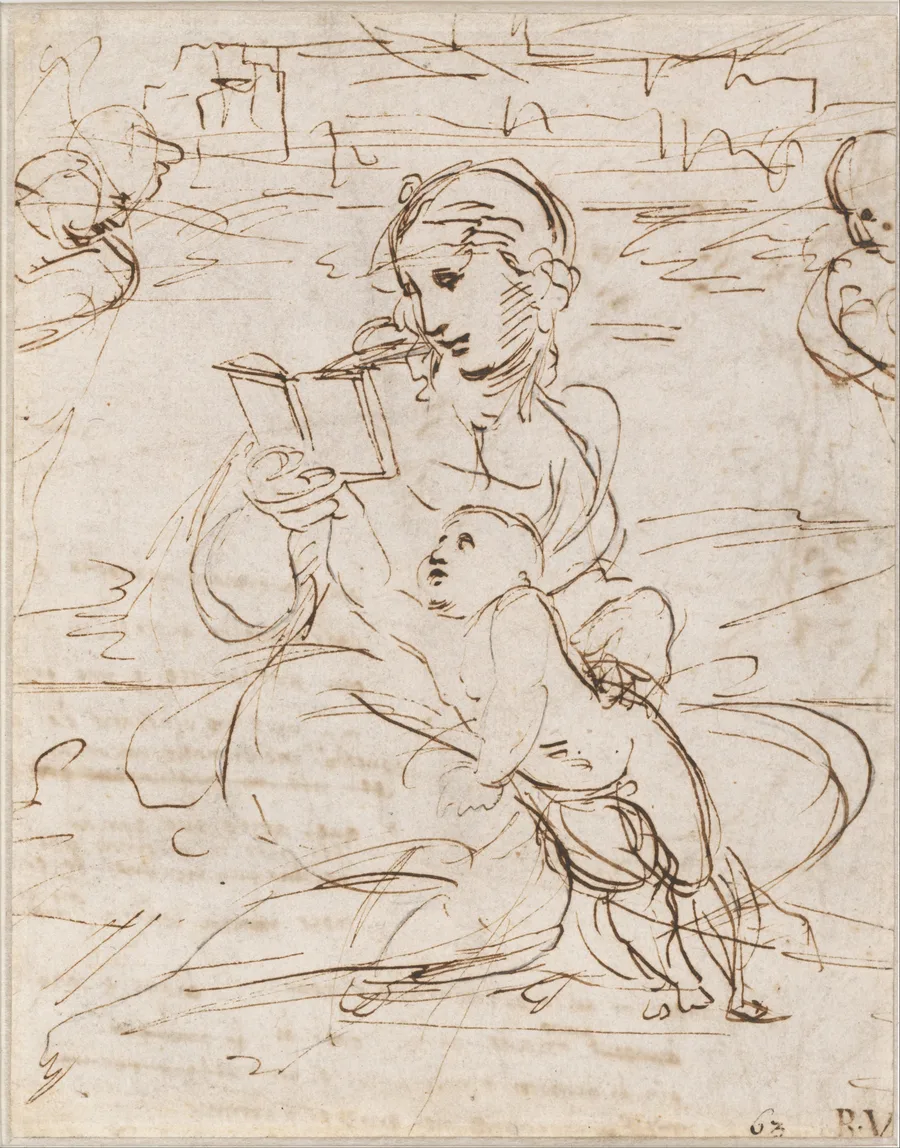
Another problem in Raphael's life is this: where did he find his models? Certainly, when he groups several figures together to compose, for example, the drawing of the Madonna of the Fish, I recognize, by the square cloth she wears on her head, the Trasteverine woman, seated on an overturned crate. Around her are students, friends, perhaps some laborer descended from the scaffolding of the Villa Farnesina to briefly play the role of the young Tobias.
But in the drawings that present only one or two studied figures, where can we find the types for these personages of sovereign beauty—austere old men, powerfully built men, and especially the women, with their naive and chaste grace, and the smiling, chubby children? Should we believe, with the connoisseur Mariette, that the delightful red chalk drawing in the Louvre, the first study for the Holy Family of Francis I, was drawn from the Fornarina? Sic ab amicâ exemplum sumebat (Thus from his mistress he took his model). All the portraits of this famous beauty that have been shown to us in Florence and Rome give the idea of a beautiful mistress, a soul of marble in a body of fire.
How far they are from the ideal of chastity and candor that inspired the Madonnas and Holy Families!
No, the modest bust of La Belle Jardinière, her slender hips that widen for maternity and not for sensual love, her sloping shoulders, her arms with their gentle movement—this entire ensemble of forms, chosen with exquisite taste to express a virginal nature, could never have belonged to the woman who possessed what the writer De Maistre called the "beast" in Raphael. Either the painter's visual memory was a gift of exceptional power, or he knew how to find, in the shadow of domestic virtues, humble models very different from those used today. One will notice, moreover, that in drawings for pious compositions such as the Madonnas, the model is almost always clothed.
At most, the painter managed to have the skirt raised above the knees to reveal the legs. No doubt the mother was present, according to Italian custom. Have we not seen in Rome, in the studio of S***, the young Marietta come to pose, with fewer clothes however, under the vigilant eye of her mother?
The drawing for which we have the facsimile before us, when compared with all those we know by the master, proves that Raphael did not feel obliged to first draw the nude form of every figure in a painting, only to cover them later with draperies or clothing, according to the academic method rigorously established as law by Jacques-Louis David. The Italian masters proceeded differently. After the solid studies of anatomy and osteology that were the scientific basis of their art, they had such a knowledge of the human body that the life drawing, a purely imitative study of surfaces, became unnecessary for them.
A writer does not look up every word in the dictionary nor perform a grammatical analysis of each sentence. For them, as for the writer, the grammar of their art flowed naturally, enveloped in the forms of a learned practice.
From Drawing to Painting: A Study in Alterations
Between the drawing of La Belle Jardinière and the painting in the Musée du Louvre, there are notable differences. However, although a black chalk cartoon is reported to be at Holkham, in the collection of the Earl of Leicester, the grid squares drawn on this paper indicate that Raphael did not seek to push the study of his composition further. Like the Creator, he saw that it was good, and he stopped. But once the drawing was transferred to the panel or cartoon on a larger scale, he modified certain details. It is curious to follow these differences step by step to understand the changes they brought to the work's expressive value.
Mary's inclined head has been raised and turned to the left. It thus acquires a special importance, likely motivated by Raphael's encounter, after the drawing was made, with an exceptional model of innocence, whose marvelous purity he hastened to reproduce. Yet this attitude seems to accord less well with the general movement of the body than the more conventional pose of the initial drawing. One senses a certain stiffness which, combined with the very individual character of the physiognomy, leads us to believe it is a portrait. The rest of the body, with the exception of the left arm, which is brought back a little, has undergone no modification.
But by enveloping her in a vast blue mantle, Raphael significantly altered her character. It seems that the painter, by means of this drapery brought over the right shoulder, only wanted to fill the void between the right arm and the hip. How did he not see that he was simultaneously hiding the young mother's virginal breast, her supple waist, her elegant hips—in short, the undulating grace of this beautiful body? Are so many charms taken from our sight the result of a simple desire to fill a gap, or could they be caused by the remorse of a religious prudery? We do not believe in this latter motive.
It seems more probable to us that Raphael, having long since escaped the swaddling clothes of Perugino's style and now under Florentine influence, sacrificed the primitive slenderness of his Virgin to a search for an artificial fullness for which Fra Bartolomeo gave him the example. It cannot be denied that the painting has lost something in the process. Compared to the drawing, it has a heavy aspect. More than one person has surely searched beneath the blue drapery of the painting for the figure's movement, which can only be understood by looking at the drawing.
Revisions to the Children
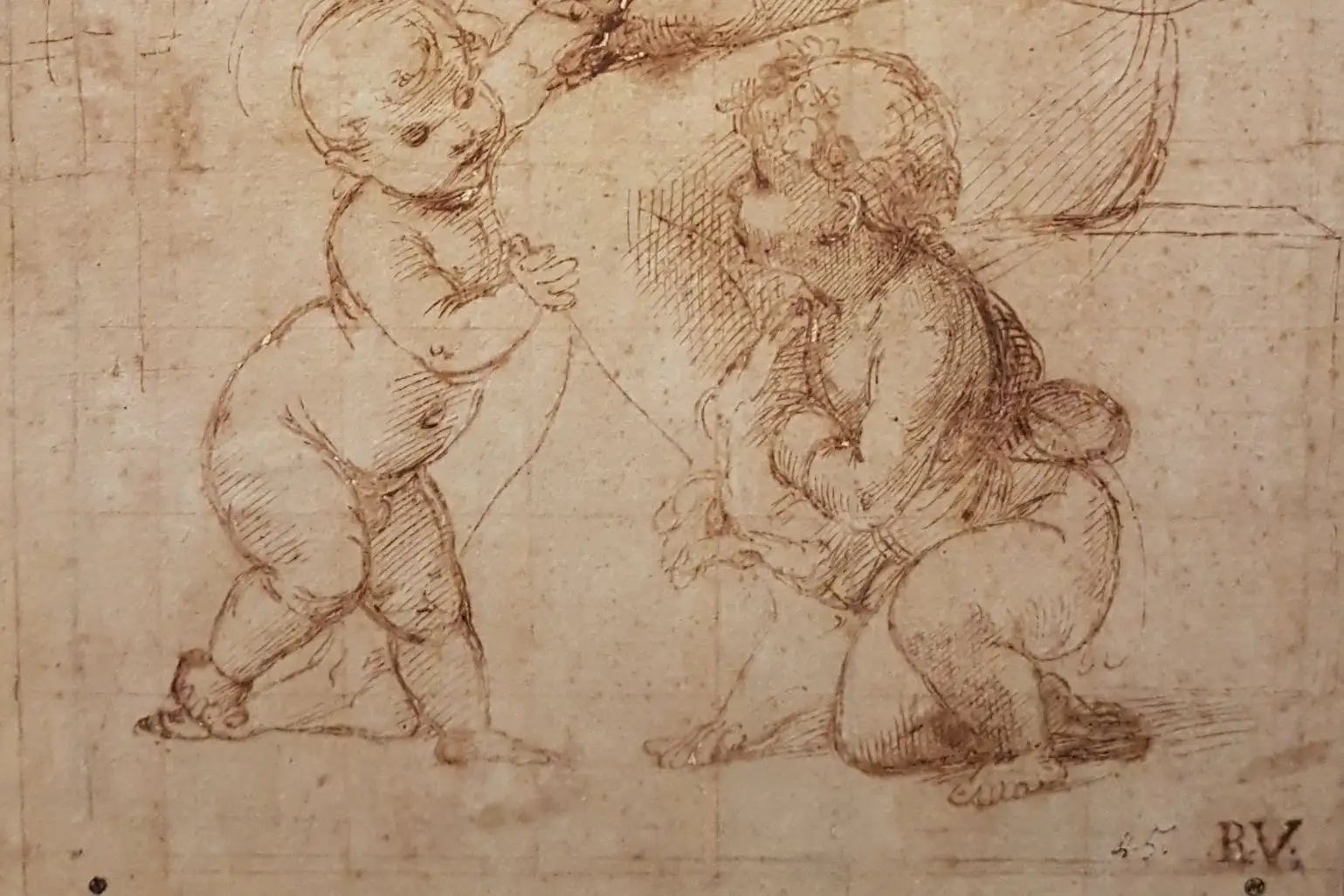
The changes made to the figures of the children are more successful. In the drawing, the little Saint John is presented only as a confused embryo: his hands go nowhere, and his face expresses nothing. Raphael has only found the position of the legs, and he is careful not to modify it in the painting. He even uses it to motivate the movement of the left arm; to the right arm, he adds the reed cross, a necessary support for the body leaning forward. But it is above all the expression of the head that completely modifies the character. In the drawing, the painter's imagination, in search of poetry, had crowned it with flowers.
In the painting, there is no more crown: the hair flows in the wind, the poetic whim becomes true poetry. Everything contributes to this: the gaze, the smile, the graceful inflection of the neck, the lips that are about to speak.1
Nothing is more supple, more childlike, more familiar than the little Jesus as presented in the drawing. But his left arm connects poorly to his mother's hand that supports him. Whether the painter simply wanted to justify this arm in a more natural way, or whether he found the lines of this charming body too contorted, or even if one admits a religious preoccupation, a desire to equal the pious calm of Fra Bartolomeo's works, the fact remains that Raphael straightened the divine Bambino by resting his chest, and no longer his face, against Mary's knee. This justified a detail of intimate tenderness whose significance was hardly understood in the drawing: the child's little foot placed on his mother's.
And as Jesus, thus grown taller, could now only look down on Saint John, the painter turned his gaze full of love towards his mother.
Thus, through a chain of detailed changes, the core idea of the composition is modified, or rather completed, from the drawing to the painting. In the drawing, the act of adoration by the young Saint John is the focal point, receiving the gazes of both Jesus and Mary. In the painting, this center shifts. The eye of Jesus, a focus of love, receives the homage of Saint John and redirects it to his mother. A higher, more serene poetry envelops the three figures. The drawing was the smile of innocent grace, born in the intimacy of the heart. The painting is the tranquil emotion of a soul that beholds beauty.
Technique and Dating
The differences we have noted, and even more so the clear progress in poetic expression in the painting, seem to indicate that a rather long period of time elapsed between the painter's first thought and its definitive realization. Indeed, if we accept the conjecture of Passavant, which in this case seems well-founded, the painting of La Belle Jardinière would be the one that Raphael began in 1508 and left unfinished, at the moment of his departure from Florence for Rome, in the hands of Ridolfo Ghirlandaio.2
Now, the execution of the drawing presents the greatest analogy with all the studies we know for the Deposition in the Borghese Palace, which predates it by a year. It is the same system of small cross-hatching, alternating with broader, freer hatching that strives to follow the modeling. In the drawing of La Belle Jardinière, this execution reaches a remarkable degree of beauty. One does not know what to admire more: the firmness that guided the limpid line of the Virgin's legs without a tremor, or the skillful hesitations that inscribed their repentirs (revisions) along the contours of Jesus's body.
The divine child's left leg is, thanks to these indecisions, a marvel of suppleness. The neck, shoulders, chest, and hips of the Virgin are indicated with a sovereign breadth, and yet her hand, with a much more original intention than in the painting, shows all the difficulty of a naive artist sincerely seeking the truth. What science in this naivety! What candor in this science!
The Drawing's Provenance
The drawing for which the Gazette des Beaux-Arts today offers a facsimile to its readers can therefore rightly be regarded as one of the most curious in Raphael's oeuvre. This was the opinion of all those who have successively owned it. Listed as number 104 in Mariette's catalog, the drawing of La Belle Jardinière had belonged to the famous collector Crozat, who obtained the best part of his collection from the heirs of Timoteo Viti, Raphael's pupil. Later passing into the hands of Knight and then Sir Thomas Lawrence, it was purchased by the dealer Woodburn, who sold it, along with many others, to the Prince of Orange, later King of Holland under the name of William II.
At the sale of King William's collection, M. de Vos of Amsterdam paid 410 florins for it. Today, the fortunate possessor of this precious piece is M. d'Arozarena. Transported under the burning sky of Havana, may it teach the New World to know and love one of the greatest masters of the Old World, and may it fertilize a land still resistant to the arts by showing it the model of the most delicate grace and the most amiable beauty!