Following the equine canon previously discussed, this article will now detail the comparative proportions of man and horse. The aim is to instruct the draftsman's eye by approaching the truth as closely as possible. However, it must be repeated—as was stated when addressing the human canon—that all measurements taken from a living subject can only be, and are, approximations.
By "proportions," we will simply mean the simplified expression of the relationships between different regions that correspond to the most favorable overall arrangement for good vital function. Despite research into the horse's exterior based on the measurement of a great number of subjects, I would not hesitate to acknowledge the insufficiency of this work. I would declare it incomplete, sterile, and flawed at its foundation if one were only concerned with defining forms without understanding the skeleton and the movement of the joints, the knowledge of which reveals their position, whether apparent or covered by the muscular layer.
It was after continued studies of photographic collections that I was led to outline the equine canon, recently explained in the Gazette. The present article is its necessary complement. We know it is impossible to reduce all horses to a single model, and it is impractical to assign to that model the responsibility of being beyond reproach. It is, however, permissible to establish a rule based on a drawing that harmoniously summarizes the animal's contours. This is what we have attempted to do, by gathering as many indicators as possible to facilitate accuracy in drawing and to prepare the artist to sketch a model from memory.
I. Anatomical Analogies and the Classical Canon
First, let us briefly review, with the help of an explanatory drawing, some anatomical details of the man and the horse that share a certain situational analogy. We will then identify the relationships that can be drawn from their respective sizes, indicating the scale for comparing measurements.
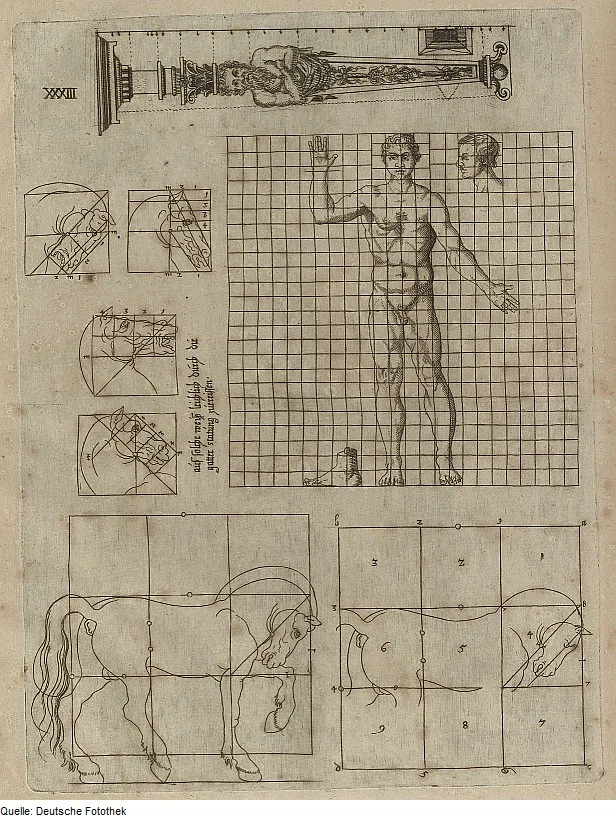
In Figure 2, capital letters will mark the different bony points on the horse's drawing, while italics will mark those of the same name on the man. C, the horse's elbow, indicates the long process of the ulna (the olecranon); c is the human elbow. R and r represent the patella (kneecap). O is the accessory carpal bone, while o is the pisiform bone in the upper row of the human wrist, or carpus.
In the horse, the metacarpus—in the form of the cannon bone with its two splint bone annexes—is our palm. The nail of the middle finger can be compared here to the tip of the front hoof. In the hind limbs, T is the heel or calcaneus of the soliped (a single-hoofed animal); t is its human equivalent. It is here that the anatomical foot begins, with the tarsus followed by the metatarsus. As in the forelimbs, one finds only tendons and ligaments covering the cannon bones, as well as the single digit, whose toe, corresponding to the human big toe, presses against the ground. The main points of the joints are marked for reference on the drawing (Figure 2), which conforms to the equine canon.