
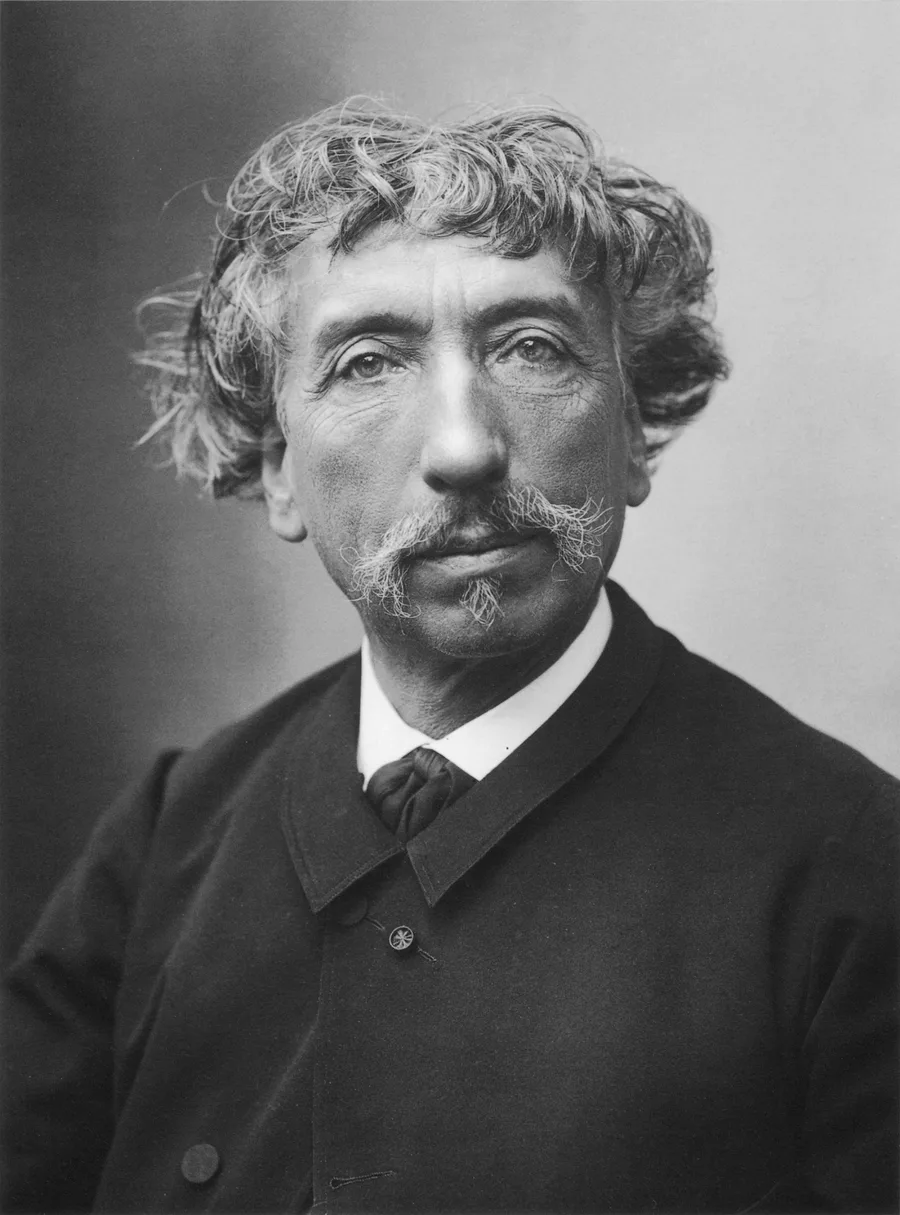
![Cropped - [Charles Garnier in the Drafting Room While Designing the New Paris Opera]](/_ipx/gravity_North&f_webp&q_64&fit_cover&s_2280x1520/api/content/extracted_images/cropped-1782470745298-ddd8c61a-4cce-48af-b8c6-1d3a9d0d55c0.jpg)
It is difficult to assess an artist's work at the very moment of their passing. One ought to observe it from a greater distance, when it is possible to better grasp the full scope of the circumstances that influenced the artist, and when the particular sentiments they provoked can no longer alter the independence of a definitive judgment. That definitive judgment will belong to posterity, to whom Charles Garnier now belongs. But whatever that verdict may be, we cannot wait for it to salute one of the most powerful masters of modern architecture and to state what, even now, can be thought of his work.
This modern architecture, which contemporaries struggle to recognize because its aspirations and forms are so multiple that it does not seem to constitute a whole at first glance, found one of its most characteristic manifestations in Garnier's Opéra.
The Opéra: A Monument for a New Paris
The circumstances of the building's creation are well known. Napoleon III had transformed the Paris of previous reigns. Amidst the edifices of all kinds rising to affirm the new city, the old Opéra on the rue Le Peletier—lightly and provisionally built, and consequently dangerous, as a fire would soon prove—seemed out of place. With its congested and difficult approaches, it no longer fit within a city whose center was shifting ever westward. This gave rise to the idea of a grandiose monument, situated right on the boulevard at the intersection of magnificent planned avenues, that would remain the pride of the Second Empire.
A competition was held, and Charles Garnier emerged as the victor in the second round. Whatever the names of the other contestants, and whatever the very great talent and already established authority of some of them—it is not necessary to recall their names here—I believe one can assert today, without being rash, that each of them revealed their limits. Not one would have understood the new Opéra as Garnier understood it—that is to say, as it needed to be. From others, we might have had a theater of real value, with learned and correct forms and rich decoration, but we would not have had the one that was needed in that place: festive and brilliant. It is to Garnier's glory that he conceived and realized it as such.
Evidently, in establishing the plans for the new Opéra, Garnier did not intend merely to raise a temple to Music. He dreamed of an exceptional palace, as well suited for celebrating the great works of musical art as for hosting the grand pleasure or charity galas—those spontaneous or official Parisian festivities that set a crowd in motion and whose spectacle fills the entire monument.
Certainly, Garnier's solid studies, his contemplation of the imposing ruins of ancient Rome, and his personal research into the polychromy of old Greek temples predisposed the young architect to the conception of such a work.
![[Charles Garnier in the Drafting Room While Designing the New Paris Opera]](/_ipx/w_900&q_82&f_webp/api/content/artwork/ddd8c61a-4cce-48af-b8c6-1d3a9d0d55c0.jpg)
The Architecture of the Palais Garnier
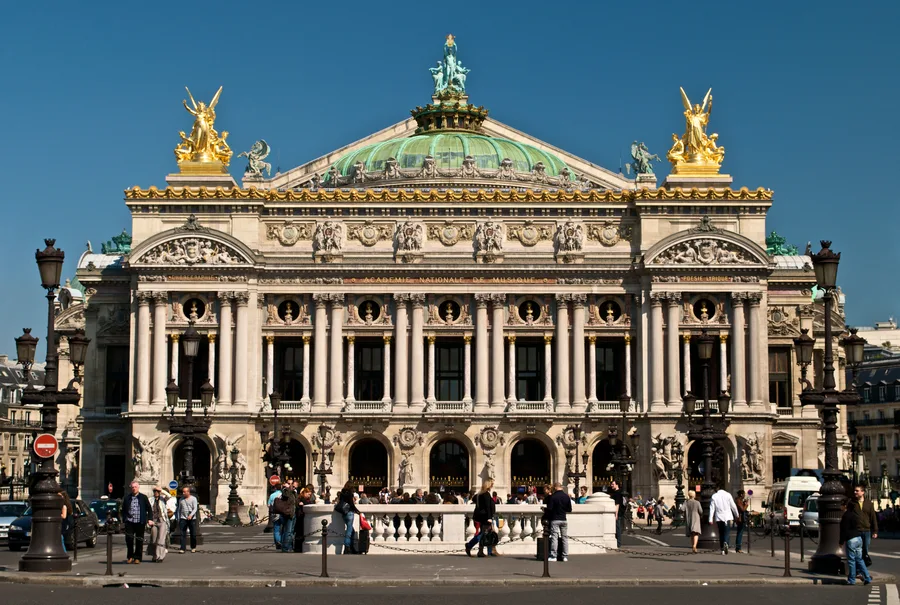
Garnier's plan immediately asserted itself on the exterior through distinct subdivisions, which articulated the different functional parts of the building while harmonizing them into a whole that gave a silhouette to its enormous mass. One must admire this plan, so simple and frank both inside and out that it can be easily grasped with a quick glance.
A Plan of Logic and Clarity
At the front are the access vestibules, forming a base for the grand foyer. Beyond that lies the famous staircase, the ceremonial entrance to the auditorium, whose dome is set like a golden crown on the central part of the edifice. Then, dominating everything, is the great pediment of the stage house. On the right and left flanks are the rotundas, reserved entrances for the head of state and the general public. Finally, there is the administration wing. Such are the broad strokes of this plan, which continues the traditions of logic and clarity characteristic of our French architecture.
Upon this fine plan, the façades were raised. They are animated and yet harmonious, well connected to one another by long, continuous lines, offering superb and varied aspects from all sides, across the grand avenues that clear a space around the building. Garnier's training was too classical for him not to employ all the conventional orders in the composition of his façades. But he used this ancient language with such breadth, utilized all its resources so well, and renewed it with such verve and invention in the details, that he made it a mode of expression entirely his own and with a thoroughly modern accent.
Exterior Façades: Classical Language, Modern Verve
Indeed, the detail is personal to him. Upon the classical framework of his monument—a framework respected in its general construction—he cast an adornment of extraordinary luxury and diversity. This is not to say that this adornment is made to charm us completely. It astonishes us more than it seduces us. There is at times, in the movement and swirling of the ornaments, a superabundance, an excess that offends what we call good taste. Although his floral motifs derive from a few known antique fragments, under his pencil they have become an intense vegetation, simultaneously producing all the most strange flowers and fruits, convulsing in absolutely surprising surges of sap.
If, on the exterior, this forceful approach to ornamentation remains in scale with the masses and is softened by distance, it becomes more palpable on the interior. The grand staircase, truly superb in its conception, can still support this mode of decoration thanks to its gigantic proportions, a mode necessarily limited by the strength and value of the materials employed.
Interior Spaces: Grandeur and Excess
The grand foyer, however, where the decoration consists of nothing more than light and artificial materials, unfortunately gave too free a rein to the architect's intemperance. The general arrangement of this foyer disappears under the excess of ornamentation. All the resources of decoration are accumulated there, crushing one another with their mass and projection.
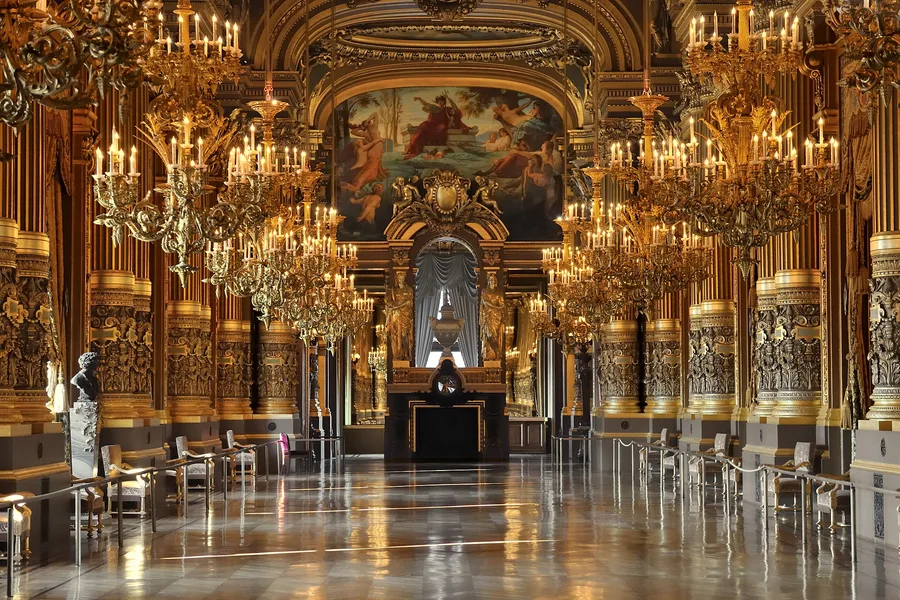
In this regard, one must certainly regret that Paul Baudry's paintings, of such a delicate art, remain invisible in the vaults of this astonishing foyer, which are encumbered with high-reliefs. But as admirable as Baudry's works are in themselves, did the painter not make a mistake in expending himself thus, to no avail, under such conditions? Was what was needed there not merely a few patches of color, creating openings in the Italian fashion? And should Garnier not have made better use of his friend's great talent in a better place?
It was not, moreover, easy for the collaborators of such an architect to divine his work in advance and to hold themselves to his standard. Two, however, succeeded: Jean-Baptiste Carpeaux, with his La Danse, once so criticized and which today remains the only piece of sculpture that is absolutely in keeping with the spirit of Garnier's monument; and then the ceiling of the main auditorium, by Jules-Eugène Lenepveu. This vast painting—in its composition, proportions, movement, and coloration—seems to us to be in complete accord with the hall it is meant to crown, not crush, rising above it like an apotheosis.
The auditorium itself is truly grandiose in appearance. Garnier had the intelligent modesty to take the old hall as his model, but he gave it an incomparable majesty. To be sure, there is still a bit of that excess in the decor, which is impossible not to notice throughout the multiple developments of this colossal monument. There are truly enormous figures, and severed heads needlessly thrown onto the background of the proscenium boxes. But all of this disappears into a striking whole, into a warm and golden harmony that provides a sumptuous frame for the magnificent spectacles on the stage.
One must, however, particularly regret that this beautiful hall is not absolutely favorable to the performance of all musical works. Is it an imperfection of the acoustics? Or is it rather the effect of its overly large dimensions? The fact remains that voices are lost in this immense vessel, and that the vocal and orchestral masses lack clarity and power. One is then obliged to seek out singers of force more than artists of talent, and our composers feel compelled to use every possible sonority to fill the void of a hall that does not sufficiently project the sound. It is certain that the most perfect, yet subtle, works struggle to be properly appreciated there. This must and will have a regrettable influence, in the present and in the future, on our modern French music, pushing it toward the search for grand effects and perhaps causing it to forget too much the qualities that are its own.
Whatever the case, if this hall is not all that it should be, it nonetheless remains a work in which Garnier's talent was affirmed in a superior fashion. Shall we go further? It seems useless to transport ourselves to the foyer de la danse (the dance rehearsal room), fortunately forbidden to the uninitiated, where we could only note the excesses of an overworked imagination which, in trying to surpass itself yet again, gave way to the least acceptable fantasies.
Garnier's Enduring Legacy
But how can one impose limits on such a temperament? He possessed rightness and breadth in his conception, power in his masses, and brilliance in his decoration; can we also ask of him a refined style, delicacy, grace, and charm? Besides, in trying to simplify himself, to control himself, to resist his spontaneous ardor, would Charles Garnier not have compromised his work by chilling it with a contrived solemnity, lacking sincerity and disconnected from the true requirements of the subject—by depriving himself, let us say it, of his best gifts? Let us be content with beauty as Garnier felt it: robust, with a bold bearing, speaking loudly and resolutely.
It is useless to detail here all the technical and mechanical aspects of such an edifice. The architect revealed himself to be a practitioner full of resource and invention, placing his theater—at that time, at least—at the forefront of the best-equipped. It is preferable to look again at the whole of this unique monument, to which Garnier dedicated the most fertile part of his life and gave all his artist's heart. In his ardent imagination, he set out to restore to a place of honor the most beautiful materials consecrated by tradition. Marbles, precious metals, mosaics, and gold were lavished by him in a revival of polychromy that we cannot encourage enough and which, despite the smoke of the great city, sends a festive shiver across the façades and domes.
Garnier's palace does indeed evoke ideas of pleasure and joyful luxury; it beckons with its display of exterior decor that promises wonders within. The spectacle is on the outside as much as in the hall, even before the curtain rises. On all sides, the eyes are dazzled, surprised by so much accumulated splendor. It is natural, then, that the new Opéra was greeted by the crowd with a cry of admiration and that it seems, to the most distant countries, to be the culminating point of the tempting city. Let us also say that this Opéra has compelled the admiration of foreign artists who, through their freely given tributes, have made the glory of Charles Garnier universal.
Let us not begrudge him our own sincere admiration. While criticism can easily be leveled at such a considerable monument, it will nonetheless remain one of the most characteristic examples of French architecture in the 19th century. Although one cannot, fortunately, claim that the era is summarized in this single building, one cannot deny the influence that Garnier's Opéra has had on our architects at this end of the century. Should we be pleased about this? While some, in France and abroad, have been able to draw inspiration from his work to realize, with some success, monuments of a similar character, it was nevertheless imprudent to attempt to transpose the highly personal style of such an artist and debase it in works of lesser scope. There is no doubt that from this pretentious imitation first emerged works that were heavy, contorted, and gaudy. These works, gradually moving as far away from Garnier's Opéra as from the 17th and 18th-century traditions to which they seemed for a moment to want to connect, now offer us a sort of fin-de-siècle (end-of-century) rococo—bloated, incoherent, in which all the beauties we believe we ought to love are sinking.
Some forty years ago, when Félix Duban, Louis Duc, and a few other masters enamored with antiquity strove to extract its principles to revitalize the traditions of our French Renaissance, one might have believed that from this contact a new art of elegance and purity would emerge victorious. That was certainly a magnificent moment of expansion and faith, to which we owe a number of remarkable edifices. The fine enthusiasms of these masters have left fertile seeds in our soil, which will soon be reborn even more vigorously and will lead our French architecture back—we have firm hope of this—not toward forms long admired, but to the principles of logic and sincerity that must be our law and which alone can ensure the advent of a truly modern art, corresponding to our needs and our customs.
When one has spoken of Garnier's Grand Opéra, it seems there is nothing left to say of his other works. This is because such a monument is sufficient for its creator's glory. And yet, must we not at least recall the casino-theater of Monte Carlo, which he adorned, between the blue of the sky and the sea, with all the spangled trinkets of his fantasy? And then the Cercle de la Librairie (Booksellers' Club) in Paris, which, with a less impetuous, more sober art, will remain one of his most perfect creations?
In sum, let us glorify ourselves for counting among our own such an artist, who will take his rightful place among the great masters of all countries. Let us be proud of his work, a magnificent and durable witness to his genius.
PAUL SÉDILLE