
The utility of retrospective exhibitions has been noted on several occasions in recent years. They awaken and gradually form public taste, highlighting the decorative sentiment of the past, sometimes found even in the most humble products. Furthermore, they provide unexpected information for scholars and invite scrutiny and discussion. Thus, as these exhibitions of ancient art become more widespread, the public attends them with greater assiduity than ever.
The Exhibitions of Orléans and Reims
The two recent exhibitions in Orléans and Reims exceeded the desires of the municipalities that had initiated them. If the financial results were published, one would be surprised to see how many people in these industrial centers are preoccupied with art.
Ceramics were widely represented in both cities I speak of. In Orléans, Abbé Desnoyers, who is deeply engaged with these questions and has proven his understanding of them by donating part of his collections to the municipal museum, had methodically grouped the faience from various regions as much as possible. In Reims, Mr. Dauphinot had devoted himself entirely to his city's exhibition, just as he dedicates himself to any useful creation serving the country's material interests.
Considering the two exhibitions as a whole and looking for the ceramic products particular to these two regions, Orléans provided an abundant group of marbled faience, a style for which the local factories long held a monopoly. In the Champagne region, one would have expected to see a certain number of pieces from the Aprey factory, which was the most famous manufactory in the vicinity; however, these were rare. In contrast, a rather considerable group of faience from Les Ilettes, collected by various enthusiasts, would seem to prove that this factory, with its lively underglaze imagery, more generally appealed to the taste of the people of Champagne.
In both exhibitions, I noticed certain pieces that provide material for controversy. I have studied them closely and will attempt to indicate as clearly as possible the points that prevent me from adopting the attributions provided by their owners. Today, thanks to good publications, we have a body of knowledge that is not yet entirely complete, but it is important not to disturb it with overly light inductions.
Contested Attributions in Orléans
At the Orléans exhibition, among the objects loaned by the Marquis de Vernon, were three plates, nos. 318, 319, and 320, attributed by their owner to the "factory of Clamecy." These are three mementos from the revolutionary period. Number 318 is adorned with a medallion in the center of which is written: Vive la montagne! (Long live the Mountain!). A Phrygian cap, furled standards mixed with small tricolor flags, and an oak garland surround the medallion. Below is written: Ragon le jeune (Ragon the younger).
The decoration of number 319 features an allegorical female figure, wearing the cap of liberty, seated with one hand resting on a quiver and the other on an architectural cippus bearing the legend: Droits de l'homme (Rights of Man). Number 320 has no inscription. A trophy is composed of a pike with a liberty cap, a flag, axes, a drum, a cannon, and cannonballs.
The execution of these faience pieces is poor. The enamel is widely and irregularly crazed, not to mention the pitting. I can best compare these products to coarse army bread or to waste paper, in the composition of which there is more straw than rags. The painter's palette consists of tones without frankness: an opaque yellow, faded blues, joyless greens, and dirty violets. One might imagine the pretty town of Nevers seen at the end of autumn on a rainy day.
I mention these pieces because they have been the subject of recent studies and are now classified. A very precise monograph by Mr. Cherest, curator of the museum in that city, has proven that no faience manufactories ever existed in Auxerre. Another scholar, Mr. Grasset, founder of the Museum of Varzy, near Clamecy, would not have failed to claim for the latter city the honor of having produced faience. Based on the characteristics indicated above and the research of these two local writers, one can affirm that there were no faience makers in Clamecy and that Ancy-le-Franc must claim these pieces, whose characteristics leave no room for doubt.
In the same shipment from the Marquis de Vernon were two plates (nos. 316–316 bis) with this legend in the booklet: "Faience of Plonat, at Cosne (1647)." No ceramic treatise to date has mentioned the small town of Cosne as a center for faience production. The name Plonat, as a faience maker, is likewise not indicated anywhere. I was kindly allowed to handle this piece from the Orléans exhibition. An inscription is written on the back, but it does not absolutely correspond with the designation in the booklet. Here is a specimen, engraved as a facsimile from an exact tracing.
In this inscription, I read: Chez Mr Plon m × à Cosne, 1647 (At Mr. Plon's, merchant in Cosne, 1647). Could we not admit, until proven otherwise, that the plate, with its absolutely primitive Nevers-style decoration, was made in Nevers and offered by the head of the factory to a merchant in Cosne who regularly sold similar services? This is seen on other pieces. The Sèvres Museum possesses a small fine faience vase, made and decorated in England, bearing the name and address of the French retailer.
Reservations of such minutia open a field to the infinitely small; but when it comes to adding a new name to the already considerable list of second- and third-rate factories, one must not leave too much room for the indeterminate.
Patriotic Emblems and Forgeries
At this same exhibition, under number 383, I must point out a series of rare faience pieces belonging to Mr. Henri de Rancourt. It is a service of ten plates (two are likely missing), painted in 1766 for Jacques-Noël Pilté, undoubtedly a cooper. Their particular characteristic is that each plate is decorated, without repetition, with subjects showing the various phases of barrel making. This is the first type of patronymic faience I have seen with such a variety of decoration.
I did not find at the Orléans exhibition—and this is why I point them out to local archaeologists—any of the coarse earthenware, called terres-à-feu, signed by stamping: L. GILBERT A ORLÉANS. He was a faience maker active during the Revolution and cited by Glot in the list of petitioners to the National Assembly. The dish I have before me would be attributed to the Ollivier manufactory in Paris if the signature did not attest to its origin. It shows the same simplicity of execution, even poorer in this Orléans dish, which warped during firing. Its decoration is clumsily copied, as if by a child, from a Nevers subject (L'Auberge de la paix, or The Inn of Peace) which is frequently reproduced on plates, but with more skill.
In the same vein, as collectors of faience with patriotic emblems have become numerous, I must point out in the Catalogue of the Reims Exhibition "No. 1740, a curious stoneware piece enameled in the style of Sinceny faience, with medallions, blue decoration, bearing on one side the portrait of Mirabeau and on the other that of Louis XI, destroyers of feudalism, with this motto: 'Dedicated to Louis Didier by Lepage, 1780.'"
This Sinceny stoneware enameled like faience already seemed troubling to me, but the association in 1780 of Mirabeau and Louis XI as "destroyers of feudalism" hardly seemed to correspond to the sentiments heralding the Revolution. The piece I saw is, in fact, one of those that imaginative industrialists manufacture to meet the desires of amateurs who want rare items. One cannot be too wary, at the present time, of these deceptions that fill Paris and the provinces.
The Quimper Manufactory and Norman Influence
The skill of imitation has become such, and certain workshops use colorings and enamels with such great perfection, that one can, for example, place certain modern products from the Hubaudière factory in Quimper in a display case of old Rouen faience without creating too great a discrepancy in the analogy between them. In this sense, the retrospective exhibition in Quimper will have been useful for those who need to avoid being deceived.
A scholar, Mr. R.-F. Le Men, archivist of Finistère, published last year a short and substantial notice on the Quimper faience manufactory. By its precision and clarity, it ranks among the best monographs on similar subjects that the provinces frequently send us.
The Early Period and Southern Styles
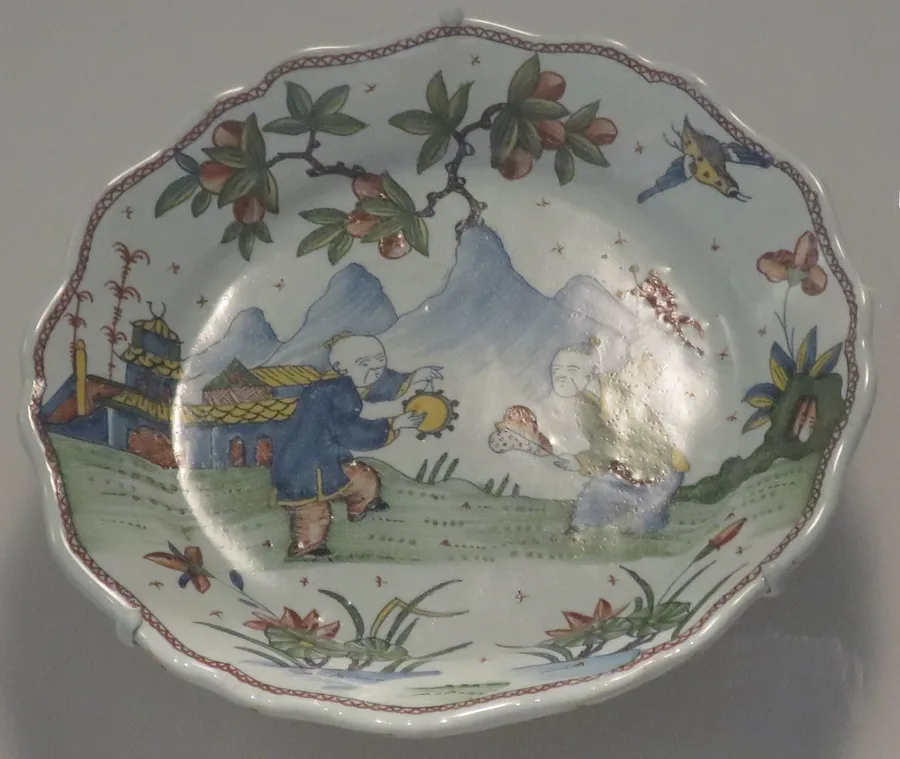
In this work, one can follow from 1690 to 1708 the attempts of a potter from the vicinity of Marseille, Jean-Baptiste Bousquet, to establish a faience factory in Quimper. The location at the mouth of a navigable river was good, and clay was abundant in the surroundings. Thus, the establishment succeeded admirably. This constitutes the first period, whose products bear the influence of the south—that is, decorations from Moustiers, but somewhat bastardized, as can be found in the factories of the old Quercy region and, in general, in all places where the Bérain style was saying its last word.
But although this period from 1690 to 1748 is well-filled, it is primarily the operation by a new owner, Pierre Caussy of Rouen, that I will focus on. For nearly forty years, he changed the southern traditions of the Breton manufactory to substitute them with Norman experiments, which are the ones most important to know, to define well, and to characterize as clearly as possible.
Pierre Caussy and the Rouen Tradition
The Normans were, among the master potters of all France, the ones who remained most attached to the ornamental tradition of their province. And it is perhaps this fidelity, combined with the excellence of their decorations, that gives Normandy the leading rank in the history of French ceramics from the 17th century onward. In this province, the decorative art springs from such robust artistic principles, the trunk is so significant, that the branches and even the smallest twigs of this art remain interesting.
The decorative method of Rouen is sober and perfect; it does not permit deviations, and all its decorations emerge with a teaching that may be little varied, but is frank and well-poised. Caussy's father, a faience maker in the Saint-Sever suburb of Rouen, had reflected at length on the necessities of his art. The best gift he gave to the one who was going to seek his fortune in Quimper was a manuscript Treatise on the Art of Faience, which was religiously preserved by the son, and which the current owner of the factory, Mr. Fougeray, still possesses.
It is not surprising that, raised by such a father, the son would worthily follow in his footsteps. He had become a Breton manufacturer, but he remained from Rouen at heart. This means that the products of his Quimper manufactory were Norman, and it is from the strength of this Rouen seed transplanted to Brittany that a certain difficulty of assessment has arisen, which it is important to address.
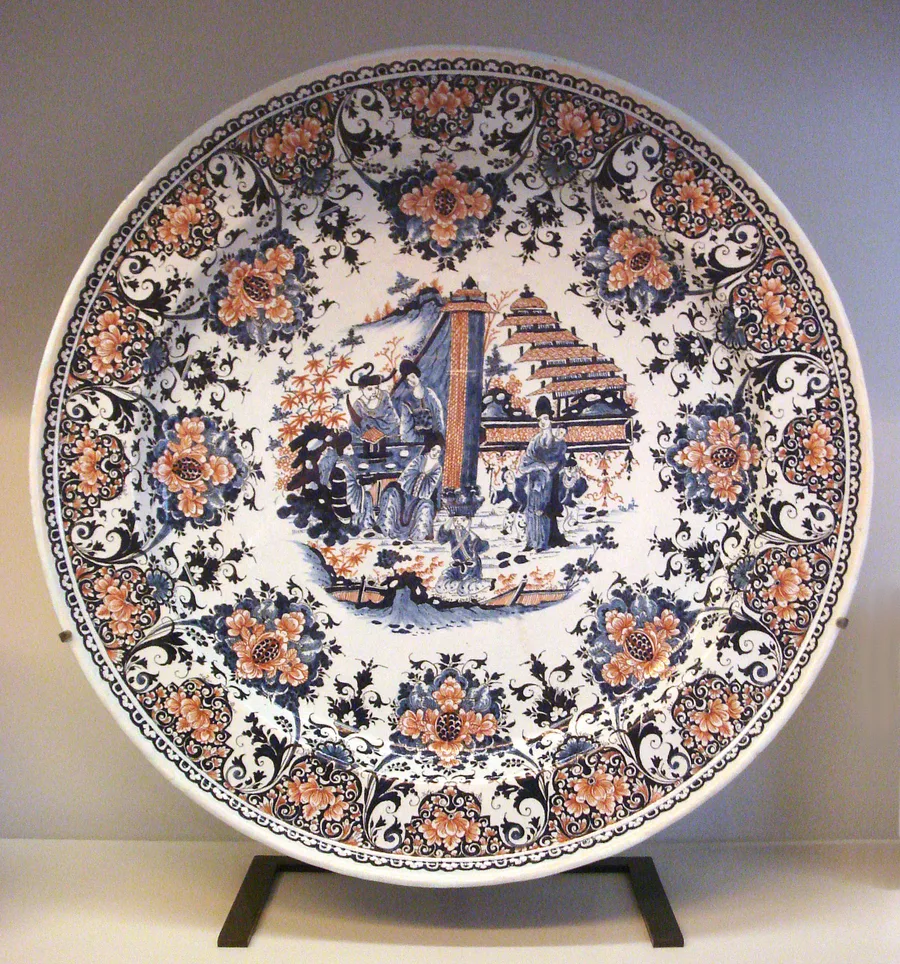
The son of the Rouen faience maker had brought from his father's factory a large number of pounces of subjects then very much in fashion: the decoration known as à la corne (with a cornucopia), the one called au carquois (with a quiver), the one au dragon (with a dragon), and so on. The principal workers—painters, throwers, etc.—must have been Normans; the use of Rouen colors and enamels was known. The son followed his father's teaching step by step. All the products of this era, with few exceptions, are therefore Rouen faience executed in Quimper, with some inferiority.
Imagine David exiled in Brussels during the Restoration, and look in the museums of Flanders at the paintings of Belgian artists who were able to receive his teaching; you will have a tail end of the Empire style. And yet, David's students are Belgian, whereas Pierre Caussy's workers are for the most part Normans.
The Challenge of Classification
I say, therefore, that unless one wishes to waste time on minutiae, the Breton products, although made in Quimper, are no less Norman products, and it would be unfortunate to try to recognize or affirm them as being from Quimper. Here, there is no longer a transformation as in Sinceny, where the Rouen note still dominates; however, Sinceny has offered to the curious large pieces whose distinct decoration and beautiful tones can be recognized at first glance as belonging to the Sinceny factories.
The same is not true for Quimper. The variations lie in a weakening, a less brilliant use of colorings—miseries of detail that could just as well belong to the last-order factories of Rouen. To establish a classification on this matter would be to confuse the issue. One will try in vain to describe these variants. I defy anyone who reads the minutiae that may be written on this subject to be enlightened if they do not have the original pieces before their eyes.
Mr. Le Men's brochure is nonetheless useful; it provides a rapid history of the various successions of heads of the Quimper manufactory. It gave rise to an interesting retrospective exhibition, and one must praise the authorities of a country so distant from the center for having accepted the idea.