The sea is an omnipresent force in Holland. It insinuates itself into the indentations of the coast, among the numerous islands of Zeeland, and the Zuiderzee curves deep into the heart of the country. Entire portions of territory are submerged by it; only a few desolate islets—Texel, Vlieland, Ameland, Schiermonnikoog—still attest that civilizations once lived in these regions, now covered by water forever.
Since the greater part of the Netherlands lies lower than the sea, the water invades even the provinces furthest from it, along the German border. The Hollandsch Diep near Dordrecht, the former Haarlem Lake, and the lakes of Friesland and Drenthe around Sneek, Leeuwarden, Groningen, and Meppel occupy considerable areas. To one looking down from a balloon, the Netherlands would appear as a network of streams, rivers, and especially canals, where windmills pump water to drain it towards the beaches.
The Dutch Character and the Sea
The primary preoccupation of the Dutch is the struggle against the sea. A formidable budget is allocated for this purpose; engineers, whose dedication and science are renowned throughout Europe, are occupied year-round with the work of the dikes. The peasants themselves have been regimented for the common defense. Pliny the Elder compared them to sailors, similes navigantibus, and indeed, the plots of land, encircled by canals, resemble immense rafts that seem to have stopped mid-journey.
It is the sea that has given the Dutch their strong qualities: gravity, reflection, and tenacity. It pushed them toward distant expeditions, which procured for them, as if they did not have enough already, immense oceans enclosing tiny lands. It gave rise to illustrious admirals: Tromp, Ruyter, and other "teamsters of the seas." And in this country, which boasts so many incomparable artists, the sea has found sensibilities keenly moved by the varied and impressive spectacles it presents, ready to paint and celebrate it.
Here we find Jan van Goyen, whose blond seascapes expand under a low, cloudy sky, rendered with an honest, intimate art in which it is a pleasure to delight. We see Hendrick Dubbels and Simon de Vlieger. Above all, there is Ludolf Bakhuysen, who lived on the IJ to better observe the sea, which he loved to show turbulent, its waves beating against the jetties or the sides of ships. Finally, there is Willem van de Velde the Younger, highly esteemed at the court of James II and Charles II, who so loved to depict the calm of the waters, when only the kabbeling (rippling) wrinkles the surface. In our own century, Johan Barthold Jongkind and Hendrik-Willem Mesdag, among many others, have revived the glorious tradition of their ancestors.
The Life of the Artist
Hendrik-Willem Mesdag was born in Groningen on February 23, 1831. This small city, on the northern confines of Holland, was once of great importance. Both a fortress and a commercial center, as Mr. Henry Havard notes, it sent sailors to the Crusades, became a Hanseatic city in 1284, and still possesses a long-prosperous University where Deusing, Gomar (the adversary of Arminius), Bernoulli, and Hofstede de Groot taught.
Its port is Zoutkamp. Innumerable canals connect it with the Ems, the North Sea, Germany, Friesland, and the Zuiderzee. It is watered by two rivers, the Hunze and the Aa, and for these reasons has always been a grain market known throughout Europe.
Mesdag's father, who was one of its most honorable merchants, brought his son into his business at an early age. The apprentice did the best he could, overjoyed when, as a reward for his efforts, he was granted a few hours of leisure. He devoted this time to taking painting lessons from Christoffel Buys and copying English engravings in black chalk.
In 1866, at the age of thirty-five, encouraged by his wife and by Johannes Hinderikus Egenberger, director of the Groningen Academy of Drawing, Mesdag made a momentous decision. After mature reflection, driven by an imperious calling, he resolved to leave a well-established position to learn the painter's craft and risk the uncertainties of an artistic life. "The fellow has some nerve!" exclaimed Jozef Israëls.
After a few months in Oosterbeek, he settled in Brussels on September 25, 1866, and, on the advice of his relative, Lawrence Alma-Tadema, he took lessons from the professor Willem Roelofs. Putting in considerable labor, he executed a host of drawings and sketches, some of which, exhibited by the circle of Artistes Libres at the Galeries Royales Saint-Hubert, drew attention to the artist.
A holiday in Groningen in 1868, near the sea, following this two-year period of work where he pushed his skills in all directions, decided his future. From then on, his efforts converged on a single goal: painting the North Sea. In 1869, he moved to The Hague and traveled to Scheveningen every day. There, he painted canvases that he exhibited at the Paris Salon the following year, immediately winning a gold medal.
From that time on, he has consistently and successfully enriched our annual exhibitions. In 1890, his particular sympathies led him to opt for the Salon du Champ-de-Mars. His time is divided between his studio in The Hague and his one in Scheveningen, first at the Villa Zeerust and later at the Hotel Rauch. He deserted them for only one year to paint the panorama of the sea on the Zeestraat in The Hague. The Musée du Luxembourg, the Rijksmuseum, the Museum Boijmans in Rotterdam, and numerous private collections possess his works; the most flattering distinctions have testified to the high esteem in which various countries hold him.
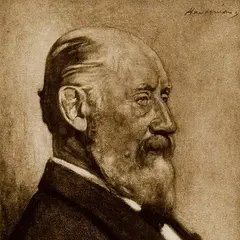
Physically, Mr. Mesdag is a serious man, presenting the rugged appearance of the sailors and fishermen he has so often depicted in his canvases. The features of his face are large and calm; nothing in it would betray the poet and dreamer, were it not for the glint in his eyes. One feels one is in the presence of one of those cold, reflective wills that, once a goal is chosen, heads straight for it—one of those honest temperaments for whom work, in front of nature and in the silence of the studio, is the very condition of life. It is thanks to these qualities, placed at the service of a vigorous talent, that he has been able to produce a considerable body of work, at once unified and varied, and of such cohesion, assurance, and strength that few contemporary artists can present its equal.
The Work
The sea fills his entire oeuvre. With rare exceptions—around Groningen, in Rotterdam (Het Scheur, 1881), Dordrecht (Sunrise on the Hollandsch Diep, 1882), and in Enkhuizen on the Zuiderzee—Mesdag has primarily studied the sea at Scheveningen, which is his favorite beach.
The Setting of Scheveningen
All who have spent a few hours or resided there have retained an unforgettable memory. "Before you," says Eugène Fromentin in his Maîtres d'autrefois (The Masters of Past Time), "is the North Sea, flat, gray, fleeting, and white-capped... The sea is to the left; the staggered dune sinks to the right, rising in tiers, diminishing, and gently rejoining the pale horizon. The grass is bland, the dune is pale, the shore colorless, the sea milky, the sky silky, cloudy, extraordinarily airy, well-drawn, well-modeled, and well-painted, as they used to paint it..."
The same wave, which was studied so many times, beat with regularity the beach that sloped imperceptibly toward it. It unfolded, rolled, and died, continuing that intermittent and monotonous sound, which has not varied by a single note since the world began....
When the season is not far advanced, around Pentecost, the beach is still solitary, and the artist can dream there at ease. The blond sea, with its bluish shimmers, fringed with white foam, comes to lick the sand of the coast. The dunes, so dear to Jan Wijnants, roll their white rotundities, which the breeze constantly reshapes. They are hollowed out by deep ravines, where reverie is sweet. The sounds of the waves arrive there, muffled, as if from a great distance. The sky is blue, crossed at times by gulls, sea-mews, and albatrosses; and all around, little flowers try to live. There is the forget-me-not, the viper's bugloss, some rough gorse, a few faded pansies, wild chicory, and long grasses that pant with thirst so close to the Ocean. One thinks of the old masters who loved these horizons, the aridity of these shores, this soil of the motherland, all the more dear for being less secure, and who limited their entire ambition to representing it as best they could: honest, serious, modest, naive natures, almost all of whom were tested by misfortune. And it takes the pale crescent moon lighting up in the East to remind the dreamer that the hour of return has long since sounded.
There is not a day that Mesdag has not experienced these emotions; they are found, vibrant, in his canvases, where the complete life of the beach has been recounted. Artists, as Mr. Edmond Pottier recalled in his review of the Salon of 1892, have not depicted the sea in the same way.1 The ancients—Claude Lorrain, Jacob van Ruisdael, Joseph Vernet—showed it "in its relationship with man," who was always present, most often struggling with it. The contrast between the weakness of man and the power of the elements became a source of emotion.
Depicting the Sea's Moods
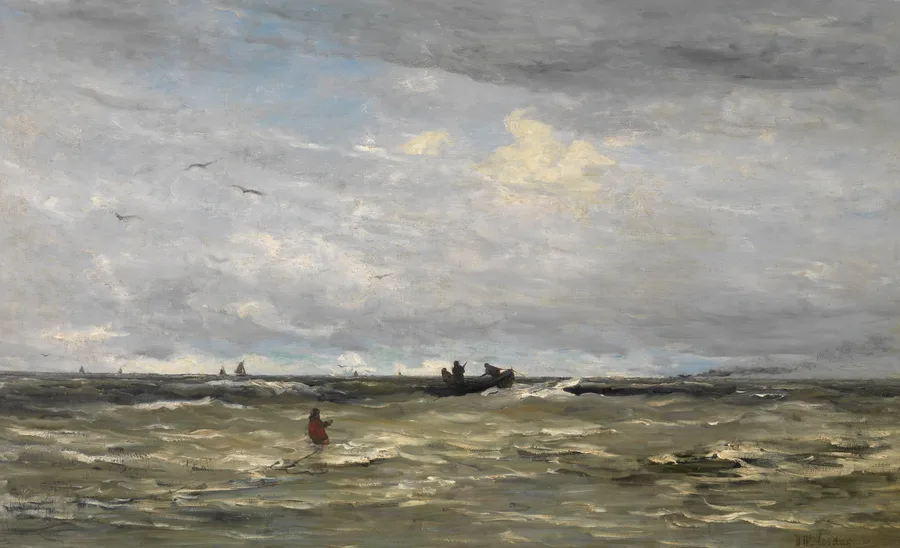
The moderns tend to "suppress the dramatic mainspring of these scenes, to consider only the sea by itself, a living and complex being, endowed with incessant mobility, by turns formidable or caressing, rich in vigorous colors or enveloping itself in elusive mists. Man has disappeared, and yet the poetry has remained, perhaps deeper and simpler." Mesdag belongs to both schools.
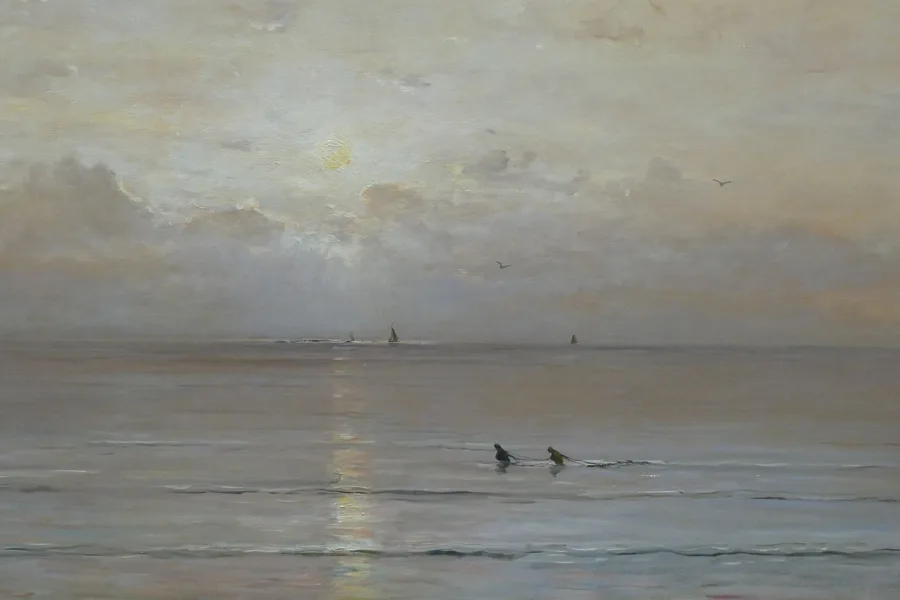
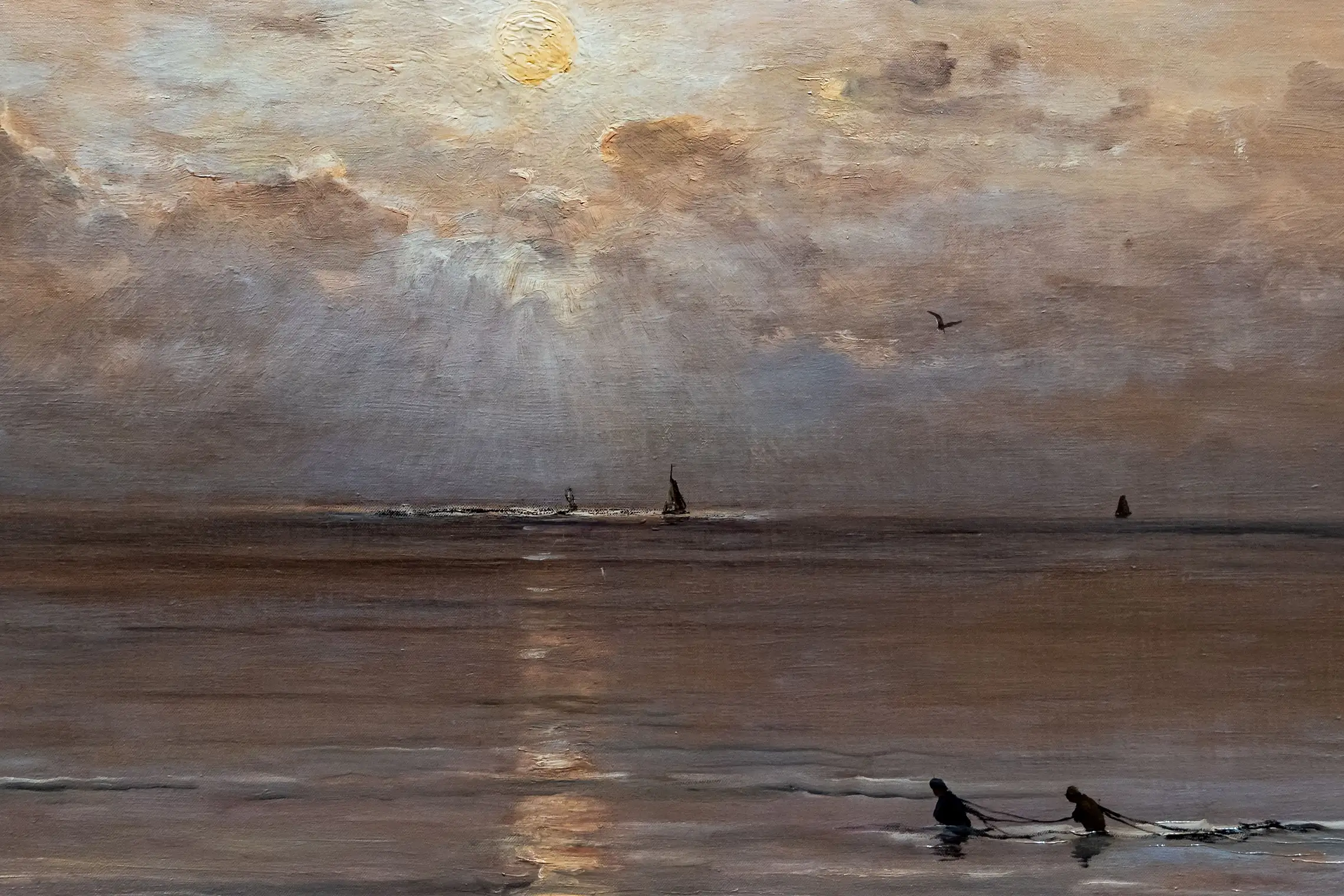
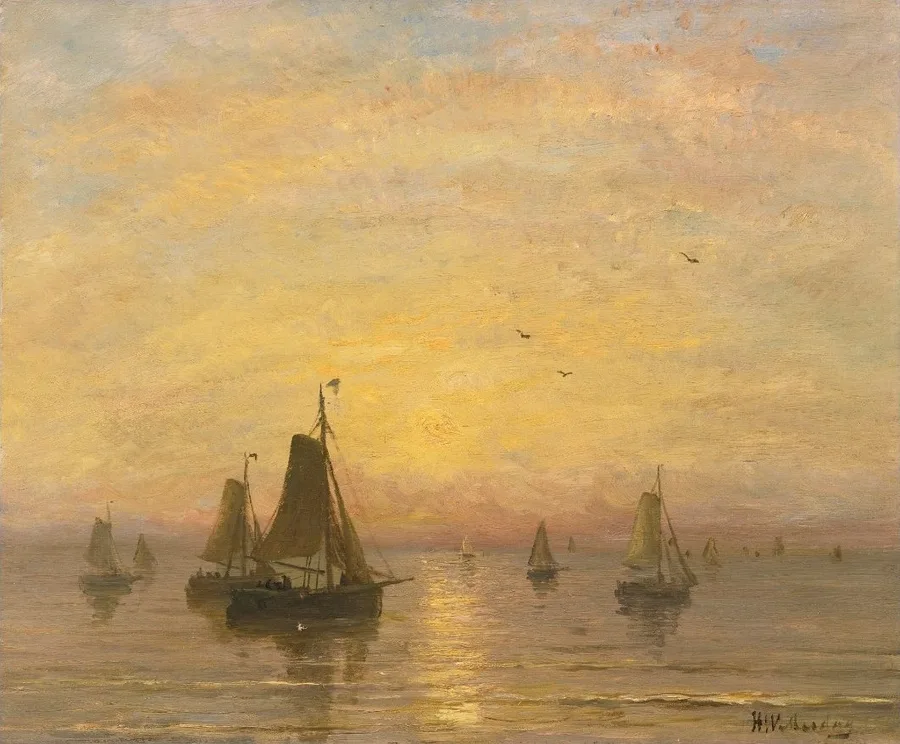
Here is the solitary sea. Barely, here and there in the distance, a small sail, which makes the solitude even more crushing, like a tree in an immense plain. The flat horizon sinks far, far away, beyond sight, into the expanses of the Noord Zee, while the sky opens onto the infinite. The waves are already rising (Avant l'orage, or Before the Storm), presenting the harbingers of the tempest. The clouds, heavy with squalls, press against one another, on the verge of colliding; and the sun, whose bloody image is spread across the waves, casts the glow of a fire.
It is also Temps tranquille (Calm Weather). "The canvas," wrote Paul Desjardins, "is divided, two-thirds to one-third, between the fluid sky and the opaque sea, the pearl-gray sky and the green sea—not glaucous, but truly an absinthe green—so that there is an opposition of one to the other, and harmony through opposition. A flotilla of boats is scattered on the liquid mirror; in the foreground, two small, narrow, and long waves wrinkle the surface of the water...; they are but two white lines, barely foamy, marking the regular pulsation of Neptune at rest; the heavy swell laps against the tarred hulls, imperceptibly balanced; the raised sails palpitate, hanging from the mast..."2
This is also seen in the panorama on the Zeestraat in The Hague, of which Anna C. Croiset gives this description:
Whichever way one turns, the gaze is lost in infinite space. The sea stretches out before us, with its physiognomy of a beautiful summer's day, immense and superb; here and there, the reflection of a cloud darkens the green of its waves; on the indigo-blue horizon, one sees it fleeing towards Katwijk, passing through all the gradations, and the distant boats stand out against these bright colors like gleaming white spots. The waves collide and break against the fishing smacks, whose nets on the sails are silhouetted like lace...
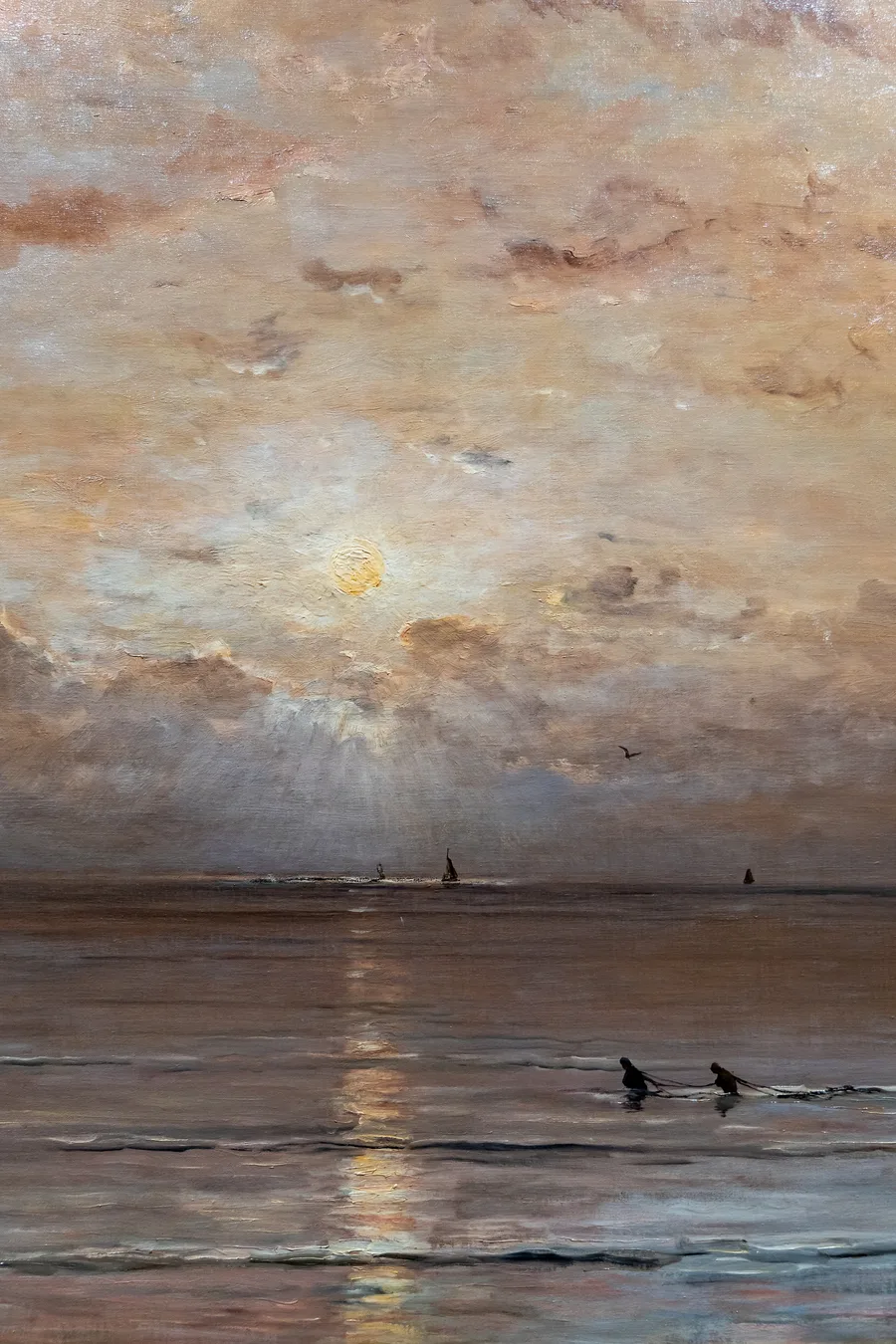
Mesdag has represented the sea at all hours of the seasons and the day. There is winter, with the gray, low sky on the horizon; the spring showers; the splendors of summer and the sun; and many times he has vibrated to the melancholy poetry of November. Here are the triumphant mornings, when dawn rises over the waters; the afternoons and the evenings—the flamboyant evenings, flooded with red light, as if the sun, about to die, wanted to attest to its vitality—and the violet twilights, where everything fades, and the nights, in the immensity of the sea and sky.
The Life of the Fishermen
Most often, however, he animates his canvases with the thousand dramas or occupations of the beach. In his paintings, the pinques (a type of fishing boat) play the main role. These are fishing boats particular to Scheveningen; more elongated than those of the Zuiderzee, where navigation is so dangerous, they are equipped, like them, with sorts of leeboards hanging from their sides, which keep them upright when the sea is rough. Their brown sails proudly bear at their head: SCH., with a registration number. Their departures interest the artist as if it were a grave event, and he attends their return, anxious or joyful, depending on whether the catch was good or bad, whether the sea is merciless or clement. When the storm has raged on the coasts, breaking anchors, disrupting moorings, snapping masts, and damaging hulls, he comes to measure the extent of the damage and to pity the fate of the poor pinques (The Collision, 1881; Searching for Anchors after the Storm, 1884; In Danger, 1893; The Beach at Scheveningen, the Day after a Storm, 1896).
He has the deepest sympathy for the fishermen, who, for their part, return it. No detail of their adventurous, serious, and arduous life has escaped him; he is moved by their emotions and suffers their sufferings. He has given them glory. These simple beings perform the same actions that their ancestors, for centuries, performed before them and like them. Their children will continue the tradition, as it is said in the psalm: Sicut erat in principio, et nunc et semper, et in saecula saeculorum (As it was in the beginning, is now, and ever shall be, world without end). But it has happened that the noblest talents have not thought it beneath them to study them. If the fishermen pass, obscure, through life, they live on in the eternity of art, and many a magnificent sovereign might envy these humble people their panegyrists.
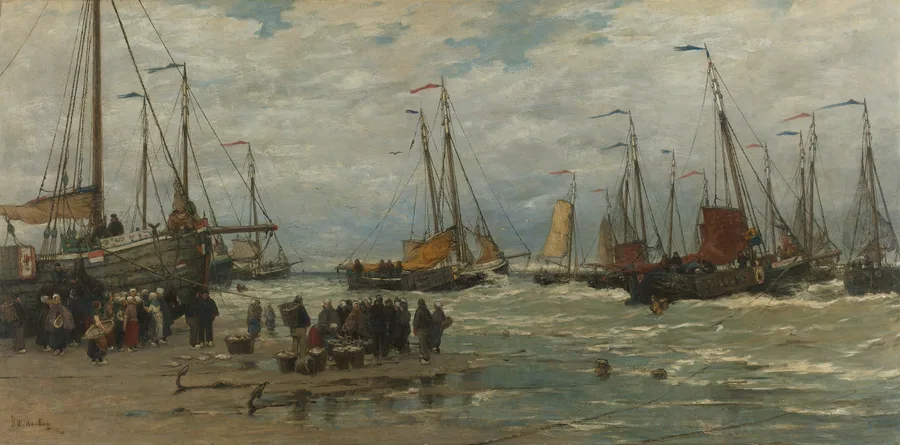
And so, Mr. Mesdag is at once a realist and a poet. He loves to study everyday existence, the men who bustle around him in search of their daily bread; he has not draped them in pretentious clothes or with colors for effect; he has not dramatized their labors and their sorrows. His ambition has been to represent them as they were, particles of humanity, small and frail, in the face of the colossal and powerful elements that toy with them.
However, there is not a dreamer who does not vibrate to these strong canvases, painted with a sober and severe art, where the touch weds the very form of things. The spectacle of the sea elevates thought, broadens it, purifies it, by its very immensity. In it, one has some idea of the infinite, even though this notion is inaccessible to the intellect. The murmur of the waves and their wrath are generators of noble impressions and of masterpieces. I imagine that the two greatest poets of the Ocean, Victor Hugo and Jules Michelet, would have delighted in the work of Mesdag.
GEORGES RIAT