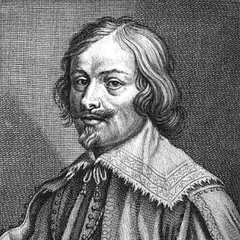
Some men are born under a lucky star, drawing so copiously from the coffers of Renown and carving out such large plots of reputation for themselves that scarcely any remains for their contemporaries, who may equal and sometimes even surpass them. I am thinking of certain artists like Benvenuto Cellini, Salvator Rosa, and Jacques Callot—men of some merit, to whose chariots have been hitched, in turn, biographers, novelists, playwrights, and, naturally, the crowd. Because they were mixed up in a few adventures, these artists have been, so to speak, framed alongside their own characters.
As the public is particularly interested in adventurers, matamores (braggarts), and swashbucklers, they have always wanted to see Benvenuto Cellini and Salvator Rosa as cape-and-sword artists, without concerning themselves too much with their works. In the same way, for two centuries, the beggars, buffoons, and bohemians in his prints have been made to form Callot’s entourage.
The engraver’s name has even become a term of comparison in the realm of the grotesque, with phrases like "in the style of Callot" or "fantasies in the manner of Callot." His name very nearly forced its way into the dictionary, almost taking the place of fallot, a French word for a type of lantern that also evokes buffoonery.
The Myth of the Grotesque Artist
On various occasions and at different ages, I have leafed through the work of the Lorraine engraver, searching for the fire, the ardor, and the genius that biographers endlessly praise. A quote from E.T.A. Hoffmann has stayed with me: "Why can I not get my fill of your bizarre and fantastic works, O sublime master!" Yet each new study of Callot reinforced my idea that he should be seen as a sensible engraver of mediocre imagination, perhaps not even of the same caliber as his contemporary Abraham Bosse, the man who best conveys the costumes, professions, and manners of the people of his era.
One writer has particularly insisted on the "comic verve that sparkled in Callot's drawings" when he was studying with his first master in Italy. Apparently, this same verve also "poured out, without ever being exhausted, in countless caricatures where every person he knew was represented with their most salient ridiculous feature" during his childhood.1 But who has seen these childhood and youthful drawings? In what collection are they found? To find any trace of them, one must turn to the engraver's actual body of work.
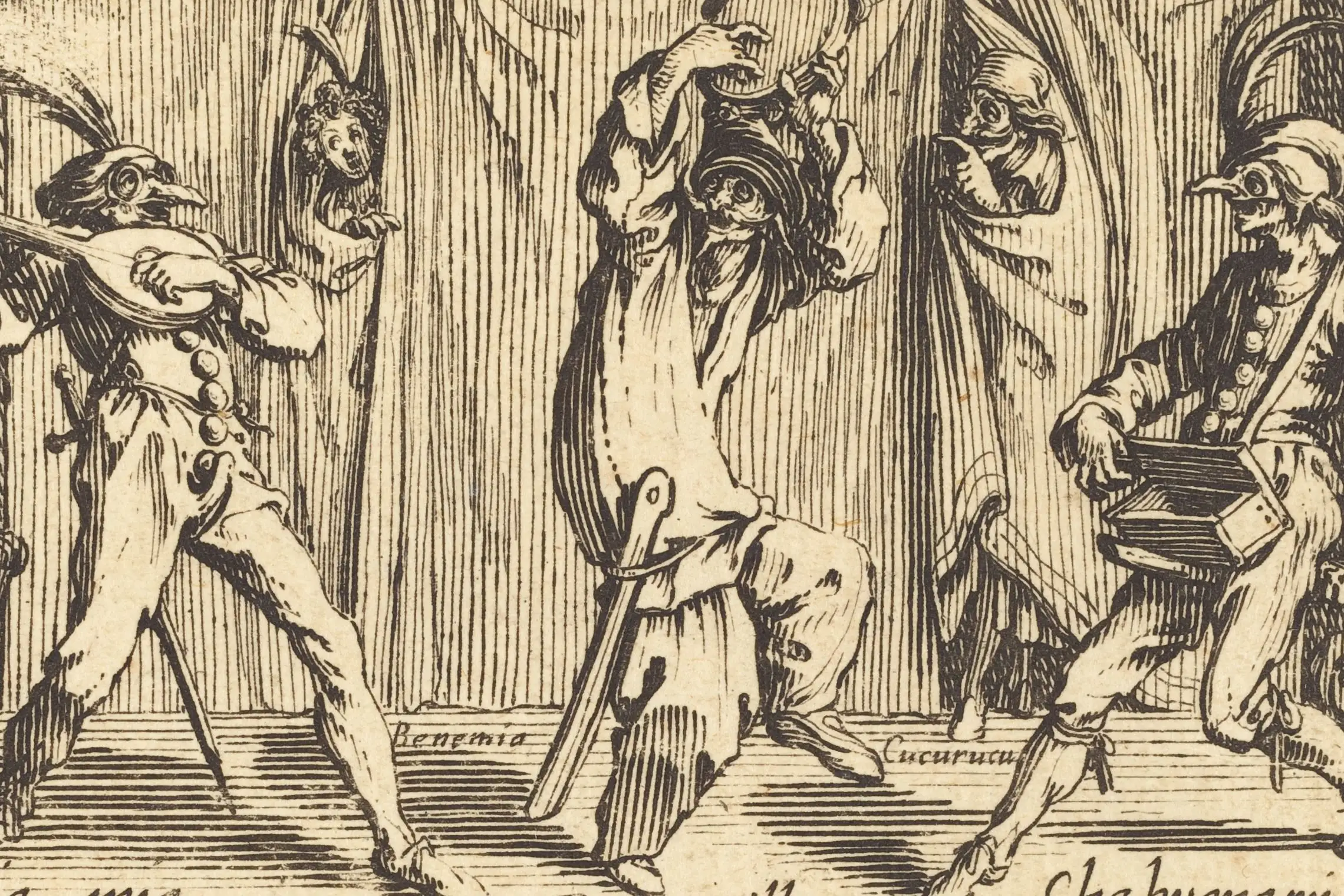
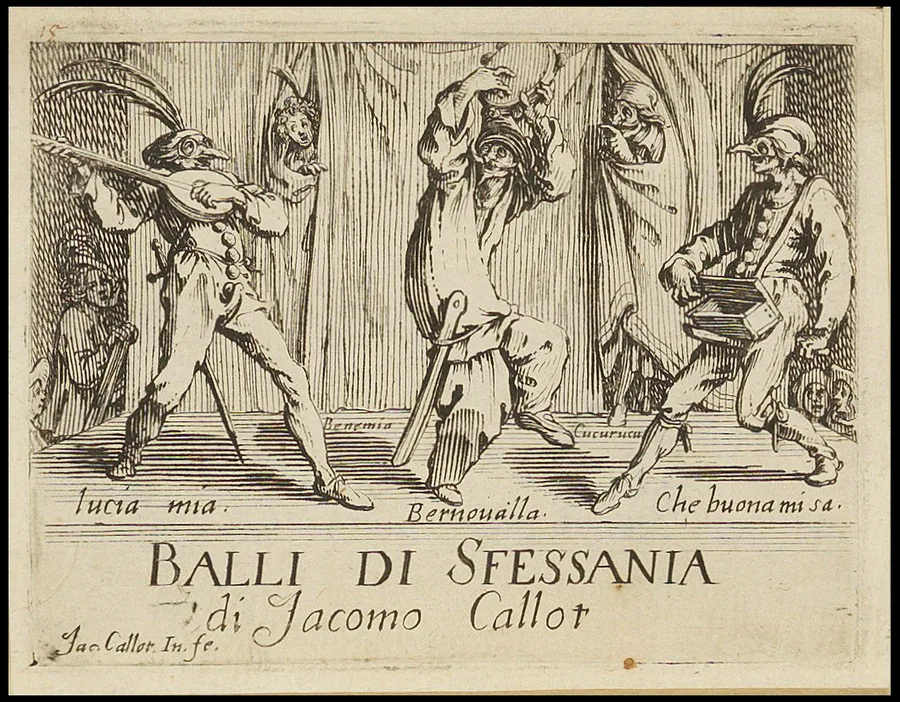
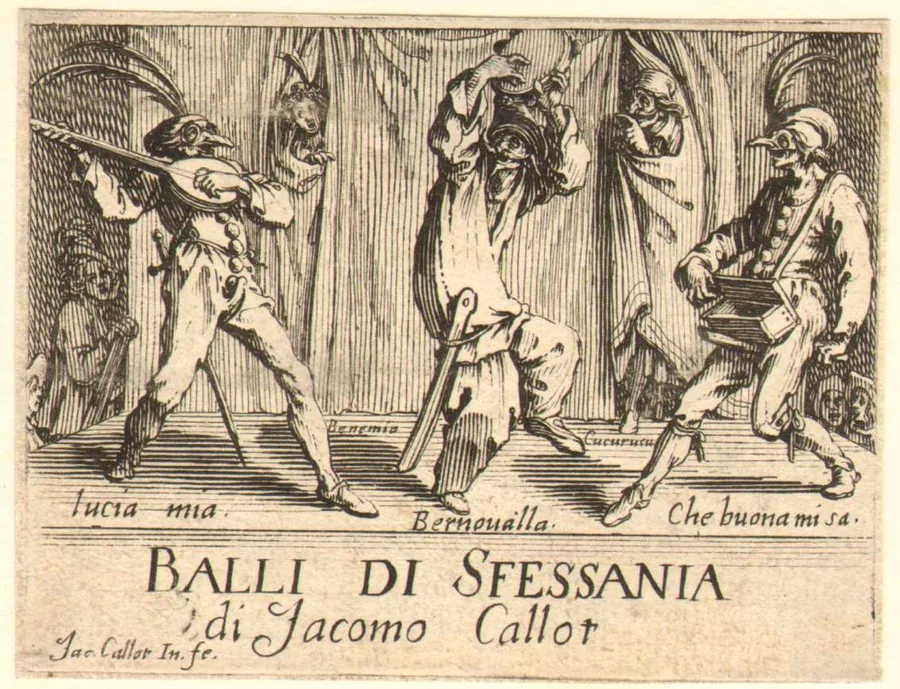
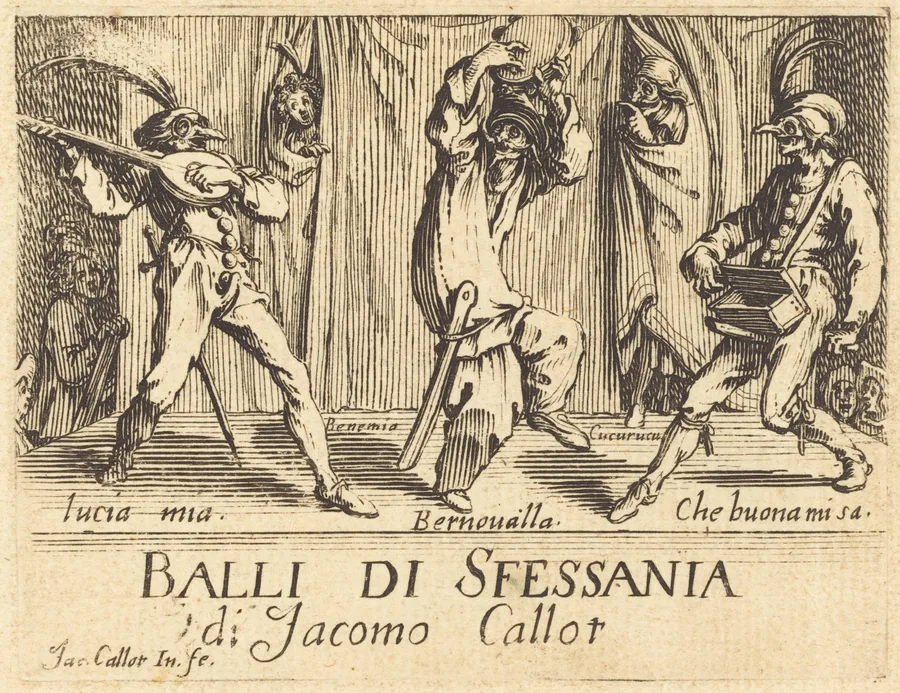
Three series are worth consulting: the Balli di Sfessania (Dances of Sfessania), the Varie figure gobbi (Various Hunchbacked Figures), engraved in Florence in 1616, and the Capricci di varie Figure (Caprices of Various Figures), in which a few rare grotesques are mixed with regular figures and poses.
The plates of Italian masks and buffoons make up roughly a tenth of Callot's work, yet it is these that have most contributed to the reputation of a man who was, above all, a proper engraver of princely festivals, sieges, and pious subjects. The public's imagination has worked considerably to dress this rational and patient artist in a fool's costume.
An Analysis of Callot's Comedic Works
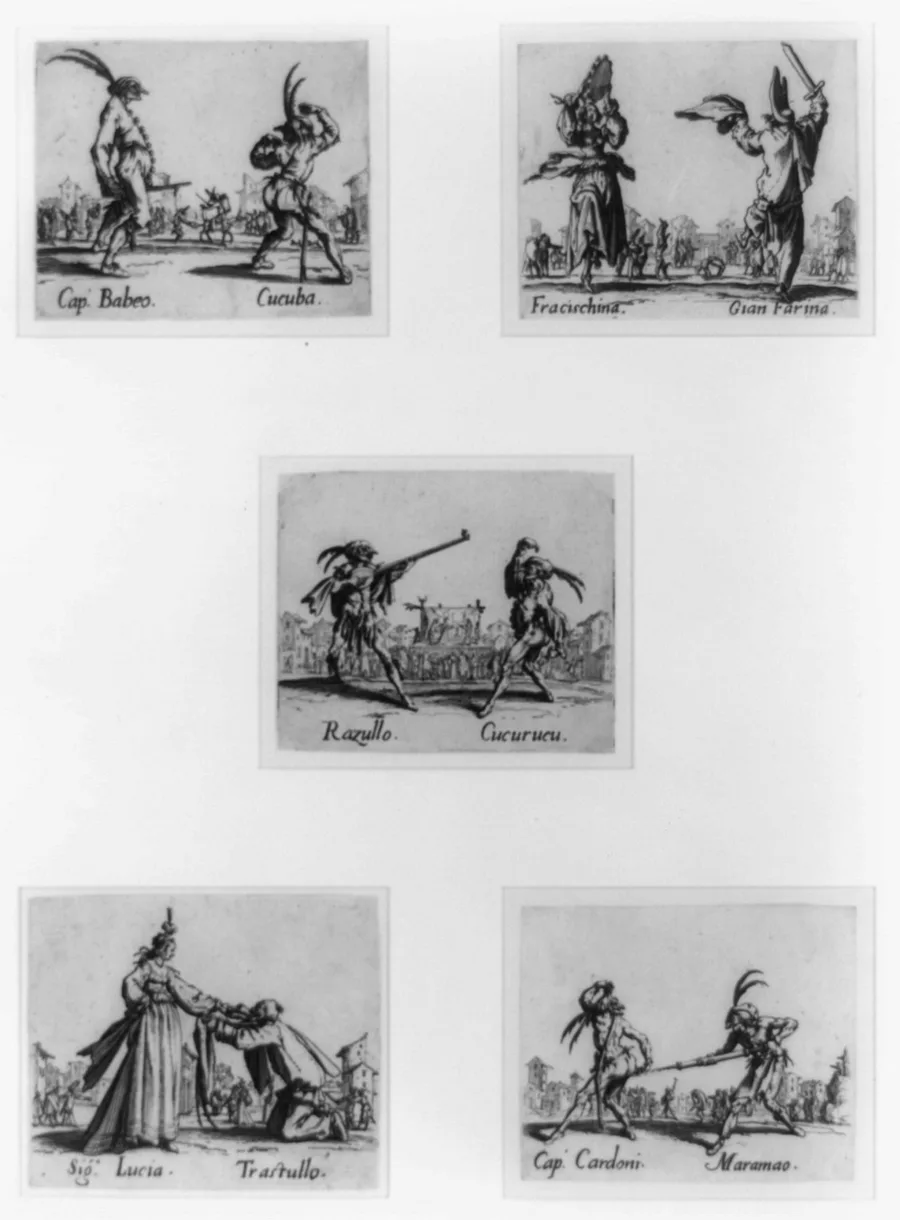
I would be more than happy to be amused by the lanky dances of Cocodrillo, Gian Farina, and Franca Tripa; the syringes mixed with mandolins do not shock me in the least. I can accept Pulcinello declaring his love to Signora Lucretia, as well as the character with the improbable name of Cucurucu. However, I do not find sufficient comic variety in the Balli di Sfessania. This small book of etchings repeats itself invariably on every page. The Italians, who are endowed with a devilish verve and whose mimicry is gesticulating, spontaneous, lively, and restless, must surely accuse Callot of a comic poverty.
If Callot gives some idea, albeit a very faded one, of the Florentine stage actors who must have exaggerated the pantomime of the more high-ranking comedians of their time, his second booklet, Varie figure gobbi (made in Florence, in the year 1616), is of a marked inferiority and weakness. It contains small figures who are all hunchbacked, all with large heads and big bellies.
The only quality of these small pieces—a somewhat negative quality—lies in the serious line that renders the swaying and contortions of this band of puppets. The engraver remained impassive while transferring the wriggling nature of his characters onto his copper plate. This is a case that Denis Diderot would not have failed to address in his Paradox of the Actor: namely, whether the artist who must move, touch, or provoke gaiety needs to share in that emotion, laughter, or tenderness himself.
For my part, I believe that an emotion can only be stirred in the public by an emotional person, and that an artist who is not first amused by his own work runs a great risk of leaving the public cold. What is a book, a painting, or a musical work, if not the vibration of a particular soul that feels things keenly and thereby elicits the same sensations in the public? Callot's soul lacked those vibrations that one is certain the serious Rabelais shared in his own buffooneries.
These grotesques are therefore a minor part of the Lorraine engraver's considerable body of work, and it is astonishing that posterity has hung them in its small museum, where even marvels gain entry only with difficulty. This would leave, to Callot's credit, The Temptation of Saint Anthony, his masterwork, the one teeming with deviltries of every kind.
The Famous "Temptation"
At the risk of offending minds that cling to tradition and rarely account for their own sensations, I confess that this famous Temptation leaves me absolutely cold and seems to me the very opposite of the fantastic. Looking at the composition as a whole, one finds, along with a lack of effect, a dryness that makes Mariette's sensible opinion understandable: "Callot was born to be the inventor of minuscule productions which, in a very small space, represented grand subjects." Here, the field is far too vast for the engraver's Lilliputian figures.
But one must look at the details. The main actor, the great devil who seems to descend from the theater's friezes and who immediately commands attention with his considerable wingspan, lacks the accent of strangeness that Eastern artists bring to their supernatural representations. A monstrous figure must have its own particular typical character, just as an angelic figure does. Whether terrible or comical, a monster is nonetheless bound by certain fantastic laws, of which the Chinese and Japanese have provided numerous examples.
Callot made this character, who unleashes so many capricious larvae, devils, and chimeras around Saint Anthony, menacing and of a fierce humor. He inspires no sympathy. If we move from the father to the children his maw has spewed forth, we see that most are tasked with deafening the saint's ears with music and detonations invariably borrowed from the arsenal of the god Crepitus. Nearly all of these second-rate actors press the mouthpiece of their trumpet to an opening that is not exactly the mouth. The smoke from their blasts invariably exits through the same orifice, and the engraver's burin is neither varied enough nor pleasant enough to make one forget this unity of situation.
The aforementioned biographer states, "Callot knew how to introduce into this masterpiece, The Temptation, a mixture of the serious and the comic, of the grotesque and the grandiose, worthy of Dante and Ariosto." It is one thing for a native of Lorraine to praise the patriotism of the engraver for refusing to engrave a plate commissioned by triumphant adversaries; that is perfectly fine. But to place the author of the Divine Comedy on the same level as a patient craftsman—that goes beyond all bounds and will surely make the reasonable generation that follows us smile at our limitless artistic enthusiasms.
Those who know the old Flemish masters, Hieronymus Bosch and Pieter Bruegel the Younger (known as "Hell Brueghel"), know how many details Callot borrowed from their symbolic plates for his Temptation. Those artists, the Flemish painters of the 16th century, were full of complicated, overflowing, and confused imaginations. As tireless workers, they stuffed their barns with such a heap of drolleries, whimsical dreams, and strange symbols that the artists who succeeded them all found material to draw upon.
Callot's Enduring but Misplaced Reputation
But Callot can be erased from the list of drôles (jesters). This will not be an easy task, so much does imagination prevail over reality, and so much do conventional and self-perpetuating opinions form a glue that traps light and drowsy minds, and sometimes even reflective ones.
I was deeply struck by a dramatic detail that proves the power of imagination. Louis-Nathaniel Rossel, condemned to death for his part in the Paris Commune insurrection, waited a long time for his fate to be decided. Political fever and pride aside, the man was intelligent, and his faculties could have been turned toward a higher purpose than commanding troops of maniacal insurgents. To what occupations did Rossel devote himself in his cell to escape the solitude and anguish of a death sentence? He copied, in pen, figures from Callot's series Les Gueux (The Beggars). He commented on them and added ingenious annotations that prove how much he believed in the engraver's reputation.
I would have understood the condemned man reading a great philosophical work, from a philosopher or a skeptic like Plato or Montaigne. But I remain, to say the least, astonished by such a use of one's last, numbered days, and by this admiration for the meticulous and cold Callot, whose place is marked in the Dictionary of Engravers, but who should occupy only a very small corner in the background of the small group of truly fantastic masters.