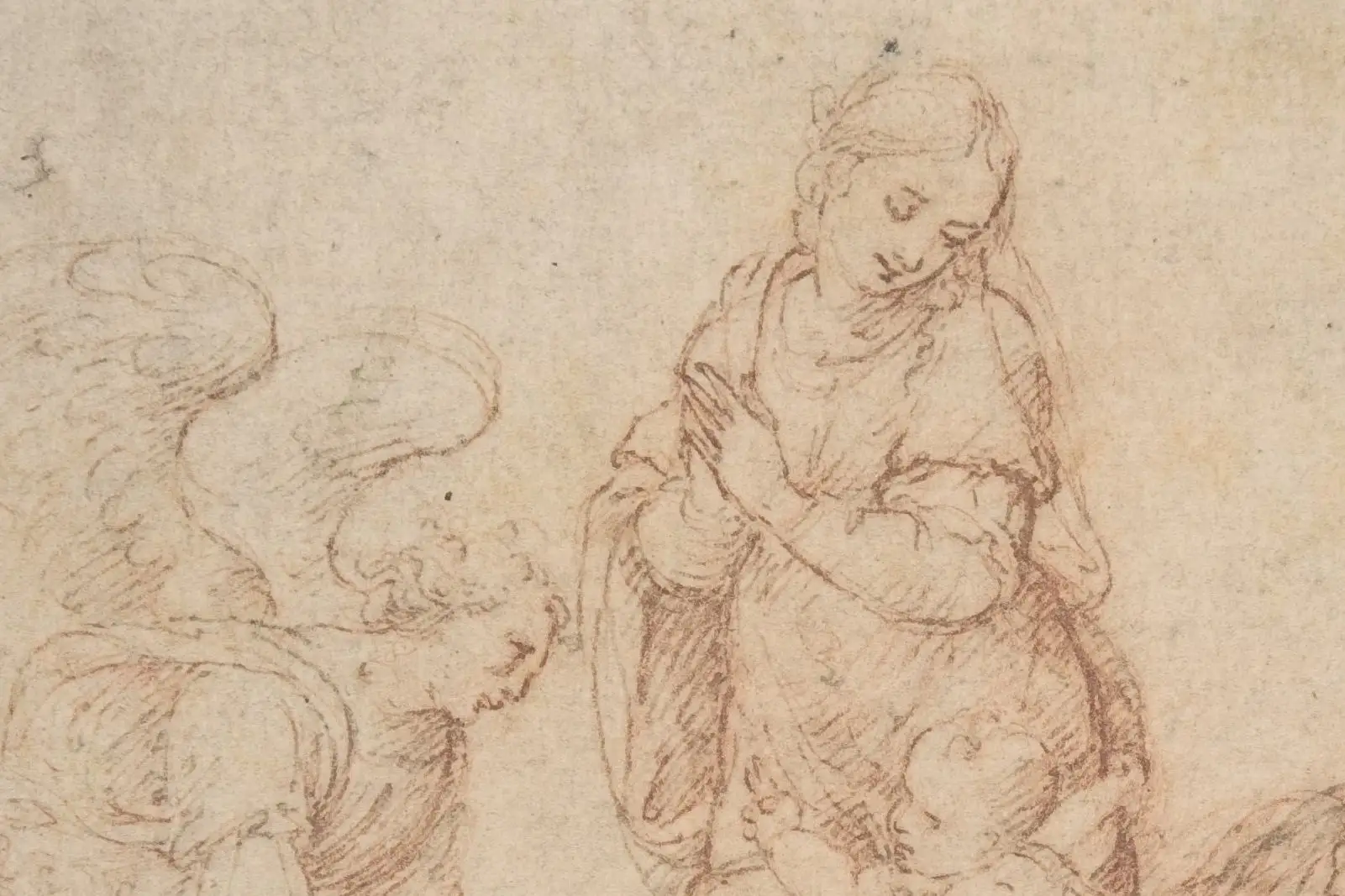
The Musée du Louvre, in its "Salle des boîtes," exhibits a sepia drawing under the name of Raphael, representing the Virgin nursing the Christ Child.¹ This drawing is a true marvel; for the charm of its sentiment and the perfect science of its execution, it can be considered one of the most admirable drawings attributed to Raphael at the Louvre.
I believe, however, that the attribution to Raphael is not certain and that this drawing should instead be returned to the Lombard School, to a student of Leonardo da Vinci. Between this drawing and the works of Raphael, there seem to me to be essential differences, both in the initial conception of the work of art and in the manner of its execution.
A Disputed Drawing at the Louvre
Neither the type nor the expression of the Virgin is Raphaelesque. The elongated face, the pointed chin, the long and fine nose, and especially the thin lips drawn into a smile—this is characteristic of Leonardo and all the masters who followed him. It is the very type created in the Virgin of the Rocks at the Musée du Louvre. In Raphael's work, the female type is always of a more robust race: the chin is squarer, the nose broader, the face a less elongated oval. And what is an even more essential sign, Raphael's women are serious virgins who never smile.
No less significant is the type of the Christ Child. Raphael's children are almost always little men rather than young, plump beings with soft, fatty flesh. On this point, Raphael remains faithful to the traditions of the Umbrian School and participates only distantly in the naturalistic research that was Leonardo's own—that meticulous study of small children, without bones or muscles, with fine joints encased in little rolls of flesh.
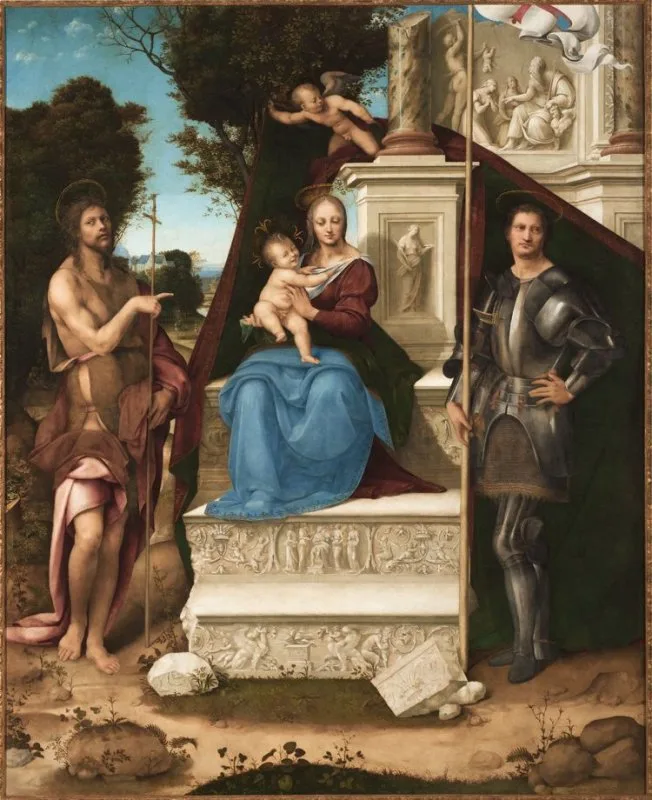
In the Louvre drawing, the Christ Child places one hand in his mother's bodice and with the other presses her breast, which he is about to take. This detail is of the highest importance. Raphael never uncovered the Virgin's breast; he never created a Virgin nursing her son. On the contrary, this representation is very common in the Lombard School and constitutes one of its particular characteristics.
From this entire work emerges the impression of a feminine and refined art. The characteristic of Raphael's art, it seems to me, is on the contrary nobility, dignity, and a somewhat cold majesty. Raphael is never very familiar. For him, the Virgin is not a young mother nursing her child and smiling at him; she is a fearful and respectful virgin who watches over the Child God and adores him.